Whale Hall & Fin Whale Skeleton — Cambridge's Most Breathtaking Free Spectacle
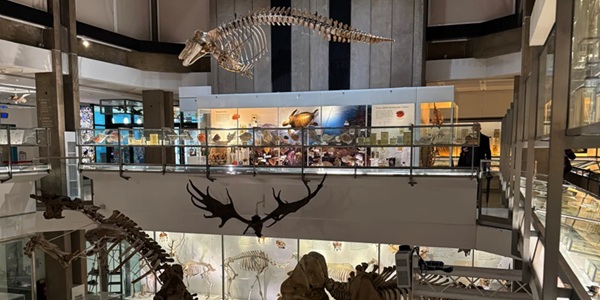
The absolute core and spiritual symbol of the museum. The glass Whale Hall, newly built during the 2018 renovation, serves as the museum's entrance and soul — a 21-metre (approx. 70-foot) long fin whale (Balaenoptera physalus) skeleton suspended in the centre of the hall, several metres above the ground. Looking up, it resembles the ribs of a sunken giant ship gleaming in the sunlight. This is the skeleton of the world's second-largest whale species, which would have weighed up to 80 tonnes alive — equivalent to eight double-decker buses combined. In 1865, this giant whale was washed ashore at Pevensey Bay in Sussex, and the museum purchased it a year later; it has been on display for over 150 years. During the museum's 2013-2018 renovation, re-hanging this skeleton took two staff members over four weeks. The hall's glass curtain wall allows natural light to pour in, creating different light effects on the skeleton at different times of day — golden morning slanting light passes through the rib gaps, while evening transforms it into a silhouetted outline. In addition to the fin whale, five other whale specimens are suspended from the Upper Gallery above the hall, including a rare double-tusked narwhal and a minke whale. The staircase beside the hall leads to the Upper Gallery, offering views of the whale's underside from various heights — the best angle for panoramic shots. The hall features interactive information kiosks and touch specimen stations where children can touch whale teeth and ear bone fossils. Visiting tips: The hall is the only area where photography is permitted (flash prohibited); 10-11am has the fewest visitors for quiet appreciation; winter (Nov-Feb) offers the softest light through the glass curtain wall.
Darwin & Wallace Collections — The Intellectual Cradle of Evolution Theory
The exhibit area that most excites science history enthusiasts. During his studies at Christ's College, Cambridge from 1828-1831, Charles Darwin did not pay much attention in lectures — instead, he spent most of his time frantically collecting beetles in the marshes and woodlands around Cambridge. His cousin William Darwin Fox was already a well-known beetle collector on campus, and the pair searched together for rare species in the then-undrained Cambridge Fens. The museum's "Darwin's Beetle Box" displays specimens he personally collected as an undergraduate — a wooden collection box about one foot long containing 841 specimens with 470 identifiable taxonomic units, predominantly ground beetles (Carabidae: 347 specimens/177 species). The most famous anecdote: Darwin found a third new species while holding one beetle in each hand; in desperation, he popped one into his mouth, which happened to be a bombardier beetle capable of spraying defensive chemicals — a narrow escape indeed. The labels on the specimens are not in Darwin's handwriting (his labelling habits were poor, often noting only vague locations like "Brazil"); they were later organised and labelled by entomologist George Robert Crotch. In addition to beetles, the museum also holds fish specimens collected by Darwin during the Voyage of the Beagle — preserved in spirits due to shipboard conditions, jokingly referred to by Chinese visitors as "Darwin's medicinal liquor." Alfred Russel Wallace — the independent discoverer of natural selection — also has his specimens exhibited here; beetle specimens he sent to Darwin in correspondence are mixed into the collection. In 1866, Wallace presented Darwin with a beetle specimen that was added to the box. Visiting tips: The beetle box display case glass reflects significantly; shoot at a 45-degree angle; the area features reproductions of Darwin's letters describing his beetle-collecting stories; adjacent are the "Beagle Fish" spirit-preserved specimen jars with pale yellow preservation fluid — do not tap the cases.
Extinction Gallery: Dodo & Giant Sloth — An Eternal Warning from Lost Life
The museum's most contemplative exhibit area, and the place where Sir David Attenborough personally placed exhibits during the 2018 reopening ceremony — he positioned a standard wing bird of paradise specimen into a display case, vividly describing witnessing their courtship dances in the Indonesian wild. The gallery's centrepiece is one of the world's most complete dodo (Raphus cucullatus) skeletons — this large flightless pigeon lived only on Mauritius and went extinct less than a century after human discovery in 1598 (around 1690), due to hunting and invasive species. The museum's dodo skeleton is assembled from multiple individual bones, posed in a standing position that recreates its clumsy gait. Adjacent is the complete skeleton of the Giant Ground Sloth (Megatherium) — this Ice Age giant stood as tall as a giraffe when upright, weighing about 4 tonnes, making it one of the largest terrestrial mammals ever to exist. This skeleton is one of only two genuine specimens in Europe; the other is in France. Beside the skeleton, a reconstruction model shows its spectacular pose standing on hind legs, foreclaws reaching for high foliage. Also on display is the Huia bird from New Zealand — the difference between male and female beaks is extraordinary: the female's curved, slender beak probed live wood for beetle larvae, while the male's stout beak pried open rotten wood. This bird went extinct in the early 20th century. Nearby is a specimen of the Kakapo — the world's only flightless nocturnal parrot, with only about 250 individuals remaining, all under conservation care. The gallery uses extinct species to deliver contemporary warnings about habitat loss, invasive species, and climate change. Visiting tips: The floor in front of the dodo skeleton case has a reflective plate for viewing skeleton underside details; the giant sloth has an interactive screen showing movement simulations; lighting is dim — increase ISO for photography.
Insect Treasury & Bird Dome — A Microscopic Universe of a Million Specimens
The "heaviest" and "lightest" part of the museum's collection — the insect collection numbers up to 1.2 million specimens from around the world, including approximately 450,000 British insects, serving as a precious time capsule tracking environmental change. Display cases showcase jewel beetles with metallic elytra shimmering like gems under the lights, and 1850s Cambridge specimens of the Large Blue Butterfly — a species that went extinct in the UK 20 years ago, making these museum holdings irreplaceable historical records. Among the beetles Darwin collected around Cambridge, some species are now extremely rare or completely gone — the specimens themselves form a silent environmental history. The Mollusc section displays rare shells from global oceans — including a "Circular Saw Shell" collected during Captain Cook's second Pacific voyage (1772-1775) at Cook Strait, also known as "Captain Cook's Shell." The Bird Dome is the Upper Gallery's most breathtaking space — dozens of British bird specimens hang from the ceiling: the Eurasian Jay's blue feathers shimmer iridescently, a Kestrel frozen mid-hunt with wings spread, a Pheasant's tail feathers resplendent as brocade. The highest point of the dome projects a looping deep-sea scene — jellyfish drifting spectrally, divers emerging from the abyss, echoing the suspended whale specimens in a harmony of heaven and earth. The Mammal section also houses an Asian elephant specimen donated from Sri Lanka in 1928 — standing 2.7 metres tall, its skull so heavy it takes two people to lift, it appeared in the opening sequence of Stanley Kubrick's 1968 film 2001: A Space Odyssey. Nearby are an African elephant skull and tusks, a complete giraffe skeleton, and an okapi specimen — this particular okapi was repeatedly stroked on its left shoulder by visitors in the old gallery, resulting in a small bald patch. Visiting tips: Insect case lighting is precise — use low ISO with long exposure; the best spot for photographing the Bird Dome is standing in the centre looking up; the okapi's "bald patch" is a famous museum anecdote — ask volunteers for more stories.