Punting on the Cam Travel

Punting is Cambridge's most iconic experience, bar none. A "punt" is propelled by a 5-metre pole pushed against the riverbed to drive the flat-bottomed, square-nosed wooden boat forward — a tradition dating back to the 19th century, originally a means of cargo transport on the Cam. In the early 20th century, local Cambridge man Maurice "Jack" Scudamore introduced recreational punting, founding Scudamore's Punting Company in 1910, still the largest operator on the river today. The River Cam stretches approximately 64 kilometres, but the most scenic punting section is just 2 miles (3.2 km) long, known as "The Backs" — the gardens of the colleges lining the riverbank. Departing from Mill Lane or Silver Street pier, a professional chauffeur stands at the stern poling the boat upstream, passing successively through Magdalene Bridge, Bridge of Sighs, Kitchen Bridge, Trinity Bridge, Youth Hostel Bridge, Clare Bridge, King's Bridge, Mathematical Bridge and other ancient bridges (8-9 in total), along the way passing the Backs of Magdalene College, St John's College, Trinity College, Clare College, King's College, Queens' College and 6 other colleges. Weeping willows line both banks, lawns are lush green, Gothic spires reflect in the water — this is the true depiction of Xu Zhimo's line "The golden willows by the riverside are young brides in the setting sun." Three punting options exist: **Shared chauffeured tour** (£22-25/person, 50 min, most hassle-free); **Private chauffeured punt** (£120-160/boat, ideal for couples or families); **Self-hire punt** (£24-30/hour/boat, you pole yourself, beginners tend to spin in circles or even fall in). Chauffeurs are mostly Cambridge students working part-time, sharing college gossip and historical anecdotes along the way — like "why St John's Bridge of Sighs has nothing to do with Venice" and "did Newton really build the Mathematical Bridge without nails?" In peak season (May-August), the river is so crowded with boats that they queue to pass through bridge arches — advance online booking is recommended, or choose the evening slot to avoid the crowds.

1902
Recreational Punting Origins
7
College Backs Visited
9
Ancient Bridges Passed
£22
Shared Tour Starting Price/Person
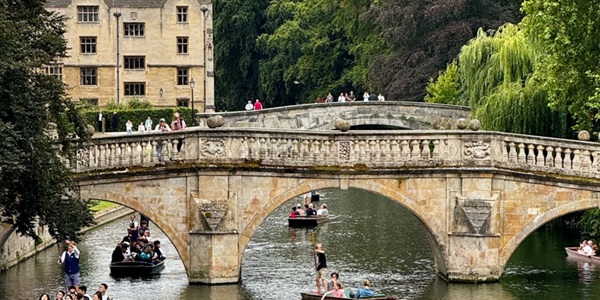
Classic scene of a punt on the River Cam passing the Backs and Bridge of Sighs
Punting on the Cam
A flat-bottomed wooden boat glides upstream on the River Cam, weeping willows brushing the water on both banks, Gothic spires shimmering in the ripples — the puntsman's long pole gently touches the riverbed, bringing Xu Zhimo's words to life: "To seek a dream? Just pole a boat upstream to where the green grass is greener"

Punting on the Cam Classic River Tour

Departing from the 19th-century tradition, take a flat-bottom wooden boat through the Backs of 7 colleges and 9 ancient bridges, and in the Oxford-accented tales of your chauffeur, discover the eternal poetry of 'Farewell to Cambridge'

Duration
45-60 minutes (classic Backs return route)
Main Destinations
The Backs, Bridge of Sighs, Mathematical Bridge, Clare Bridge, King's College Chapel, Willow Tunnel, Upper River Grantchester
Best For
Literature lovers, couples, families, photography enthusiasts, Xu Zhimo fans
Budget per Person
£22-£40 (shared tour from £22 / self-hire £24/hr)
01
Punting on the Cam · Traversing 800 Years of Academic Poetry
The Backs · Bridge of Sighs Arch · Mathematical Bridge Upward View · Willow Tunnel · Upper River Grantchester
Highlights

Depart from Mill Lane Pier — Scudamore's main pier, where Jack Scudamore began renting out the first recreational punt in 1903. Board a traditional flat-bottomed punt, approximately 22 feet (6.7m) long and 3.5 feet (1m) wide, stable and flat, seating 12 people in four rows facing each other. The professional chauffeur stands on the till at the stern, holding a 5-metre aluminium or ashwood pole, inserting the tip into the riverbed silt and pushing off — the boat glides smoothly forward. The direction is upstream — Cambridge tradition has the chauffeur standing at the stern facing forward (called "Cambridge End"), the exact opposite of Oxford where the chauffeur stands at the bow facing backward — the rivalry between the two universities extends even to punting posture. Along the way you pass: Magdalene Bridge — connecting Magdalene College where Samuel Pepys studied; Bridge of Sighs — an 1831 Gothic Revival covered bridge, as you pass underneath you look up at the keystone carvings while the chauffeur tells the story of Queen Victoria's visit in 1843; Kitchen/Wren Bridge — a three-arch stone bridge designed by Christopher Wren in 1709; Trinity Bridge and Youth Hostel Bridge; Clare Bridge — built in 1639, the oldest surviving bridge on the Cam, one of the ball decorations on the railings deliberately missing a piece (legend says the stonemason forgot); King's Bridge — facing the majestic west facade of King's College Chapel, its 42-metre fan vault looking magnificent from the river; Mathematical Bridge — the 1749 wooden bridge, looking up from underneath reveals the truss structure like a three-dimensional geometric poem. In peak season the river is crowded with boats queuing to pass through the arches, with chauffeurs calling out to coordinate. After reaching Silver Street Bridge, the boat turns around and drifts back downstream — now you can relax and enjoy the scenery: students sunbathing on the Backs lawns, willow branches brushing the water, ducks swimming alongside the boat. Choosing the evening slot (after 18:00) paints the college stone walls in golden sunlight, the river like a mirror, the whole boat gliding as if through an oil painting.

Attractions
Punting Departure Point & The College Backs
The core punting experience is "The Backs" — a 2-mile stretch of the Cam through Cambridge city centre, flanked by the "back gardens" of 7 colleges: Magdalene, St John's, Trinity Hall, Trinity, Clare, King's, Queens'. This section has wide, calm waters bordered by manicured lawns, ancient trees and Gothic/Tudor architecture reflected in the water. The name "Backs" originates from the colleges using this riverside land as the rear extension of their lawn courts. As you sail, on your left might be Trinity College's massive lawn (Newton's apple tree is near this area), on your right the magnificent west facade of King's College Chapel. This is one of the most photographed river sections in all of England, and the real-life setting of Xu Zhimo's lines "The floating heart growing in the sludge / Sways leisurely under the water." Three main departure piers: Mill Lane (Scudamore's main station, most boats), Silver Street (beside Queens' College, popular for self-hire), Quayside (further upstream, connects to the Grantchester route). Advance online booking for shared chauffeur tours (£22-25/person) is recommended — queuing on-site in peak season can take 40+ minutes.
Bridge of Sighs & Mathematical Bridge – Passing Under the Arches
The most thrilling moments of punting come when passing under the Bridge of Sighs and the Mathematical Bridge. The Bridge of Sighs was built in 1831, designed by Henry Hutchinson, connecting St John's College's Third Court to New Court — the only covered bridge on the Cam. Looking up from below, you see exquisite Gothic rib vaulting and stone carvings — this bridge became famous when Queen Victoria visited in 1843, exclaiming "It's so beautiful! So unique!" and revealing it was her favourite building in Cambridge. The chauffeur will tell you: the name was inspired by Venice's Bridge of Sighs, but aside from both being covered bridges, they have almost nothing in common, and St John's College has never used it for "sighing." The Mathematical Bridge offers a completely different experience: designed by William Etheridge in 1749, looking up from underneath reveals the tangent-radial truss wooden structure like a precision instrument, each timber arranged at an exact 11.25-degree angle. Most chauffeurs will recount the legend that "Newton built the bridge without a single nail, and when students dismantled it they couldn't put it back together so had to use screws" — then smile and tell you Newton died in 1727, 22 years before the bridge was built. When passing through the arches: in peak season boats are dense, and when two boats meet you must keep your hands inside the boat to avoid getting pinched.
Willow Tunnel & River Cam Ecology
The most moving scenery along the Cam is formed by the weeping willows creating a "green tunnel." These weeping willows are not native to Britain — their ancestors came from Beijing, China, travelling along the Silk Road to Europe where they hybridised with European white willow, forming the unique semi-weeping, semi-upright shape seen today. Willows have extensive root systems, love moisture and tolerate wet conditions, making them ideal riverbank trees. Their branches brushing the water's surface create the most poetic imagery on the Cam. Xu Zhimo's lines "The golden willows by the riverside / Are young brides in the setting sun" describe these willows in the glow of sunset. The riverside willows also inspired Kenneth Grahame's The Wind in the Willows — Grahame grew up in Cambridge, and the river animals and willows formed the world of Mole, Ratty and Toad. The Cam's ecology is rich: mallards, grey herons, swans (note: swans belong to the Crown and must not be fed bread), and occasionally otters. The riverbed silt supports dense streamer weed, habitat for trout and eels. Willow roots provide spawning shelters for fish. Due to climate change in recent years, some century-old willows have been felled due to root rot (such as the 100+ year old willow outside King's College removed in 2023), but new trees are constantly replanted, and the green tunnel remains the soul of the Cam.
Upper River Route to Grantchester & Byron's Pool
Beyond the classic Backs downstream route, adventurous punters can choose the **Upper River (Granta) route** — departing above Mill Pond lock, heading upstream to the village of Grantchester, approximately 5km one way, requiring 2-3 hours round trip. This section is narrower, deeper, with thicker silt, demanding higher punting skills, but the scenery is more pristine: open Grantchester Meadows, wildflower-covered banks, grazing cattle, and occasional kingfishers skimming the water. Byron's Pool is a famous landmark on this route — the poet Lord Byron swam here as a young man; today it is a small natural pool with clear water. Grantchester village is famous for the Orchard Tea Garden — since 1909, it has been a summer retreat for Cambridge intellectuals, where writer E.M. Forster, economist John Maynard Keynes and poet Rupert Brooke discussed affairs of state. Xu Zhimo visited during his time at Cambridge in 1921-1922, writing in "The Cambridge I Know": "There is an old village called Grantchester, with an orchard where you can lie under the heavy shade of peach and plum trees drinking tea, and fruits will fall into your teacup." The Upper River route is best attempted during the high-water season of May-September; in winter the water is shallow and silt deep, making grounding likely, and you should carry a rescue paddle in case the pole becomes stuck.
Practical Information
Transport & Piers
  • Train from London King's Cross to Cambridge ~50 min
  • Mill Lane Pier: ~12 min walk from railway station
  • Silver Street Pier: 5 min walk from city centre
  • Quayside Pier: near Magdalene Bridge
Price Comparison
  • Shared chauffeur tour: £22-25/person (50 min)
  • Private chauffeur punt: £120-160/boat (max 12 people)
  • Self-hire punt: £24-30/hour/boat
  • Evening/early bird discounts: some companies reduce by £60+
  • Online booking ~20% cheaper than on-site
Travel Tips
  • Peak season: book online in advance
  • Wear non-slip shoes (boat deck gets slippery)
  • Self-hire: choose aluminium pole (lighter than wood)
  • Keep hands inside boat when passing bridge arches
  • Blankets provided by boat companies in cold weather

Must-Try Food by the Cam

Fitzbillies Traditional Afternoon Tea

The best refuelling stop after punting, just 3 minutes' walk from Mill Lane Pier. Cambridge's century-old bakery founded in 1920, famous nationwide for its Chelsea Bun — a syrup-glazed cinnamon roll, warm and flaky, which was Stephen Hawking's favourite. Three-tier afternoon tea with Earl Grey in the Victorian wooden-arched interior — the perfect way to savour the poetry of punting. Budget £15-25 per person.

The Orchard Tea Garden

Located at the Upper River terminus in Grantchester, the ultimate reward after a 2-hour punt. Opened in 1909, white cast-iron tables and chairs scattered among the orchard trees — order a pot of English tea with homemade scones, letting apples and plums fall from the trees into your teacup — exactly as Xu Zhimo described: "fruits will fall into your teacup." Byron, Forster and Keynes were all regulars. Budget £12-20 per person.

The Cambridge Chop House

1 minute's walk from Silver Street Pier, directly opposite King's College. Treat yourself to a classic British steak after punting — sirloin with red wine sauce is rich and substantial, WeChat QR code Chinese menus available. Seasonal Pre-Theatre set menu (2 courses £22). Budget £25-40 per person.

Jack's Gelato Handmade Ice Cream

5 minutes' walk from Mill Lane Pier, on Bene't Street. Cambridge's most popular handmade ice cream shop, using traditional Italian methods. Creative flavours like thyme honey, Earl Grey and rose raspberry are full of British charm. After a sunny afternoon punting, an ice cream is the perfect finish. Single scoop from £4.

Punting on the Cam Travel Tips
Best Time
  • May-August peak: best scenery but crowded — book ahead
  • Evening after 18:00: golden light, quietest river
  • Weekdays better than weekends (half the visitors)
  • Winter punting: blankets and umbrellas provided
Must-Try Foods
  • Fitzbillies Chelsea Bun
  • Orchard Tea Garden afternoon tea
  • The Cambridge Chop House steak
  • Jack's Gelato handmade ice cream
  • Cambridge Burnt Cream
Budget Reference
  • Shared chauffeur tour: £22-25/person
  • Self-hire punt: £24-30/hour
  • Private chauffeur punt: £120-160/boat
  • Dining: £12-25/meal
  • Total: £35-60 (punting + dining)
FAQs
  • Do I need to swim? → No, but non-slip shoes recommended
  • Is self-hire difficult? → Beginners spin in circles, but the boat won't capsize
  • How much tip for the chauffeur? → £2-5/person or 10% of total
  • What if it rains? → Umbrellas provided; operations rarely stop

Explore More of Cambridge