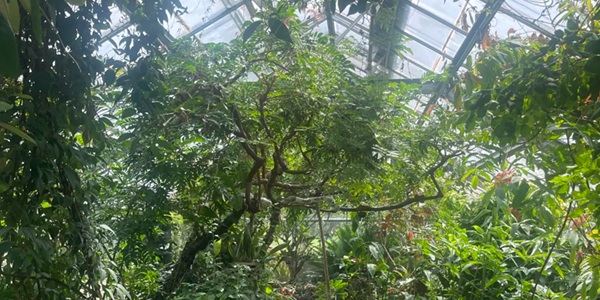
Glasshouse Range — Cross Global Climate Zones in One Hour
The garden's most awe-inspiring central attraction. Built between 1931-1934 and fully restored in 2018, the teak-framed glasshouses line the northern boundary in six themed zones. The Tropical Rainforest zone centres on the Palm House, with towering weeping figs, kapok trees and banana plants forming a dense canopy; coffee, rice and passionfruit grow at ground level in heavy, humid air reminiscent of the Amazon. A central pool holds the Santa Cruz giant water lily (Victoria cruziana), whose leaves can reach 2 metres across — each flower blooms for only two nights: first white as a female, turning pink after pollination as a male. The Tropical Wet Zone is filled with aquatic water lilies and lotus, evoking Southeast Asian rice paddies. The Arid Zone replicates African and American deserts with diurnal temperature swings of up to 50°C; giant cacti and succulents store water in their stems, many leafless or bearing only fine spines to reduce evaporation. The Oceanic Islands zone showcases endemic species that evolved in complete isolation, such as Galápagos endemics, integrated into rocky landscapes recreating their native habitats. The Alpine House rotates genuine high-altitude plants from the nursery during peak flowering, requiring excellent drainage and air circulation. The Non-Flowering Plants zone displays mosses, ferns and ancient plant groups that evolved before flowering plants. The overarching theme of the glasshouse range is the "Drama of Diversity" — each zone highlights plants' astonishing adaptations to extreme environments. Each spring, the Jade Vine (Strongylodon macrobotrys) blooming is a botanical highlight — metre-long jade-green flower clusters hang from the canopy like strings of gems. Visitor tip: the glasshouses can be very hot (up to 35°C+ in summer), so remove outer layers before entering; floors may be wet in tropical zones — wear slip-resistant shoes; allow 30-40 minutes total.
Systematic Beds & Rising Path
The garden's most academically significant area and a living textbook for botanical teaching worldwide. Designed by the first curator Andrew Murray in 1845, the beds arrange plants by evolutionary relationships following Swiss botanist Augustin de Candolle's classification system. 144 irregular "green island" beds spread across nearly 1.5 acres (approx 6,000 sq m), displaying over 1,600 species from 120 families of temperate herbaceous plants. The core logic is comparison — members of the Asteraceae family sit adjacent, next to the related Apiaceae and Campanulaceae, allowing students to visually compare morphological similarities and differences across families. Between 2016-2019, the beds underwent major renovation, retaining the Victorian "gardenesque" aesthetic while adding molecular biology perspectives of modern plant classification. The Rising Path at the southern edge is the garden's most award-winning recent project — an elevated boardwalk designed by chadwickdryerclarke studio, offering visitors a bird's-eye view of the geometric bed patterns, equipped with microscope observation stations and modern classification explanations such as plant DNA barcoding. Part of the display area also holds 9 of the UK's National Plant Collections, including Tulipa, Fritillaria and Saxifraga. Visitor tip: Spring (April-May) is the optimal viewing season for the beds, when bulbs and fresh shoots burst simultaneously; summer (June-August) brings full bloom; autumn (September-October) reveals fruit and seed diversity.
Winter Garden & Limestone Rock Garden
While other parts of the garden lie dormant in winter, the Winter Garden enjoys its most glorious season. Opened in 1976 and perfected in 1979, this area is planted specifically for peak performance from December to April. Coloured-stem willows (Salix) glow in warm tones of gold and orange-red under winter sunlight; the stems of Siberian dogwood (Cornus alba 'Sibirica') shine like coral; heathers (Erica) and hellebores bloom defiantly through frost. Succulent sedums and ornamental grasses sparkle under frost, adding structural interest to the grey season. The terrain of the Winter Garden is carefully contoured — micro-topographic undulations create focal stages that subtly highlight each plant's form. Adjacent, the Limestone Rock Garden (built 1954-1957) uses limestone quarried from the lake edge to recreate alpine and Mediterranean rock habitats — rock roses, houseleeks and bulbous plants bursting defiantly from crevices create a wild, picturesque scene. The Rock Garden offers an excellent vantage point overlooking the lake and woodland garden. Visitor tip: The best time to photograph the Winter Garden is on cold mornings after frost (roughly 8-10 am outside summer months), when angled sunlight saturates the coloured stems most intensely; summer (June-July) is the main season for alpine and Mediterranean plants in the Rock Garden.
Rose Garden & Scented Garden
The Rose Garden lies along the South Walk, designed in 1980-1981 by legendary English rose expert Graham Stuart Thomas (1903-2009) — a "homecoming" work at the end of his career: Thomas began his apprenticeship at the age of 17 in this very botanic garden, studying under geneticist Charles Hurst, and his late-life design of the Rose Garden "translated" Hurst's rose genetics research into a living plant landscape. Strolling north along the South Walk is like walking through the evolutionary timeline of roses — the southern side holds wild species and primary hybrids (such as China's Rosa chinensis), while the northern side presents modern cultivars arranged by lineage in radial island beds (China roses, Damask roses, Bourbon roses, modern Hybrid Tea roses). Back-to-back benches between two rows of yew hedges offer seating; during June's peak bloom, the air is thick with the layered fragrance of hundreds of rose varieties. The neighbouring Scented Garden offers another sensory feast — hyacinths, wintersweet and chocolate cosmos release intense fragrances in winter and spring; thyme, sage, rosemary and other herbs take turns through summer and autumn. The Rose Garden also features Cambridge-bred varieties: Rosa × cantabrigiensis and Rosa 'Cantab'. Visitor tip: Peak bloom runs from late May to July, with June universally regarded as the zenith month; autumn (September-October) brings rose hips in shades of deep red, orange-red and scarlet for a different kind of beauty; the Scented Garden has different aromatic protagonists each season — close your eyes, breathe deeply and identify them one by one.