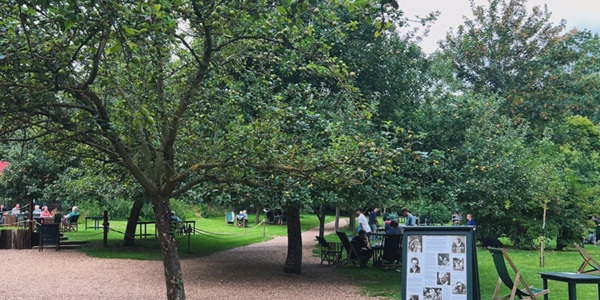
Century-Old Apple Tree Tea Lawn (Orchard Tea Lawn) — 125 Years of Unbroken English Ritual
The core soul of the tea garden — a Victorian meadow orchard with dozens of century-old apple trees (mainly Blenheim Orange and Cox's Orange Pippin varieties), their thick trunks covered in moss, canopies casting dappled shadows. White wicker tables and chairs are scattered among the fruit trees — in spring, apple blossoms cover the branches like snow; in summer and autumn, fruit hangs heavy and low. In 1897, Mrs Stevenson began entertaining Cambridge scholars with tea in her own orchard, initially simply placing teapots and scones beneath the apple trees, inadvertently creating Cambridge's most romantic tradition. Today, the Classic Cream Tea includes freshly baked plain and raisin scones, Devonshire clotted cream, local strawberry jam, and selected teas (choose from Earl Grey, English Breakfast or Darjeeling); the Orchard Afternoon Tea upgrades to a three-tier stand — bottom tier finger sandwiches (cucumber, smoked salmon, egg salad), middle tier assorted scones with clotted cream, top tier delicate French-style petits fours and macarons. Spring (April-May) is most magical when apple blossoms bloom, petals falling like pink snow; summer (June-August) offers dense green shade, the best season for tea and cooling breezes; autumn (September-October) apples ripen, and fresh apple juice from the orchard is available. Visiting tips: Lawn seating is first-come, first-served with no reservation system; in peak season (April-September) visit on weekdays or arrive before 2pm; in winter (November-March) the lawn area closes, replaced by indoor tearoom service; scones are freshly baked daily and sell out, popular varieties may be unavailable after 3pm.
Rupert Brooke Museum — The Poet's Tea Garden Memory
A micro-museum located in the main building of the tea garden, free to visit (suggested donation £2), yet carrying some of Cambridge's most touching literary memories. Rupert Brooke (1887-1915), one of Cambridge's most famous war poets, spent almost every afternoon during his studies at King's College soaking in the tea garden — writing poetry, debating, and conversing passionately with members of the Bloomsbury Group. The museum displays Brooke's manuscripts, private letters, photographs from his lifetime, and first editions of his poetry collections. The most precious item is the original love letter he wrote to his girlfriend Cathleen Nesbitt in 1912. A classic oil painting on the wall depicts the young poet leaning against an apple tree trunk, notebook open on his lap, sunlight filtering through leaves onto the page. The centrepiece exhibit is the manuscript of "The Old Vicarage, Grantchester" — written in 1912 during Brooke's travels in Berlin, every line brimming with longing for this orchard: "And if I could smell but the scent of tea / I'd give up everything to return to Grantchester." Chinese poet Xu Zhimo, who was a visiting scholar at King's College Cambridge in 1921-1922, also frequently visited the tea garden. His poem "Farewell to Cambridge" depicts the scenery looking back toward Cambridge Bridge from near the tea garden. The museum also features a "Xu Zhimo Corner," displaying Chinese translations and historical materials about the poet's visits. Visiting tips: The museum space is small, accommodating no more than 10 people at a time; visit during off-peak hours; free bilingual Chinese-English guide leaflets are available; volunteer guides offer a 15-minute free tour every Saturday at 3pm.
Grantchester Village Walk & St Andrew's Church
Leaving the tea garden, walk west along High Street for 5 minutes to reach the heart of Grantchester village. This is a typical English countryside village — thatched cottages, Victorian red-brick villas and Tudor-style farmhouses line winding lanes, roses climbing white fences, and sheep graze leisurely on the village green. Brooke's former home, "The Old Vicarage," stands in the village centre — a Tudor-style red-brick building with a plaque bearing his verse at the entrance. Although it is a private residence and cannot be entered, the exterior alone evokes the poet's life and writing here a century ago. Continue along the village road to St Andrew's Church — a Norman-style church first built in the 12th century, with traces of Saxon-era stonework still visible on the walls. Inside, stained-glass windows depict the martyrdom of Saint Andrew, and medieval carvings on the wooden pews are exquisitely detailed. Brooke's resting place is not here (he died and was buried on the Greek island of Skyros), but the church has a memorial plaque dedicated to him. The churchyard is quiet and solemn, century-old tombstones covered in moss, wildflowers growing abundantly — the perfect spot to feel the soul of the English countryside. From the church garden, you can overlook the entire Grantchester Meadows — flat, open riverside wetlands dotted with cattle and sheep, the River Cam winding like a silver ribbon in the distance. Visiting tips: Village roads are narrow without guardrails — take care with children; keep quiet inside the church and check before photographing if no service is in progress; the round trip from the tea garden to the church takes about 20 minutes; you can also visit the small Grantchester Gallery art space along the way.
Return Punt on the River Cam & Byron's Pool
The most romantic way to return from the tea garden to Cambridge — punt north along the River Cam. The tea garden has its own small landing stage (Mill Way Landing Stage), just a 3-minute walk from the exit. Two routes are available for the return punt: the classic route departs from the tea garden jetty, passes through the wide section of Grantchester Meadows, enters the Willow Tunnel — weeping willows on both banks brush the water's surface forming a green canopy, light dappled and dreamlike; passes Byron's Pool — a natural deep pool where Lord Byron is said to have swum naked, now part of a nature reserve where kingfishers dive for fish and swan families glide serenely; continues north past the Backs of Cambridge colleges, passing in succession the reflection of King's College Chapel, the exquisite stone carvings of Clare Bridge, and the Bridge of Sighs at St John's College, eventually arriving at Mill Road Quay in Cambridge city centre. The full punt journey takes about 50-60 minutes, operated by a professional puntsman while passengers relax and enjoy the scenery. Self-punting is possible but requires skill — paddling against the current is more challenging than going with it. Alternative to punting: Walk back along the Riverside Walk, a dirt path hugging the south bank of the Cam through meadows and willow groves, taking about 35 minutes — an excellent route for observing English countryside birds (kingfishers, egrets, mallards). Visiting tips: Peak punt season (May-September) recommends booking online in advance; the tea garden jetty sells tickets on-site but queuing may be necessary; £18-25 per person (including puntsman gratuity); Byron's Pool area is a nature reserve — please do not feed wildlife; the golden hour (one hour before sunset) offers the most beautiful light for punting, golden rays scattering across the water like an oil painting.