Corpus Clock Travel

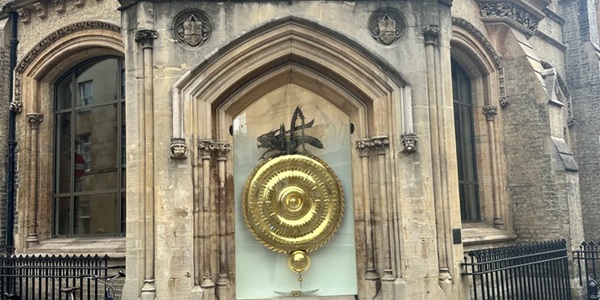
The Corpus Clock — also known as the "Chronophage" (Time Eater) — is the most captivating public art installation in Cambridge city centre. Created by inventor Dr John C. Taylor OBE, an alumnus of Corpus Christi College, over seven years at a cost of approximately £1 million, it was officially unveiled by physicist Stephen Hawking on 19 September 2008 to commemorate the college's 656th anniversary, and was named one of Time magazine's Best Inventions of 2008. The 1.5-metre diameter 24-carat gold-plated stainless steel disc has no hands or numbers — instead, three layers of blue LED light rings flow through engraved slots to indicate hours, minutes and seconds. The radiating ripple pattern on the disc surface was formed by underwater explosion, metaphorically representing the residual radiation of the Big Bang. Atop the disc sits an 85-kilogram metal monster resembling a grasshopper/locust — the "Chronophage" (Greek for "Time Eater") — which opens its jaws for half a minute each minute to devour time, closing on the final second. At the top of each hour, chains rattle and a hammer strikes a miniature coffin, warning that "all things in this world shall pass." The clock is deliberately inaccurate: it calibrates only once every five minutes; at other times it speeds up, stops, or runs backwards, with 50 hidden "tricks" that continually toy with human perception of time. The Latin inscription "Mundus transit et concupiscentia eius" (The world and its desires pass away) is engraved at the base, forming with the grasshopper's eternal chewing a philosophical theatre about mortality and time.

2008
Unveiled by Hawking
1.5m
Gold-Plated Disc Diameter
50
Hidden Tricks
£0
Free Street Viewing
Corpus Clock gold-plated disc and Chronophage grasshopper sculpture on Cambridge street
Corpus Clock, Cambridge
The 24-carat gold-plated disc gleams in sunlight, the Chronophage grasshopper devours irreversible time at a beat-per-second, the Latin inscription whispers at the base: the world and its desires pass away

Corpus Clock Half-Day In-Depth Tour

From the LED light flow on the gilded disc to the eternal chewing of the grasshopper devourer — amid the ancient courts of Corpus Christi College and the Taylor Library, embark on a philosophical pilgrimage about time and mortality

Duration
Half-hour to half-day (core viewing 10-15 minutes)
Main Destinations
Corpus Clock, Corpus Christi College Old Court, Parker Library, Taylor Library, King's Parade Photo Spot
Best For
Mechanics enthusiasts, physics lovers, art pilgrims, photography buffs, Hawking fans
Budget per Person
£0-£30 (free street viewing, dining extra)
01
Time Devouring & Medieval Court Tour
Corpus Clock · Chronophage · Corpus Christi College Old Court · Parker Library · Taylor Library · King's Parade
Highlights

In the morning, find the golden disc embedded in the outer wall of the Taylor Library at the southern corner of King's Parade — it faces the west façade of King's College Chapel and is Cambridge's most easily "passed-by-but-missed" attraction. Stop and observe for at least 5 minutes: you'll notice blue LED dots flowing slowly along three concentric rings — the outer warm light shows hours, the middle blue light shows minutes, the inner faint light shows seconds; meanwhile, the Chronophage grasshopper crawls at a non-uniform pace, its jaw opening at the first second of each minute and closing at the final second, as if chewing each moment. On the hour (listen hourly), chain rattling and the dull thud of a hammer striking a miniature coffin echo from within the clock, sending a chill down your spine. Then step inside Corpus Christi College — Cambridge's sixth oldest college, founded in 1352 by local guilds (not a king or bishop), retaining a humble "townsmen's college" character. The Old Court's red brick and stone buildings date back to the 14th century, among Cambridge's oldest dormitory blocks; the Parker Library houses priceless manuscripts including the 6th-century St Augustine Gospels and the Anglo-Saxon Chronicle, regarded as one of the world's most important collections of medieval manuscripts. Return to the Corpus Clock in the evening, waiting for the LED lights to come on at dusk — the gilded disc transforms into a golden flame, the grasshopper's silhouette grows more menacing in the light — the most dramatic moment for photographing the Corpus Clock.

Attractions
Corpus Clock & Chronophage Time Eater
The Corpus Clock itself is a 1.5-metre diameter, 24-carat gold-plated stainless steel disc. The radiating ripple pattern on its surface was formed by underwater explosion (secretly carried out at a Dutch military research institute), metaphorically representing the residual radiation of the Big Bang. Atop the disc, the Chronophage (Greek for "Time Eater") is an 85-kg metal monster resembling a cross between a grasshopper and locust, its surface painted with mottled gold powder and dark red to simulate biological moulting and bodily fluid residue effects. It employs the world's largest — and only publicly displayed — "grasshopper escapement," an invention of 18th-century English clockmaker John Harrison, who solved the problem of measuring longitude at sea. The escape wheel was formed from a single steel plate by vacuum explosion forming, then gold-plated. The clock face has no hands or numbers — time is shown by 2,736 blue LEDs behind Vernier slits, with dots flowing along three concentric rings, calibrated once every five minutes. At other times, the pendulum deliberately stalls, accelerates or runs backwards — designer Taylor intentionally made the clock "inaccurate" to metaphorically represent Einstein's relativity of time and the subjectivity of human time perception. The base inscription is from 1 John 2:17 in Latin: "Mundus transit et concupiscentia eius" (The world and its desires pass away). The grasshopper's jaw opens and closes once per minute, its eyes flicker irregularly, it raises its sting every 15 minutes, and on the hour produces the sound of chains falling into a coffin. Among the 50 hidden tricks triggered randomly, 4 special programmes are reserved for: John Harrison's birthday (25 March), John Taylor's birthday (25 November), New Year's Day, and Corpus Christi Feast Day. In 2023 the clock's glass was smashed by a vandal; it was repaired and re-displayed in June of the same year.
Corpus Christi College Old Court & Parker Library
Corpus Christi College was jointly founded in 1352 by the Guild of Corpus Christi and the Guild of the Blessed Virgin Mary — the only Cambridge college established by civic guilds (rather than a king, bishop or noble), and the sixth oldest. The Old Court, begun in the 14th century, features red brick and stone buildings that have undergone six centuries of additions and alterations while remaining in continuous use — Cambridge's oldest continuously inhabited building complex. The Parker Library, built between 1376-1416, is England's oldest college library, still retaining its medieval layout — green wooden bookshelves, chained book fittings (a single book in medieval times was worth the price of a house), and vellum spines turned inward. Its treasures include: the 6th-century St Augustine Gospels (a copy of the Gospels brought by St Augustine when he introduced Christianity to England), the Peterborough Chronicle bequeathed by Archbishop Matthew Parker, and numerous Anglo-Saxon manuscripts — listed by the British Library as "one of the world's most important manuscript collections." The college also holds Britain's only "tablet library" — a large collection of Babylonian and Assyrian cuneiform tablets, the most precious dating back to 2000 BC, older than the Code of Hammurabi. Notable alumni include: playwright Christopher Marlowe (author of Doctor Faustus, Shakespeare's predecessor), 2017 Nobel Chemistry laureate Richard Henderson (pioneer of cryo-electron microscopy), and geologist Joe Farman (discoverer of the Antarctic ozone hole).
Taylor Library & Corpus Clock Inscription Close Reading
The Taylor Library is Corpus Christi College's modern college library, named after John C. Taylor, donor of the Corpus Clock, open 24 hours to college members. The wall above the main entrance is the home of the Corpus Clock — originally the entrance of the London County Bank (built 1866), later leased by NatWest. When the lease expired in 2005, the college decided to demolish the bank frontage and convert it into a library entrance. Due to planning restrictions, the old entrance could not simply be bricked up, so Taylor proposed filling the space with a "clock that devours time" — the clock became both the library's façade ornament and the college's metaphor for the relationship between time, scholarship and eternity. The Latin inscription at the base reads "Joh. Sartor Monan Inv. MMVIII," meaning "John Taylor from the Isle of Man made this in 2008" (Sartor = Taylor, Monan = Manx, Inv. = Invenit/created, MMVIII = 2008). Below the clock face is another inscription: "Mundus transit et concupiscentia eius" — 1 John 2:17: "The world and its desires pass away." The pendulum tail points to ten peaks on a rhodium-plated disc, further homage to John Harrison and his precision clocks. Beside the clock hangs a purely decorative key; turning it tells you which clock it belongs to — on the top left is also engraved Taylor's most famous invention: the pattern of the bimetallic thermostat controller for electric kettles.
King's Parade & Best Photo Spots for Corpus Clock
The Corpus Clock sits at the corner of King's Parade and Bene't Street, directly opposite the west façade of King's College Chapel — one of Cambridge's busiest intersections. The three best shooting angles: ① Front low-angle — stand on the south pavement of King's Parade, shoot upward at the gold-plated disc and grasshopper silhouette, with King's College Chapel spire in the background, creating a dialogue between "medieval faith" and "modern philosophy of time"; ② Side angle from Bene't Street — shoot at a 45-degree angle from Bene't Street to capture both the full flow of the LED halo and the grasshopper's side profile — the most classic Corpus Clock angle on Instagram; ③ Blue hour at dusk — 15-30 minutes after sunset, when the sky is deep blue and the LED blue light on the gold-plated disc shines brightest, the grasshopper resembles a mechanical creature from the future against the contrast of warm street lamps and cool blue sky. Shooting tips: avoid noon overhead light (excessive metallic glare); recommended 9-11 am or 6-8 pm; due to the curved glass cover over the clock face, adjust your angle to avoid your own reflection; weekend afternoons are crowded — patience required for a clear spot. The clock's glass, shattered by a vandal in 2023, has been repaired and the glass cover is now intact.
Practical Information
Transport
  • Train from London King's Cross to Cambridge ~50 min
  • ~15 min walk from Cambridge station to Corpus Clock
  • Located at city centre street corner, walkable to all attractions
  • Adjacent to bus stop "Great St Mary's Church"
Tickets
  • Corpus Clock: Completely free (public street installation)
  • Corpus Christi College: Free entry to Old Court
  • Parker Library: Advance booking required (research purposes)
  • College guided tours: Available at certain times (check website)
Travel Tips
  • Stay at least 5 minutes to observe a full time display cycle
  • Around the hour (±1 min) you can hear chains and coffin sound
  • Most dramatic when LED lights come on at dusk
  • Off-peak/early morning — fewer people, best for photos

Must-Try Food Near the Corpus Clock

The Cambridge Chop House

Directly opposite the Corpus Clock! This British steakhouse at 1 King's Parade, just across the street from the Corpus Clock, offers the best "box seat" for watching the Time Eater. Signature Sirloin steak with rich red wine sauce is robust and satisfying. Offers pre-theatre set menus (2 courses £22 / 3 courses £29), perfect for a quick meal before the theatre. Budget £20-£35 per person.

Aromi Sicilian Café

At 1 Bene't Street — the very alley where the Corpus Clock sits! This independent Sicilian café is the perfect place to rest tired feet. Hand-poured coffee using Ethiopian beans offers rich fruity notes; handmade Italian cakes and croissants are equally excellent. Small and cosy, grab a coffee and sit on a street bench, looking up at the Corpus Clock's grasshopper gleaming in the sunlight. Budget £8-£15 per person.

The Senate Bistro

A 3-minute walk from the Corpus Clock, beside the Senate House of Cambridge University's Old Schools. Specialising in refined modern British cuisine, the signature roast cod (Colley) with lemon butter sauce is fresh and delicious, and the fish and chips are crispy outside and tender inside. The terrace overlooks the Gothic Senate House — the quietest lunch spot in the area. Budget £15-£25 per person.

Bread & Meat

A 5-minute walk from the Corpus Clock, Cambridge's most popular minimalist sandwich shop. Roast beef sandwiches use locally pastured beef, thick and juicy, paired with artisan sourdough and house-made sauces — the perfect energy boost during a shopping stroll. Simple menu, fast turnover, ideal for a light lunch. Budget £8-£12 per person.

Corpus Clock Travel Tips
Best Time to Visit
  • Early morning 7-9 am: Lowest foot traffic, peaceful viewing
  • Dusk 6-8 pm: LED lights on, most dramatic
  • Avoid weekend afternoons (crowded pavements)
Must-Try Foods
  • The Cambridge Chop House Sirloin steak
  • Aromi Sicilian pour-over coffee
  • The Senate Bistro roast cod
  • Bread & Meat roast beef sandwich
  • Fitzbillies Chelsea bun
Budget Reference
  • Corpus Clock viewing: £0 (completely free)
  • Dining: £10-25/meal
  • Accommodation: £80-200/night (Cambridge city centre)
  • Total: £10-50 (half-day tour including dining)
FAQs
  • Can I touch it? → No, the clock face has a protective glass cover
  • Can I take photos? → Absolutely allowed, public street installation
  • Why is the clock inaccurate? → Deliberate design, calibrated only once every 5 minutes
  • What does "unveiled by Hawking" mean? → Stephen Hawking pressed the start button to officially unveil it on 19 September 2008

Explore More of Cambridge