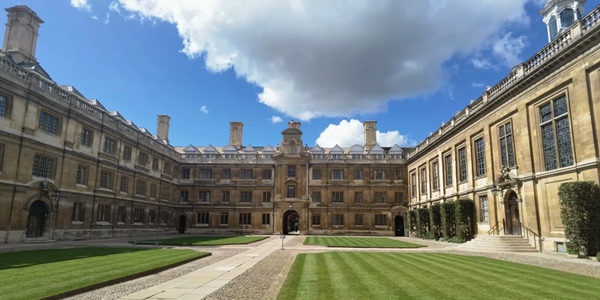
Old Court — One of Britain's Most Beautiful 17th-Century Courtyards, a Perfect Marriage of Gothic and Classical
The heart and soul of Clare College. Construction began in 1638 (east range), was interrupted for over twenty years by the English Civil War, and was not completed until 1715 — a 77-year build that accidentally created an architectural wonder: the east and south ranges retain medieval Gothic elements (stone tracery, battlements, arched windows), while the north and west ranges embrace the Classical sense of order championed by Sir Christopher Wren (columns, segmented pediments, symmetrical façades). The two styles coexist harmoniously, without any sense of incongruity. The courtyard measures 152.5 ft × 110.5 ft, enclosing a neatly trimmed lawn so quiet you can only hear the wind rustling through the trees. It is the only pre-1800 Cambridge college court to maintain its architectural integrity, untouched by later additions. The east gate features a segmented pediment possibly inspired by Peterhouse Chapel; above the gate, two storeys of elaborate carved detailing add extraordinary refinement. The north range (1683-1690, designed by Robert Grumbold) houses the college Dining Hall on the ground floor, its oak-panelled walls lined with portraits of former masters. Visitor tips: Keep off the grass — a Cambridge iron law; morning light from the east illuminates the courtyard most beautifully; the cobbled/flagstone surface is unsuitable for high heels. Since 2024, the Old Court has been undergoing energy-efficient renovations (insulation system installation), so some scaffolding may be present, though the main structure remains visible.
Clare Chapel — An 18th-Century Sanctuary of Light, Soul of the Choir
A hidden gem tucked away on the north side of the Old Court. Built 1763-1769, designed by Sir James Burrough (Master of Caius College), completed after his death by James Essex. Unlike other Cambridge chapels, it avoids the Gothic Revival path, opting instead for mid-18th-century Neoclassicism: whitewashed walls, simple Corinthian columns, a semicircular barrel vault, and a vast Palladian window at the east end flooding the space with natural light. This "translucent simplicity and elegance" is unique in Cambridge and has remained virtually unchanged since completion. The altar painting, The Annunciation by Giovanni Battista Cipriani (1727-1785), depicts the angel Gabriel announcing to the Virgin Mary that she will bear Jesus — its colours exceptionally soft in the sidelight. Following the wishes of founder Elizabeth de Clare, the chapel and entire college are dedicated to the Virgin Mary. The Clare College Choir, founded in 1866, enjoys international renown, touring and recording worldwide. During Full Term, choral evensong is held three times weekly, with drinks and dinner offered after Sunday evening services — free and open to the public. Visitor tips: Maintain silence inside (private prayers may be in progress); no flash photography; if you happen upon a choir rehearsal (usually afternoons), pause outside the door to listen for a few minutes — one of Cambridge's most moving sounds.
Clare Bridge & Fellows' Garden — 14 Stone Balls, One Missing a Corner; Confucius Gazing at the Cam
Clare Bridge is the oldest surviving bridge on the River Cam, designed and built by Thomas Grumbold between 1638-1640 — predating the west and north ranges of the Old Court. This graceful three-arched stone bridge is adorned with 14 stone balls along its parapets. But count carefully — one ball is missing roughly a sixth of its mass. The story behind it is wonderfully human: after completing the bridge, the college underpaid Grumbold by 3 shillings (about 15 pence). Instead of suing, the architect silently returned to the bridge and chipped off a small piece of one stone ball — "You short-change me 3 shillings, and your bridge shall forever be incomplete." To this day, the college has never repaired that missing piece, and the small flaw has become one of Cambridge's most famous architectural anecdotes. A more "official" explanation suggests the chip resulted from a repair when a stone ball cracked and fragments fell into the river. During the English Civil War, many Cambridge stone bridges were dismantled for stone to fortify Cambridge Castle — Clare Bridge fortunately survived intact. Standing on the bridge looking north, King's College Chapel's Gothic spire frames the Cam — one of Cambridge's classic photo opportunities. Cross the bridge into the Fellows' Garden — designed in 1947 by physiologist Professor Wilmer, inspired by Hidcote Manor in Gloucestershire with its "compartment garden" concept dividing the space into distinct stylistic "rooms": yew hedge mazes, shaded lawns under giant chestnuts, a sunken garden, and a riverside walk. The garden preserves several ancient swamp cypresses and towering chestnut trees. Along the shaded avenue of the Scholars' Garden stands a special bronze Confucius statue — a 2010 gift to Clare College from Chinese sculptor Wu Weishan, President of the Chinese Academy of Sculpture. Encountering Confucius unexpectedly in a Cambridge college garden creates a unique sense of "East meets West." Visitor tips: The garden opens to students in summer and autumn; visitors can usually follow the college tour route; the Confucius statue sits midway along the avenue, not immediately obvious — look for a wooden sign; college members may be reading or strolling in the garden — please maintain quiet.
Memorial Court, DNA Sculpture & Riverside Café — A World-Changing Place, With a Good Cup of Coffee
Memorial Court lies on the west bank of the Cam, west of Queen's Road, designed by the eminent architect Sir Giles Gilbert Scott (designer of Liverpool Cathedral and the red telephone box) between 1923-1934 in the New Georgian style, dedicated to Clare alumni who fell in WWI. The spacious courtyard with its central lawn is a popular venue for college croquet — on warm days, students in white shirts swing mallets on the grass, one of Cambridge's most English scenes. James Watson arrived from America in 1951 and lived in a room in Memorial Court. Working with Francis Crick at the Cavendish Laboratory, they proposed the DNA double helix model in 1953 — a discovery that launched the era of molecular biology and is considered one of the most important scientific breakthroughs of the 20th century. In 2005, Watson returned to unveil a bronze DNA double helix sculpture on the Memorial Court lawn, commemorating the great discovery. Watson, Crick and Wilkins shared the Nobel Prize in Physiology or Medicine in 1962. The court also houses the Forbes Mellon Library, built in 1986, holding over 30,000 volumes — the primary study resource for undergraduates. The most delightful corner of Memorial Court is the River Room Café — a new riverside space overlooking the Cam and college gardens, serving teas, coffees, sandwiches, cakes and soft drinks. Many Clare students treat it as a relaxed study spot or a place to chat with friends. Sitting on the café terrace with a hot latte, gazing across at the golden stone walls of the Old Court reflected in the Cam — this is Cambridge at its most healing. Visitor tips: Memorial Court is about a 5-minute walk west from the Old Court, across the bridge and along the river; the DNA sculpture sits in the centre of the courtyard lawn, accessible for close viewing; the Riverside Café operates during term time and may close during holidays — bring backup refreshments; from Memorial Court, walk east along Queen's Road for 2 minutes to return to the college's main entrance on Trinity Lane.