Cambridge Kettle's Yard Travel

Kettle's Yard is the University of Cambridge's modern and contemporary art gallery, but its story is far more romantic than the word "gallery" suggests. In 1956, former Tate curator Jim Ede bought four dilapidated workers' cottages beside Castle Street and, together with his wife Helen, transformed them into a "livable art house." Whitewashed walls, exposed brick, bare floors, carefully placed pebbles and shells — Ben Nicholson's reliefs, Barbara Hepworth's sculptures, Joan Miró's paintings, Henri Gaudier-Brzeska's line drawings coexist harmoniously with these "found treasures." In 1966, the Edes gifted the entire house and all its collections to Cambridge University. Leslie Martin designed a modernist extension in 1970, and in 2018 Jamie Fobert Architects completed an £11 million transformation — adding two double-height galleries, a four-storey education wing, café and shop. This is not a museum, not a gallery, but an old man's lifelong meditation on light, space and beauty. The main house requires a booked visit (£14, free for under 25s), temporary exhibitions are free.

1956
Ede bought 4 cottages
2018
New transformation opened
£0
Exhibitions free / Main house £14
70 yrs
Room arrangement unchanged
Kettle's Yard Cambridge main house sitting room with art collection
Kettle's Yard, Cambridge
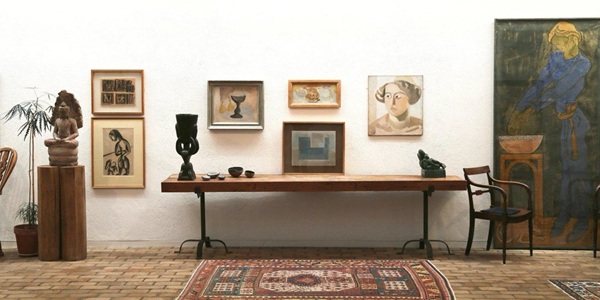
White walls echo Ben Nicholson's reliefs and Joan Miró's paintings, a pear rests quietly on the dining table — this is not a museum, this is Jim Ede's living room, unchanged for 70 years

Kettle's Yard Modern Art & Poetic Space Exploration Tour

From Jim Ede's living room to Jamie Fobert's new galleries, from Ben Nicholson's reliefs to Gaudier-Brzeska's dancers — in an art home transformed from four workers' cottages, feel the stillness and beauty unchanged for 70 years

Duration
1-2 hours (main house tour + galleries + café)
Main Destinations
Main House (Sitting/Dining/Bedroom/Attic), 2018 New Galleries, Education Wing, Garden Kitchen Café, Courtyard Garden
Best For
Art lovers, design enthusiasts, architecture fans, families, travellers seeking serenity
Budget per Person
£0-14 (exhibitions free / main house £14) | Café £5-12
01
Art Home In-Depth Tour · Stillness and Beauty Unchanged for 70 Years
Main House Living Room → Jim's Bedroom & Attic → 2018 New Galleries → Garden Kitchen Café
Highlights

Walk from Cambridge city centre along Castle Street for about 10 minutes (passing Magdalene College and Magdalene Bridge) to reach the entrance. Upon arrival, ring the doorbell at the reception desk on the ground floor — yes, the entrance ritual feels like visiting an old friend's home. First explore the Temporary Exhibition Galleries freely (free, no booking needed) to feel the vitality of contemporary art. Then enter the Main House at your booked time — a guide will lead you through the Sitting and Dining Rooms (Ben Nicholson's 1934 relief, Miró's paintings, Alfred Wallis's seascapes, a pear and a tin plate in eternal dialogue on the table), Jim Ede's bedroom (pebble spirals, Gaudier-Brzeska's Torpedo Fish sculpture), the tiny bathroom (walls covered in bold modern prints), and the attic (Helen Ede's bedroom, with rotating themed displays). The tour lasts about 45-60 minutes. It is strongly recommended to book main house tickets in advance on the official website (£14, free for under 25s and Cambridge University students). After the tour, enjoy a coffee at the Garden Kitchen Café, sitting in the courtyard to reflect on this "meditation on light and objects."

Attractions
Main House: Sitting & Dining Room — Ede Family Living Room, Spiritual Heart of Modern Art
Entering the first room of the main house, you might wonder if you've walked into the wrong place — it looks like an ordinary living and dining room, except the walls are hung with priceless modern art masterpieces. Whitewashed walls, enlarged windows, bare wooden floors and exposed bricks form a minimalist backdrop, while everything Jim Ede spent a lifetime carefully "arranging" makes this space a complete work of art. Ben Nicholson's white relief *1934 (relief)* hangs on the wall, its geometric lines engaging in a subtle dialogue with natural light streaming through the window; beside it is Joan Miró's abstract painting, colours leaping against the white wall; Alfred Wallis's seascapes — the self-taught Cornish fisherman-painter was one of Ede's most beloved artists, his simple sailing boats and lighthouses possessing a raw, moving power. But most unforgettable are the "non-artworks": a tin plate holding a lemon on the table — Ede decreed this lemon must always be there, guiding the eye towards the adjacent Wallis painting; a shell fragment juxtaposed with a glass goblet, achieving Rococo elegance; pebbles from the beach, a piece of charred wood (resembling a medieval saint), a small Buddhist statue — these "found treasures" converse as equals with the masterpieces, none deemed "secondary." Ede said: "I didn't want an art gallery or museum, but a place to live." Here, you finally understand what he meant. Visiting tips: Remove coats upon entry (space is tight, to protect the collection); photography allowed but no flash; the lemon on the table is real, replaced weekly; the bell-pull at the door was designed by Constantin Brâncuși — yes, the modern sculpture master made this doorbell by hand.
Jim Ede's Bedroom & Attic — Pebble Spirals and Gaudier-Brzeska's Dancer
From the sitting room, pass through a narrow corridor into Jim Ede's bedroom — a space so small it feels almost like a monastic cell, yet filled with breathtaking beauty. On a low table sit Ede's most personal, most cherished objects: a spiral of river-smoothed pebbles, slowly unfurling from centre to edge like a miniature model of the cosmos; beside it is Henri Gaudier-Brzeska's *Torpedo Fish* (1914) — the genius sculptor died in World War I at just 23, and Ede collected many of his works both before and after his death, becoming the most important custodian of Gaudier-Brzeska's legacy; on the walls hang small geometric abstractions and cool-toned blue seascapes, creating a meditative stillness. Ede had a deep interest in Buddhism, and the small figurines and meditation objects from the Far East reveal his inner spiritual world. Next door is a tiny, almost comically small bathroom — its walls covered in bold, intensely coloured modern prints, creating an intriguing tension with the cramped space; you'll find yourself "guiltily squeezing" into this little corner filled with great art. Up a narrow staircase to the Attic (Helen Ede's Bedroom) — originally Helen's private bedroom, now used to rotate thematic displays from the collection. The low sloping ceiling creates an intimate, warm atmosphere, with soft daylight from the window illuminating each work. Visiting tips: The bedroom and bathroom are extremely small — please wait patiently for previous visitors to leave before entering; the attic stairs are steep — flat shoes recommended; Gaudier-Brzeska's Torpedo Fish sculpture was Ede's most beloved piece — pause to appreciate its flowing lines.
2018 New Galleries & Temporary Exhibitions — Jamie Fobert's Modernist Masterpiece, Free Exploration of Contemporary Art Frontiers
On 10 February 2018, after a two-year, £11 million renovation by Jamie Fobert Architects, Kettle's Yard reopened with a completely new look. Stepping out from Leslie Martin's 1970 extension, you barely notice you've entered an entirely new building — that's Fobert's brilliance: "I wanted people to move from Martin's architecture into my design without feeling any change, as if Kettle's Yard had always been one seamless experience." Two double-height new galleries are flooded with natural light (pouring through roof skylights), with polished concrete stairs and rough plaster walls — minimalist but not cold. Gallery 1 and Gallery 2 host temporary contemporary art exhibitions — the 2026 programme includes: *Artists for Kettle's Yard* (14 March-12 April, a fundraising donation show for the 70th anniversary in 2027, featuring Rana Begum, Antony Gormley, Jennifer Lee, Ben Nicholson, Veronica Ryan, Lucie Rie and others); *Handpicked: Painting Flowers* (opening April, showcasing the best 20th-21st century floral paintings); and Sunil Gupta's photographic retrospective *Life With a Camera, 1970-Now*. All these exhibitions are free entry. The building also features a Window Gallery facing Castle Street, allowing passers-by to enjoy artworks from the pavement. Visiting tips: The exhibition galleries are spacious and fully wheelchair accessible (in contrast to the old main house); no booking required for entry; photography allowed (no flash); the shop is located in the new entrance area, selling art books, design items and souvenirs.
Garden Kitchen Café & Courtyard Garden — A Gentle Vegetarian Finale, a Green Haven on Castle Street
After touring the main house and galleries, the perfect way to conclude is to step into Kettle's Yard's own Garden Kitchen Café. This café is entirely in Ede's spirit — all food is vegetarian or vegan, the menu changes with the seasons, and ingredients come from local suppliers (Brew Project coffee, Wylde Sky Brewing craft beer, Saffron ice cream). Lunch options include daily-changing soups, homemade salads and sandwiches, with freshly baked cakes for dessert. Sit inside the café or in the outdoor House Garden, sunlight filtering through leaves onto rustic wooden tables, with the old Kettle's Yard brick wall in the distance — this is Cambridge's most serene afternoon tea. The café is open Tuesday-Sunday 10:30-16:30, closed Monday. Beyond the café, Kettle's Yard also offers a rich music programme — Ede himself was a music lover; when the Prince of Wales inaugurated the 1966 extension, the opening performance was a duo by Jacqueline du Pré and Daniel Barenboim. Today, Kettle's Yard regularly hosts chamber music concerts in the old extension space (Solem Quartet, Carducci Quartet, etc.), with affordable tickets — check the schedule in advance on the official website. Visiting tips: The café does not accept large cash payments — cards recommended; outdoor seating is limited — arrive early on sunny days; wheelchair users can email gardenkitchenky@gmail.com to book accessible seating; if you catch a concert, don't miss it — hearing a string quartet in Ede's house is one of Cambridge's most unique cultural experiences.
Practical Information
Transport & Entrance
  • Train from London King's Cross to Cambridge ~50 min
  • ~25-30 min walk from Cambridge railway station
  • Bus 5/6 to St Peter's Street stop, 2 min walk
  • ~10 min walk from city centre along Castle Street
  • No dedicated parking; use Castle Hill car park
Tickets & Opening
  • Temporary exhibitions: Free
  • Main house tickets: Adult £14 (£12.50 excluding donation)
  • Under 25s: Free
  • Cambridge University students: Free
  • Opening hours: Tuesday-Sunday 11:00-17:00
  • Closed Monday (including bank holidays); last entry 16:15
Travel Tips
  • Main house must be booked online in advance (timed small-group entry)
  • No bags (including handbags) permitted in the main house
  • No lockers available — travel light
  • Main house not suitable for pushchairs
  • Photography allowed but no flash
  • Main house not fully wheelchair accessible; ground floor galleries accessible

Must-Try Food Near Kettle's Yard

The Garden Kitchen Café

Inside Kettle's Yard, 0 minutes walk. Fully vegetarian/vegan menu, ingredients from local suppliers — Brew Project coffee, homemade soups, fresh salads, sandwiches and daily baked cakes. Sit in the courtyard garden, sunlight filtering through leaves onto rustic wooden tables, with the old house's brick wall in the distance. This is Cambridge's most serene afternoon tea and the most natural continuation after touring the main house. Budget £5-12 per person.

La Margherita Pizza

About 5 minutes walk from Kettle's Yard, on Magdalene Street. Authentic Italian restaurant — the signature Margherita pizza uses San Marzano tomatoes and mozzarella, fired in a wood-burning oven for 90 seconds, with thin base and puffy charred edges. Carbonara is also exceptional — authentic Italian method with pecorino cheese and black pepper, no cream. Easily reached walking back from Kettle's Yard along Castle Street towards the city centre. Budget £12-20 per person.

Pho Cambridge

About 12 minutes walk from Kettle's Yard, on Wheeler Street (towards the city centre). Cambridge's most popular Vietnamese restaurant — the signature beef pho (Pho Tai) has a clear, sweet broth with silky noodles, and basil and bean sprouts are self-served. 40% of the menu is vegetarian, almost entirely gluten-free, with Vietnamese beer and cocktails. Convenient for a stop on your way back to the city centre after visiting Kettle's Yard. Budget £10-18 per person.

Namaste Village

About 10 minutes walk from Kettle's Yard, on Mill Road. A family-run Indian vegetarian restaurant that grinds its own spices and follows ancestral recipes — the menu spans regional Indian cuisines, and over 70% of regular customers aren't actually vegetarians yet don't miss meat at all. The signature Thali platter lets you sample five or six different curries and Indian breads in one sitting, with richly layered spices that aren't greasy. Perfect for a walk after visiting Kettle's Yard. Budget £12-20 per person.

Kettle's Yard Travel Tips
Best Season
  • Indoor attraction year-round, unaffected by weather
  • Tuesday-Friday quieter for best experience
  • Spring (April-May): courtyard garden flowers in bloom
  • Summer (June-August): dense concert programme
  • School holidays: family creative workshops
Must-Try Foods
  • Garden Kitchen daily homemade soup
  • La Margherita wood-fired Margherita pizza
  • Pho Cambridge authentic Vietnamese pho
  • Saffron handmade ice cream
  • Brew Project local specialty coffee
Budget Reference
  • Exhibitions: Free
  • Main house tickets: £14 (free for under 25s)
  • Café light meal: £5-12
  • Concert tickets: £10-25
  • Gift shop souvenirs: £3-30
FAQs
  • Need to book? → Main house must be booked; exhibitions no booking needed
  • Can I take photos? → Allowed but no flash
  • Is there a Chinese audio guide? → Download Bloomberg Connects free audio guide
  • Can I bring a bag? → No bags of any kind in the main house
  • Wheelchair accessible? → Galleries and café accessible; main house partially restricted

Explore More of Cambridge