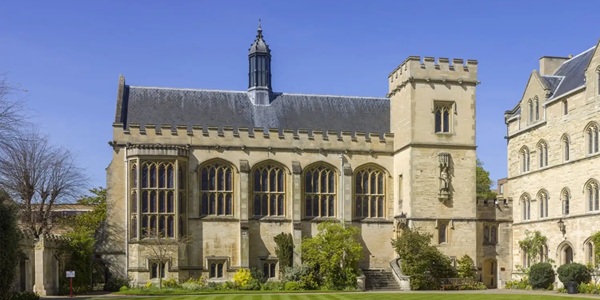
Wren Chapel — The Architectural Master's Stunning Debut
Pembroke College's most dazzling cultural jewel, and the first classical-style chapel built at Cambridge University. Designed by the 33-year-old Sir Christopher Wren in 1663-1665 — the first fully realised building of his career, predating St Paul's Cathedral by a full twenty years. The chapel's origin stems from a legendary story: Wren's uncle Matthew Wren was imprisoned in the Tower of London by Cromwell for 18 years during the English Civil War; upon release, he vowed to donate a chapel and asked his nephew to design it. The chapel was consecrated on St Matthew's Day (21 September) 1665 by Bishop Wren; Matthew Wren died two years later and was buried in the crypt of the chapel he helped create. The exterior uses Portland Stone, the Corinthian-columned facade inspired by Italian architect Sebastiano Serlio's treatise, crowned with a hexagonal lantern. The most stunning interior feature is the exquisite plaster ceiling — created by master plasterer Henry Doogood, intricate scrollwork, cherub figures and shields come alive in relief; the east stained-glass window depicts generations of college benefactors, added in 1906 to commemorate mathematician George Stokes. The organ installed in 1707 was built by Bernard Smith and restored to Baroque configuration by Manders in 1980. Visiting tips: The chapel is an active place of worship; Choral Evensong takes place Sundays at 18:00 and Wednesdays at 21:30 during term — visitors may attend to experience the heavenly sound; please refrain from photography or loud conversation during services; the floor features fine marble paving — watch your step; the spiral stone staircase in the northeast corner is a popular photo spot.
Old Court & First Court — Memories in Medieval Brick and Stone
Pass through the arched Gatehouse into Old Court — the college's oldest core area, surrounded by original buildings from the 14th-15th centuries. Red brick alternating with stone presents a typical English medieval college style; although extensively repaired and refaced over the centuries, the north range's original wall core still preserves 14th-century masonry. The Gatehouse is the college's only fully intact medieval architectural component — the stone arch facing Trumpington Street bears the arms of Foundress Marie de St Pol: three ostrich feathers with Pembroke's blue and silver stripes. The court is small but compact, with four ranges enclosing a quiet square, paved with cobbles and stone slabs. Adjacent to Old Court is First Court, once the site of the college's original chapel — that 14th-century chapel was later converted into the Old Library. On the east side of the court stands Waterhouse Hall (designed by celebrated Victorian architect Alfred Waterhouse in 1875-76, French Renaissance style mixing red brick and stone), and the entrance to Ivy Court — named for the ivy covering its walls, poet Thomas Gray was among its first distinguished residents, and his manuscript of Elegy Written in a Country Churchyard remains in the college archives. In 1763, the 24-year-old William Pitt the Younger moved into Gray's former rooms, later becoming Britain's youngest ever Prime Minister. Visiting tips: Uneven courtyard surfaces — wear comfortable flat shoes; staircases and private areas are off-limits (signposted); soft morning light 7-9am is ideal for facade photography; the Gatehouse arch is one of the best photo positions.
Old Library & Poets' Memorial — 650 Years of Knowledge and Poetry
This room, 60 feet long and 21 feet wide, has a remarkable dual identity — it was originally the college's **first chapel**, built by Foundress Marie de St Pol in the mid-14th century, making Pembroke the first Cambridge college to have its own independent chapel (previously all colleges had to attend the parish church, and Marie even obtained a special papal licence for this purpose). In 1690, the chapel was converted into a library with extensive internal remodelling: Henry Doogood's plaster cornice and ceiling were installed, the upper walls fitted with original bolection-moulded oak panelling, and fireplaces added at both ends. The ceiling is divided into three bays, the central panel carved with cherubs riding eagles, children bearing flower baskets, birds and centaurs — the quality of relief is among the finest in Cambridge. The library holds over 8,500 rare books, including medieval manuscripts donated by Laurence Booth when he established the college library in the 15th century, first-edition printed encyclopedias (complete with diagrams), and poet Thomas Gray's original manuscript of Elegy Written in a Country Churchyard. Pembroke's "poet tradition" is showcased here: Edmund Spenser (author of The Faerie Queene), Thomas Gray, Christopher Smart, Ted Hughes (former British Poet Laureate) — manuscripts, letters and portraits of all four masters are displayed in a dedicated area. Spenser entered Pembroke in 1569, and his The Shepheardes Calender opened a new era for English poetry. Visiting tips: The library is not always open to visitors — check with the Porter's Lodge on the day; valuable manuscripts are protected under glass — do not touch; the college arms relief above the east fireplace is a key photo subject.
Gardens, Bowling Green & Orchard — Cambridge's Best Secret Garden
Pembroke College's gardens have been named by The Guardian as "one of Cambridge's best secret gardens" — the most relaxing corner of the entire college. The garden system comprises multiple interconnected areas: the Orchard is a semi-wild grassy area in the college centre, blooming with daffodils in spring, laden with plums, and a Mulberry tree propagated from cuttings of the original Spenser Mulberry — the ancient tree once stood on the lawn, its roots brittle and prone to breaking, forcing gardeners to pile soil around it for reinforcement. The Round Pond was converted from a WWII fire tank, surrounded by hardy Musa basjoo banana plants — this Japanese variety grows tall but produces inedible fruit; gardeners once carefully wrapped it for winter, only to discover it grew regardless, so they gave up. The Bowling Green is the college's most famous garden feature — reputedly one of Europe's oldest continuously used bowling greens; when relaid in 1996, the distinctive central ridge (the "rub") was deliberately retained, giving wooden bowls a curved trajectory. The green is encircled by a magnificent avenue of London Plane trees, their fallen leaves carpeting the ground gold in autumn. New Court, designed by George Gilbert Scott in 1881, features Gothic Revival detailing with a Latin inscription carved on the facade: "Nisi Dominus aedificat domum..." ("Except the Lord build the house, they labour in vain that build it"), and lifelike angel statues on the roof turrets. Ridley's Walk runs along the north side of the Bowling Green, named after Protestant martyr Bishop Nicholas Ridley — burned at the stake under Queen Mary. The path is planted with hardy banana plants and dense rhododendron bushes, ending at Ivy Court. Foundress Court is the college's newest outdoor space, completed in 2014, where minimalist modern design coexists harmoniously with medieval style, and a corner features Henry Moore's sculpture Figure in a Shelter (1983). Visiting tips: The bowling green is for Fellows only — please do not step on it (signposted); numerous garden benches are perfect for sitting and reading; spring (March-April) daffodil season is best for photography; the Japanese-inspired Nihon Room Garden is professionally maintained but usually not open to the public.