St Bees Travel

St Bees, England's Lake District — the hidden gem at the westernmost point of the Cumbrian coast, a peaceful village embraced by red sandstone cliffs. This is the western starting point of Alfred Wainwright's legendary "Coast to Coast" walking route — since 1973, tens of thousands of walkers have dipped their boots in the Irish Sea here, beginning the 190-mile epic crossing of England. The village is named after the Irish princess St Bega — she crossed the sea around AD 900, fleeing an arranged marriage with a Viking chieftain, and established the first church here. In the 12th century, Norman nobleman William de Meschines founded a Benedictine priory, whose magnificent Norman west front with five arches still stands today. The red sandstone sea cliffs rise up to 100 metres, forming the only seabird breeding colony in northwest England, where black guillemots, puffins and kittiwakes nest. Semi-precious stones including agate, garnet and jasper lie scattered on the beach, waiting to be discovered. This 2-day classic itinerary includes priory exploration, cliff-side birdwatching, a Coast to Coast starting-point pilgrimage, and a historical tour of Whitehaven harbour.

1120
Year priory founded
100
Metres highest sea cliff
190
Miles Coast to Coast total
5000
Guillemot breeding pairs
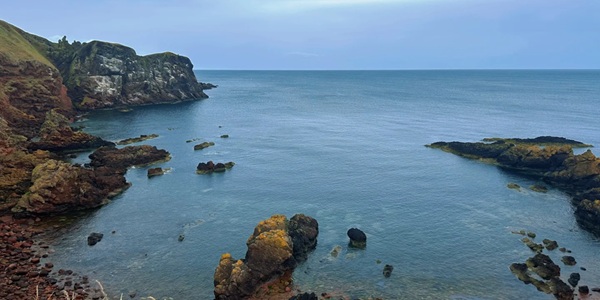
St Bees Head red sandstone sea cliffs with Irish Sea panorama
St Bees Head
The highest sea cliffs in northwest England, red sandstone precipices plunging 100 metres into the Irish Sea. An RSPB nature reserve where 5,000 seabirds nest on the ledges, with views of the Isle of Man on clear days

St Bees 2-Day Classic Tour

Stroll the red sandstone sea cliffs, explore the thousand-year-old priory ruins, and hunt for semi-precious stones among the pebbles

Duration
2 days / 1 night
Main Destinations
St Bees Beach, Priory Ruins, St Bees Head Cliffs, Fleswick Bay, Whitehaven Harbour, Rum Story Museum
Suitable For
Hiking enthusiasts, birdwatchers, history buffs, families, gem hunters
Budget per Person
£20-£80
01
Cliffs & Priory
St Bees Beach · Priory Ruins · Coast to Coast Start Point · St Bees Head Cliffs · RSPB Bird Observatory · Fleswick Bay
Highlights

Arrive in the morning at St Bees railway station — this compact Cumbrian Coast line station faces the magnificent St Bees Priory, and the 12th-century Benedictine church's Norman west front greets you as you exit. Five tiered semicircular arches diminish in size, decorated with "beakhead" carvings of human heads and serpent bodies, while trefoil dripstones above the outer arch symbolise the Trinity. Inside, the most notable area is the Bega Chapel — the best-preserved Norman section, containing Josefina de Vasconcellos's 1955 sculptures of St Bega and St Mary. In 1981, archaeologists discovered one of England's best-preserved medieval bodies — the "St Bees Man" — whose shroud and story are displayed in the church's History Area. The priory was founded by William de Meschines between 1120 and 1135, governing a vast parish stretching from Wasdale to Eskdale. Then head to the beach — this wide expanse of pebbles and sand is the official starting point of the Coast to Coast walking route, with a monument inscribed with Wainwright's famous quote. Semi-precious stones including agate, garnet and jasper lie scattered on the beach, and on clear days the Isle of Man appears suspended between sea and sky like a mirage. In the afternoon, climb St Bees Head — the red sandstone cliffs rise up to 100 metres, forming the only seabird breeding colony in northwest England. The RSPB has managed most of the cliffs since 1973, with three observation platforms. May-July is the best birdwatching season: 5,000 guillemots crowd onto ledges incubating single eggs, black guillemots (England's only breeding colony) flash their white wing patches at Fleswick Bay, and kittiwakes build nests of mud and grass on precarious cliff edges. Continue south to Fleswick Bay — this hidden pebble beach enclosed by cliffs was a smuggler's haven in the 19th century, with cave walls carved with smugglers' signatures accumulated over centuries, caves large enough to hide entire boatloads of contraband. Legend has it that Lawson's Leap is named after a local who believed he could jump across the gorge.

Attractions
St Bees Priory
A Benedictine priory founded 1120-1135 by Norman nobleman William de Meschines, dedicated to St Mary and the Irish princess St Bega. The magnificent Norman west front features five diminishing tiers of semicircular arches decorated with "beakhead" carvings of human heads and serpent bodies. The Bega Chapel is the best-preserved Norman area. The church exhibits the "St Bees Man" — one of England's best-preserved medieval corpses discovered in 1981. Also features a pre-Conquest Beowulf Stone (depicting St Michael slaying a dragon), and the final major commission of Victorian organ builder 'Father' Henry Willis from 1899. Free admission, donations welcome.
St Bees Head Seabird Cliffs (RSPB Reserve)
Red sandstone sea cliffs rising up to 100 metres, the only seabird breeding colony in northwest England and the sole remaining cliff-nesting seabird community in the region. Managed by the RSPB since 1973, with three observation platforms. Each spring and summer, thousands of guillemots, black guillemots (England's only breeding colony), kittiwakes, herring gulls and northern fulmars breed here. Fulmars glide along the cliffs on stiff wings, while peregrine falcons and ravens nest on the summit. February to July is the breeding protection period, with some areas restricted. The Isle of Man is visible on clear days. Parking approx. £5-£7/day.
St Bees Beach & Coast to Coast Start Point
A wide pebble and sandy beach, the western starting point of Alfred Wainwright's legendary "Coast to Coast" walking route (eastern end: Robin Hood's Bay, total 190 miles / 306 km). A monument bears Wainwright's famous quote, and thousands of walkers dip their boots in the Irish Sea each year to officially begin the epic crossing of three English national parks. Semi-precious stones including agate, garnet and jasper are scattered on the beach — a gem hunter's paradise. The Coast to Coast Café on the terrace overlooks the entire beach. Lifeguards on duty in summer, suitable for swimming and surfing.
Practical Info
Accommodation
  • Seacote Hotel (beside the beach, classic Cumbrian cuisine)
  • The Manor Inn (high street pub with rooms)
  • St Bees Priory B&B (quiet accommodation near the priory)
  • Hartley's Beach Shop & Tea Rooms (beachside tea room)
Food Recommendations
  • Seacote Hotel Headland Restaurant (Cumberland sausages & pies)
  • The Manor Inn (fish & chips + real ale)
  • Hartley's Beach Shop (sandwiches & hot food)
  • Priory Pop-in Café (Thursday 10:30-12:00 homemade cakes)
Travel Tips
  • Railway station is opposite the priory — very convenient
  • Beach parking is paid; free limited-time street parking available
  • Cliff paths are steep and slippery — wear non-slip shoes
  • Feb-Jul breeding season: some areas restricted, respect nesting birds
02
Harbour & Lighthouse
Whitehaven Harbour · The Beacon Museum · Rum Story · St Bees Lighthouse · Smugglers' Caves · Departure
Highlights

Take the train or bus north to Whitehaven in the morning (about 10 minutes) — this 18th-century Georgian harbour town was once the second-largest registered port in the British Empire after London, where the Lowther family created a legend from fishing village to coal empire. The old town's well-preserved grid-pattern streets are a model of British urban planning. First visit The Beacon Museum — the fourth-floor observation deck is equipped with powerful telescopes overlooking the entire Whitehaven harbour, geological formations and the distant Irish Sea. The permanent exhibition tells how the Lowther family transformed Whitehaven from a 25-household fishing village into an 18th-century industrial powerhouse, and the town's "Golden Triangle" trade with Virginia and Maryland (tobacco, sugar, rum — also involving the slave trade). A VR mining experience lets you "descend underground" to feel the life of a Cumbrian coal miner. Then visit Rum Story — a museum set in the Jefferson family's original 1785 warehouses and offices, authentically recreating the full picture of Whitehaven's 18th-century rum trade. Robert Jefferson founded the company in 1785, importing molasses from Antigua plantations to distil Jefferson's Rum, all cargo carried by the family's own fleet. The exhibition presents the dark history of the slave trade honestly and sensitively, from West African villages to Antigua plantations to Whitehaven harbour. Walk to the old harbour — late on the night of April 23, 1778, Scottish-American naval father John Paul Jones landed here with 30 crewmen, attempting to burn the harbour's ships — the only military action attacking British soil during the American War of Independence. Then return south along the coastal path to St Bees (7.4 miles / 12 km, about 4.5 hours), passing St Bees Lighthouse — a circular stone tower built in 1866, 17 metres tall, perched on the North Head cliff at 102 metres elevation, its beam reaching 18 nautical miles. The abandoned foghorn station stands on the cliff edge, once the only lifeline for sailors in thick fog. Return to St Bees beach in the evening, picking up one last agate in the sunset light.

Attractions
The Beacon Museum & Observation Deck
A modern museum beside Whitehaven harbour, with a fourth-floor observation deck equipped with powerful telescopes overlooking the entire harbour, sea traffic and the distant Irish Sea. The permanent "Changing Times" exhibition tells how the Lowther family transformed Whitehaven from a fishing village into the second-largest British port of the 18th century; "The Sellafield Story" showcases 60 years of Cumbria's nuclear industry; the VR mining experience lets you "descend underground" with a lantern to experience a coal miner's life. Tickets approx. £6-£8, concessions available. Open Tue-Sun, closed Monday.
Rum Story Museum
An immersive museum set in the Jefferson family's original 1785 warehouses, cellars and courtyards, authentically recreating Whitehaven's 18th-century rum trade. Robert Jefferson imported molasses from Antigua plantations to distil Jefferson's Rum, all cargo carried by the family's own fleet. The exhibition honestly presents the complete chain of the slave trade — from West African villages to Caribbean plantations to Whitehaven harbour. The atmosphere progresses from pirates and smugglers to Nelson's navy to Jazz Age gangsters. Tickets approx. £8-£10, advance booking recommended.
St Bees Lighthouse & Foghorn Station
A circular stone lighthouse built in 1866, 17 metres tall, perched on the North Head cliff at 102 metres elevation, emitting 134,000 candelas visible for 18 nautical miles (33 km). Originally managed by Trinity House, automated in 1987 and remotely monitored from Harwich, flashing twice every 20 seconds. The adjacent foghorn station once emitted low rhythmic warning blasts, decommissioned simultaneously with the light in 1987, but the sturdy framework and sea-facing speaker array still stand on the cliff edge like a silent sentinel. The lighthouse is not open to the public, but surrounding paths offer close-up views.
Practical Info
Transport
  • Train: Cumbrian Coast Line to St Bees station (Carlisle direction)
  • Self-drive: A595 direct, paid parking beside beach
  • Bus: Connects Whitehaven and Egremont
  • St Bees ↔ Whitehaven by train approx. 10 minutes
Tickets
  • St Bees Priory: Free (donations welcome)
  • St Bees Beach: Free
  • RSPB Nature Reserve: Free (parking £5-£7)
  • The Beacon Museum: approx. £6-£8
  • Rum Story: approx. £8-£10
Travel Tips
  • May-Jul is the best birdwatching season — bring binoculars
  • Agate and jasper can be found among beach pebbles
  • Cliff paths are extremely windy in winter — bring a windproof jacket
  • The Coast to Coast monument is a must-photo spot

Must-Try Foods in St Bees

Seacote Hotel Headland Restaurant

A hotel restaurant beside St Bees beach, specialising in classic Cumbrian cuisine. Signature Cumberland sausages with mashed potatoes, slow-braised lamb shank and fresh catch-of-the-day fish are updated daily. Hand-raised pies are made with local meat, rich gravy and golden chips. The casual bar serves sandwiches and jacket potatoes, while the Headland Restaurant offers a refined seasonal menu in the evenings. The sea-view terrace overlooks the entire St Bees beach. Budget: £15-£28 per person.

The Manor Inn

A traditional English pub on St Bees high street, CAMRA-accredited for quality real ales. The menu features Cumbrian classics: fish and chips, Cumberland sausages with mashed potatoes, slow-braised lamb shank. Saturday karaoke nights create a lively atmosphere. Run by local Caroline Taylor, full of community warmth. Just a 5-minute walk to the beach. Mon-Fri 18:00-24:00, weekends 12:00-24:00. Budget: £12-£20 per person.

Hartley's Beach Shop & Tea Rooms

A combined general store and tea room beside the beach, serving sandwiches, jacket potatoes, cakes and hot drinks. Homemade cakes are freshly baked daily, paired with Cumbrian black tea — the perfect reward after a walk. The shop also sells local jams, condiments and St Bees souvenirs. Terrace seating directly faces the beach, offering afternoon tea in the sea breeze. Open daily 9:00-16:00. Budget: £5-£12 per person.

Priory Pop-in Café

A community café set in St Bees Priory's New College Hall, open every Thursday 10:30-12:00. Entirely run by volunteers, serving homemade cakes, coffee and tea in a warm church-parlour atmosphere. Proceeds support priory maintenance. The Josefina de Vasconcellos sculpture group in the priory garden — three works dedicated to families who lost young children — is worth appreciating. Free entry (donations welcome).

St Bees Travel Tips
Best Time to Visit
  • May-Jul: Peak seabird breeding season, cliffs at their most spectacular
  • Jun-Aug: Beach swimming season, lifeguards on duty
  • Sep-Oct: Clear autumn skies, cliff wildflowers still blooming
  • Winter: Strong winds and rough seas, ideal for storm coast photography
Must-Try Foods
  • Cumberland sausages with mashed potatoes (Seacote)
  • Hand-raised pies (Seacote Headland Restaurant)
  • Hartley's homemade scones with clotted cream
  • Real ale (The Manor Inn)
  • Priory volunteer homemade cakes
Budget Reference
  • Beach/Priory/Nature Reserve: All free
  • Parking: £5-£7/day
  • Accommodation: £50-£100/night (B&B to boutique hotel)
  • Meals: £10-£30/day
  • Museums total: approx. £15-£18
  • Total: £20-£80
FAQ
  • Should I bring binoculars? → Highly recommended, RSPB platforms offer close birdwatching
  • Is the beach suitable for swimming? → Lifeguards in summer, but pebbles suggest wearing water shoes
  • Can I collect gemstones? → Agate and jasper among beach pebbles can be freely collected
  • Is Whitehaven worth visiting separately? → Extremely rich harbour history, Rum Story is unmissable
  • How long does Coast to Coast take? → 190 miles usually completed in 12-16 days

Explore More of the Lake District