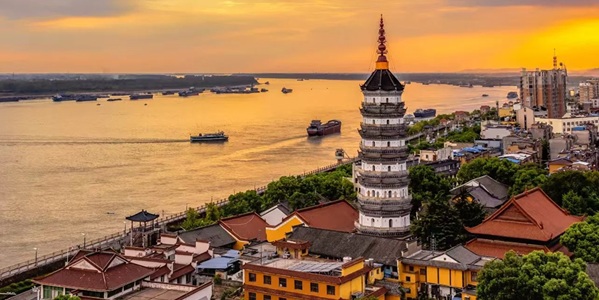
Yingjiang Temple
A thousand-year-old ancient temple founded in the Northern Song Dynasty, a key temple in Anhui Province. The temple has buildings such as the Heavenly King Hall, Mahavira Hall, and Vairocana Hall, enshrining many Buddha statues with strong incense, making it an important Buddhist sacred place along the Yangtze River.
Zhenfeng Pagoda
An ancient pagoda of the Ming Dynasty located in Yingjiang Temple, a national key cultural relic protection unit. With seven floors and eight sides, it has an elegant shape and exquisite structure, known as the "First Pagoda on the Wanli Yangtze River". Climbing the pagoda offers a 360-degree view of the Yangtze River and Anqing urban area.
Dapa Shi Historical and Cultural Block
A prosperous commercial area in Anqing during the Ming and Qing dynasties, retaining a large number of buildings from the Ming, Qing to the Republic of China. Named after the "Dapa Shi (Upside-Down Lion)" stone carving at the street entrance, it now has time-honored shops, traditional handicraft stores, characteristic snack bars, etc., showing the style of Anqing's old town.
Anqing Museum
A comprehensive local museum with thousands of cultural relics in its collection, covering various cultural relics from the Neolithic Age to modern times. It systematically displays the historical culture, revolutionary history and folk customs of Anqing, serving as an important window to understand Anqing.