Tenby St Catherine's Island Travel

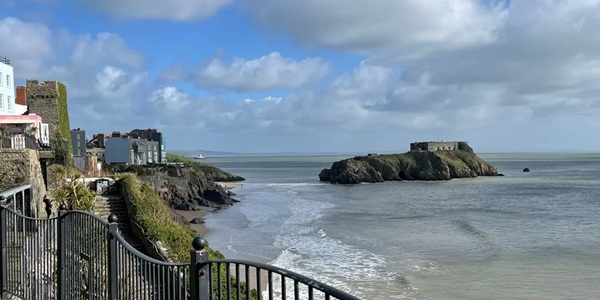
Tenby St Catherine's Island — a tidal island just 150 metres from Castle Beach, one of Britain's most unusual Victorian military heritage sites, a Grade II* listed building. First recorded in poetry as a 9th-century Norman court (llys), a chapel dedicated to St Catherine was built in the 13th century, and in 1866 the War Office purchased the island for £800, spending £40,000 between 1867-1870 to build a Palmerston coastal fort guarding Milford Haven naval dockyard — yet the French threat evaporated and its six seven-inch guns never fired. In the 20th century it became the Windsor-Richards family's lavish summer residence (purchased for £2,000 in 1914), was twice requisitioned as a military fortress in both World Wars, and from 1968-1979 transformed into a bizarre zoo — over 100 animals, with monkeys repeatedly escaping to steal hats and handbags from beachgoers, and alligators occupying the ammunition magazine alone. Today carefully restored by a team of volunteers, climb 74 steps, cross a 10-metre steel bridge, pass through the forbidding black iron door — a thousand-year legend opens to you with every falling tide.

1000+
Years of Island History
II*
Grade Listed Building
74
Steps to Summit
£5
Adult Admission
Tenby St Catherine's Island & Victorian Fort Panorama
Tenby St Catherine's Island
The Victorian Palmerston Fort stands atop a tidal limestone island, overlooking a millennium of maritime defence history across Carmarthen Bay

Tenby St Catherine's Island In-Depth Tour

From the seven-inch guns of the Victorian Palmerston Fort to the WWII anti-aircraft battery, from a 9th-century Norman court to the bizarre story of a 1970s monkey zoo — walk across the sand at low tide and journey through a thousand-year legend

Duration
Half Day - 1 Day
Main Destinations
Victorian Fort, Chapel Ruins, WWII Battery, Zoo Remains, 360° Observation Platform
Suitable For
Military History Buffs, Photography Enthusiasts, Adventure Families, Wildlife Observers
Budget Per Person
£5-£25
01
Journey Through a Millennium on a Tidal Island
Victorian Fort · St Catherine's Chapel Ruins · WWII Anti-Aircraft Battery · Zoo Remains · 360° Carmarthen Bay Panorama
Highlights

Before setting out, be sure to check the day's tide table — St Catherine's Island is only accessible on foot for approximately three hours around low tide, the soul of this entire journey. Start from the Castle Beach car park, descend the slipway to the sand. As the tide recedes, a stretch of damp sandbank appears, a 150-metre-wide shallow crossing connecting you to the island. Walk across the sand as the limestone cliffs loom closer, then ascend 74 steep zigzag steps leading to a 10-metre steel bridge spanning a final moat-like deep gully. Push open the fort's forbidding black iron door — BBC's Sherlock used this location in the 2016 episode "The Final Problem," transforming it into a North Sea prison. Enter the fort's central corridor, where gun casemates on either side seem to echo with the boots of Victorian soldiers. Climb to the open gun platform — the six cannons have been removed, but their mount bases remain, offering a 360° panorama of Carmarthen Bay: Tenby's colourful town, the golden sands of North Beach, Caldey Island's abbey bell tower, and the Pembrokeshire Coast Path stretching into the distance. Venture deeper into the fort, searching for Roman coins (excavated beneath the chapel foundations), medieval silver coins (discovered within the walls), WWI/WWII bullet scars, and the remnants of 1970s monkey cages. Volunteer guides recount the legendary tales of monkeys escaping to rob tourists of their false teeth, and the absurd story of alligators monopolising the ammunition magazine. Return before the tidal window closes, and look back from Castle Beach — the fort's silhouette against the sunset resembles a castle at sea, waiting for the next rise and fall of the tide.

Attractions
Victorian Palmerston Fort (St Catherine's Fort)
Built between 1867-1870, designed by Royal Engineer Colonel George Thomas, costing approximately £40,000 (equivalent to millions today), a key link in Britain's "Palmerston Fort" coastal defence system — built in response to the threat of Napoleon III's French navy (particularly the panic following the 1858 launch of the ironclad La Gloire), a series of coastal batteries were hastily constructed around Milford Haven, Portsmouth, Chatham and Plymouth. St Catherine's Fort is the only completed beach defence fort among the planned 17 (another inland fort, Scoveston, was also built), constructed from rock-faced limestone with tooled limestone dressings and some granite. Rectangular in plan, with a two-storey-plus-basement entrance block at the northwest end, three large square granite-faced gun embrasures on each side, and a trilobe bastion open gun platform at the southeast end. A massive semicircular cornice runs around the entire fort, above low parapets that once mounted six 7-inch and three 9-inch rifled muzzle-loading guns (fully deployed by 1886) — yet the French threat dissipated and these guns never fired. The entrance crosses a dry moat, originally fitted with a drawbridge, a rough-hewn arch with oversized radiating voussoirs, and a plaque above the lintel recording construction details. Three tiers of small square recessed gun loops on the flanking walls command the moat from above. Privately owned since 1962 by Tenby businessman Graham Fry, Grade II* listed and Scheduled Ancient Monument.
St Catherine's Chapel Ruins & Millennium History
Human activity on St Catherine's Island dates back to the 9th century — an ancient Welsh poem records the presence of a Norman court (llys) on the island, serving as the judicial and administrative centre of the local lord. In the 12th century, a hermit built a small chapel dedicated to St Catherine of Alexandria (a 4th-century Christian martyr), and by the 13th century the church was firmly established, mentioned in documents from 1525 and 1585. According to an 1812 record, the church ruins at that time still projected from the furthest point of the island. However, during the construction of the Victorian fort between 1868-1871, the chapel was completely demolished — rock-faced limestone swallowed the sacred remains. Archaeological discoveries provide physical evidence of this history: Roman coins excavated beneath the chapel foundations (suggesting possible Roman activity on the island), and medieval silver coins found within the chapel walls. Today the trilobe bastion area at the southeast end of the fort roughly corresponds to the original chapel site, and guided tours recount the thousand-year layered history from Norman court to medieval pilgrims to Victorian engineers. Cadw site number NPRN 418975.
WWII Anti-Aircraft Battery & Military Remains
During WWI (1914-1918), the Royal Artillery and Royal Marines reoccupied the fort as a coastal defence battery. On the eve of WWII (1939), the government compulsorily requisitioned the island, fearing Nazi Germany would invade Britain along Welsh beaches — St Catherine's Island, commanding Carmarthen Bay from its elevated position, became an ideal anti-aircraft battery site. The rooftop gun platform was converted into an AA position, with searchlights sweeping the horizon and anti-aircraft guns trained on the sky. The underground ammunition magazines (former gun casemates) were reinforced as air raid shelters and supply stores. In 1940, Harrods auctioned almost all interior furnishings left by the Windsor-Richards family — ornate chandeliers, marble fireplaces, Persian carpets were sold off one by one, and the fort returned to its military bare state. Today's guided tours still reveal WWII bullet scars, concrete AA mounting bases, and soldiers' graffiti. Parts of the fort's interior remain unlit (generator occasionally fails), and volunteers recommend visitors bring torches to explore the dark underground spaces, creating a unique "ghost fort" atmosphere — several visitors and former island residents (such as Ginny, daughter of the 1970s zoo owner) claim to have heard soldiers' marching songs and unexplained footsteps.
1970s Zoo Ruins & Wildlife Sanctuary
In 1968, Christopher and Marion Batt of Bristol arrived on the island with a travelling menagerie of exotic animals (their daughter Ginny was about to be born), building wooden-framed wire-mesh cages within the fort's gun casemates, turning St Catherine's Island into a bizarre offshore zoo. At its peak, the island housed over 100 animals: marmosets, night monkeys, guenons, lemurs, striped skunks, bushbabies, tree shrews, red foxes, otters, badgers, ferrets, Indian mongooses, and a group of large alligators occupying the underground magazine exclusively. The rooftop gun platform housed African civets, coatis and red foxes. Monkeys repeatedly broke their cages, scaled the cliffs and charged onto Castle Beach — they snatched hats, scarves and handbags from tourists, piling them up before sitting on the sand to play with their loot; one monkey even snatched a man's false teeth from his mouth. The locals' solution: clap and shout loudly, and the monkeys would drop their spoils and flee back to their cages. The zoo attracted 45,000 visitors annually, but salt corrosion damaged equipment and transport costs rose; in 1979 the Batt family could no longer sustain it and left the island sadly. Today the fort still contains remnants of wooden cage frames and fragments of wire mesh. The island itself is a wildlife haven: waters below the high tide line are designated a Site of Special Scientific Interest (SSSI), the limestone cliffs are nesting grounds for choughs and peregrine falcons, and the intertidal zone reveals sea anemones, starfish and barnacles. Tidal caves dot the entire island, offering a natural classroom for geology enthusiasts.
Practical Information
Transportation
  • Approx 15 min walk from Tenby train station to Castle Beach
  • From the harbour, walk along Castle Hill to Castle Beach slipway
  • Nearest car park: Castle Beach Car Park
  • MUST check tide times! Only accessible approx 3 hours around low tide
  • Alternative: local operators offer island boat tours (no landing)
Ticket Information
  • Adults (15+): £5.00
  • Children (3-15): £2.50
  • Infants under 3: Free
  • Guided tour includes fort history commentary
  • Dogs allowed on island (must be leashed)
  • All ticket income goes toward fort restoration
Travel Tips
  • Wear sturdy non-slip shoes — 74 steps + gravel paths
  • Some interior areas unlit — bring a torch
  • Bring a windproof jacket — island is exposed and windy
  • Tidal window approx 3 hours — allow enough time for return
  • Not suitable for those with limited mobility — steep steps without railings
  • Check Facebook page for latest opening updates

Food Recommendations Near St Catherine's Island

Twelve at The Mews

A stylish wine bar and tapas restaurant located in The Mews food court on Upper Frog Street, just a 5-minute walk from Castle Beach. The interior is as chic and sophisticated as a London rooftop bar, offering globally inspired 3 for £18 sharing plates — Korean fried chicken, Spanish garlic prawns, French crème brûlée each with their own flair. A glass of selected wine paired with a Welsh cheese board in the afternoon is the most rewarding treat after returning from the island. Average £15-25 per person.

Plantagenet House

Just a 3-minute walk from Castle Beach, this restaurant occupies a medieval building dating from 1023, with a honeycomb stone vaulted ceiling that is a living fossil of 10th-century Norman architecture. Signature slow-roasted Pembrokeshire lamb with rosemary jus, served in the yellow-walled dining room overlooking the harbour, perfect for a candlelit dinner. Echoing the historical depth of St Catherine's Island, it's the ideal choice for experiencing Tenby's thousand-year flavours. Average £20-30 per person.

Mykonos Restaurant

A Greek family restaurant on St Florence Parade, about an 8-minute walk from Castle Beach. The signature moussaka and swordfish steak are local favourites, served with traditional Greek salad and homemade yoghurt sauce. Warm family-style service, and on summer evenings sit outside facing the harbour and the distant silhouette of St Catherine's Island. Average £15-25 per person.

The Hope & Anchor

A fisherman's restaurant right by the harbour, just 4 minutes from the Castle Beach entrance. Fresh fish delivered daily from the Bristol Channel is written on the blackboard — garlic butter baked spider crab claws, Cornish deep-sea cod, and Pembrokeshire mussels are the signature trio. Sit by the window watching fishing boats come and go — the most satisfying refuelling stop after an island adventure. Average £15-25 per person.

Tenby St Catherine's Island Travel Tips
Best Time to Visit
  • Open Season (Easter-October): Fort guided tours operating normally
  • Summer (June-August): Stable weather, longer low tide windows, ideal for landing
  • Spring/Autumn (April-May/Sept-Oct): Fewer people, peaceful, seabirds active
  • Winter: Island closed; view the fort from Castle Beach only
  • Avoid Christmas Day (Dec 25) and New Year's Day (Jan 1) — entire town closed
Must-Try Foods
  • Tenby Seafood Platter
  • Fecci's Handmade Ice Cream
  • Welsh Rarebit
  • Harbour Fish & Chips
  • Caldey Island Monastery Chocolate
Budget Reference
  • Fort admission: £5.00
  • Castle Beach parking: £3-5/day
  • Food & drink: £10-25
  • Island boat tour (optional): £8-12
  • Total: £5-£42
Frequently Asked Questions
  • Do I need to book? → Recommended to check Facebook page for daily opening status
  • Is there a Chinese audio guide? → Currently English commentary only; recommend reading historical materials in advance
  • Can I take photos? → Photos allowed inside and outside the fort; use flash with caution
  • Can wheelchairs access the island? → 74 steps + steel bridge, unsuitable for wheelchairs and pushchairs
  • Where to find tide tables? → UK Hydrographic Office or consult Tenby Tourist Information Centre
  • Is the island safe? → Accompanied by volunteer guides; do not approach cliff edges

Explore More Areas of Tenby