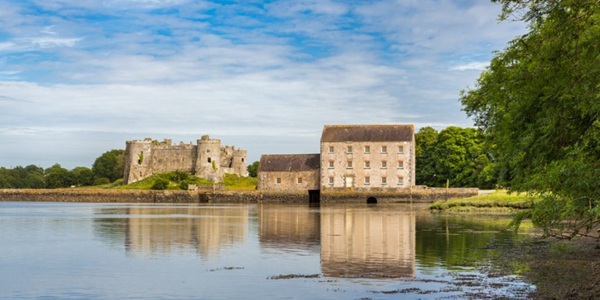
Carew Castle & Tidal Mill Travel

Carew Castle & Tidal Mill — a two-thousand-year epic standing on the tidal tributary of the Carew River, a building that evolved from a Norman motte-and-bailey into a Tudor mansion, from an Iron Age hillfort to the baptism of cannon fire in the English Civil War. In 1100, Norman knight Gerald of Windsor built the first fortress here to marry the Welsh princess Nest, the "Helen of Wales"; five centuries later, Sir John Perrot erected a huge mullioned window wall on the north side of the castle, transforming the stern medieval stronghold into a luxurious Elizabethan palace. Adjacent to the castle, the tidal mill is Wales' only fully restored tidal-powered mill, harnessing the ebb and flow of the Carew River to grind grain for nearly four hundred years. An 11th-century Celtic cross stands at the entrance, inscribed with the glory of the Kingdom of Deheubarth — in half a day, read the complete memory of Pembrokeshire from the Iron Age to the Tudor dynasty.

2000+
Years of Castle History
1100
Norman Foundation
I
Grade I Listed Building
£8.50
Adult Admission From
Carew Castle & Tidal Mill Panorama
Carew Castle & Tidal Mill
A Norman fortress on the tidal tributary of the Carew River and Wales' only restored tidal mill — a living fossil of two millennia of architectural evolution

Carew Castle & Tidal Mill In-Depth Tour

From Norman motte-and-bailey to Tudor mansion, from the waterwheel gears of the tidal mill to the interlaced relief of the Celtic cross — traverse two thousand years of Pembrokeshire history in half a day

Duration
Half Day - 1 Day
Main Destinations
Norman Castle Core, Elizabethan North Wing, Celtic Cross, Tidal Mill, Medieval Bridge, Castle Gardens
Suitable For
History enthusiasts, architecture lovers, families, birdwatchers
Budget Per Person
£8.50-£25
01
Two-Thousand-Year Architectural Evolution
Norman Castle Core · Elizabethan North Wing · Celtic Cross · Tidal Mill · Medieval Bridge · Nest Tearoom
Highlights

Depart from Tenby in the morning with a 15-minute drive to Carew Castle (or take the Fflecsi bus which stops right at the castle entrance). First, pause at the entrance to admire the 11th-century Carew Celtic Cross — a 4-metre sandstone cross intricately carved with knot patterns and Celtic interlacing on all four sides, its inscription recording the glory of Deheubarth ruler Maredudd ab Edwin (died 1035), and serving as the design inspiration for the Cadw (Welsh historic monuments agency) logo. Cross the medieval stone bridge into the castle core, climb the spiral stairs of the 13th-century southeast tower, and gaze from the battlements across the shimmering 23-acre millpond with the outline of St Catherine's Island in the distance. Study the ornate fan-vaulted windows and heraldic doorway left by Sir Rhys ap Thomas — Henry VII's staunch supporter who hosted Wales' last medieval tournament here in 1507, with the royal arms of Henry VII, Prince Arthur and Catherine of Aragon still carved above the doorway. Then walk through the ruined Elizabethan gallery on the north side of the castle, touching the giant multi-pane windows built by Sir John Perrot — these almost lace-like window walls transformed the medieval fortress into a water-facing luxury palace. In the afternoon, stroll along the one-mile circular walk to Wales' only restored tidal mill, tracing the tidal power mechanism across three levels that drove the 16-foot waterwheel to grind grain, catch crabs on the causeway and watch egrets, before finishing the journey with a Welsh breakfast tea and handmade lemon cake at the Nest Tearoom.

Attractions
Norman Castle Core & Medieval Defences
The castle's story begins around 1100 when Norman knight Gerald of Windsor built a motte-and-bailey fortress to marry the Welsh princess Nest; archaeological excavations confirm earlier Iron Age hillforts, Roman pottery and Dark Age settlements. The surviving stone castle was largely built by Sir Nicholas de Carew (died 1311) at the end of the 13th century, including the Old Tower on the east side, the hall flanked by twin round towers to the west, a gate passage with five murder holes, and thick curtain walls surrounding the inner courtyard. The walls are up to 2 metres thick, with underground vaulted cellars once used as storerooms and prisons. King John briefly confiscated the castle when passing through Pembroke in 1212; after Sir Rhys ap Thomas took over in 1480, he extensively remodelled it, adding a square gatehouse connecting the outer bailey and decorative battlements. During the English Civil War the castle changed hands four times, and the kitchens and ancillary buildings on the south side were "slighted" (deliberately demolished) to prevent enemy reuse, finally abandoned in 1686. Grade I listed building, now a Site of Special Scientific Interest (SSSI), hosting various bat species and rare plants.
Elizabethan North Range & Tudor Luxury Remodelling
The castle's most dramatic architectural chapter was written by Sir John Perrot between 1588-1592 — he demolished the medieval curtain wall on the north side and built an Elizabethan mansion facing the 23-acre millpond. The hallmark of the north range is three rows of giant mullioned and transomed windows, meticulously carved from Somerset oolitic limestone, the stone tracery between the frames making the entire wall resemble a church choir screen rather than a military fortress. Inside are five large ground-floor rooms and a 40-metre-long Long Gallery, with the Perrot family coat of arms still visible above the fireplace. Sadly, Perrot never enjoyed this palace — he was imprisoned in the Tower of London on charges of treason in 1592 and died in custody. Legend claims he was the illegitimate son of Henry VIII. Visitors can freely climb the spiral staircases to the tower tops, enjoying 360° panoramic views of the castle estate and the tidal river from the battlements.
11th-Century Carew Celtic Cross
Standing 4 metres tall beside the castle entrance, this is one of Wales' finest early medieval Christian monuments, a Grade I listed structure. The cross is assembled from two sections joined by mortise and tenon: the upper part is Carmarthenshire sandstone, the base is igneous rock from the Preseli Hills. All four sides are carved with intricate Celtic knotwork, plaiting and key patterns; the west face bears the inscription "MARGITEUT REX ETG(UIN) FILIUS" interpreted as "The cross of Etguin, son of Maredudd (grandson of Hywel Dda)", likely a memorial following Maredudd's death in 1035. This cross was the design prototype for the official logo of Cadw (Welsh historic monuments agency). Originally located at an unknown site (possibly a nearby chapel), it was moved to its current position around 1690 as a decorative landmark for the castle, relocated twice for protection in 1925 and during WWII. Free to visit, open 24 hours.
Wales' Only Restored Tidal Mill (Carew Tidal Mill)
Wales' only surviving fully restored tidal mill, one of just five such mills remaining in the UK. The existing building dates mainly from the early 19th century (one waterwheel is inscribed with the date 1801), but documentary records show a mill operating here as early as 1542. Its working principle is a textbook example of pre-industrial sustainable energy: at high tide, sluice gates open to fill the 23-acre reservoir; at low tide, the outer gates close and inner gates open, using a 6-metre drop in water level to drive two 16-foot undershot waterwheels, which through a system of wooden gears turn French-imported burr stones to grind wheat — hence its nickname "the French Mill". The mill operated continuously until 1937, then lay derelict until restoration began in 1972 by the Carew Estate in partnership with the Welsh Historic Buildings Council. Today, three floors of interactive exhibits, audio guides and family-friendly installations tell the story of tidal power, with visitors able to look directly down at the original waterwheel machinery in the basement. The causeway outside is one of Pembrokeshire's best crabbing spots.
Medieval Bridge & Millpond Circular Walk
The medieval stone bridge spanning the Carew River is the only way into the castle, its surface still bearing the grooves of ancient stone cart wheels. From the bridge, a one-mile circular walk extends along the south bank of the millpond — flat and wide, suitable for wheelchairs and pushchairs, forming a branch of the Pembrokeshire Coast Path. Interpretation boards along the route explain the wetland ecology: mudflats and salt marshes provide ideal habitat for egrets, kingfishers, oystercatchers and various wading birds, with thousands of waterbirds stopping over in autumn. A second car park on the north bank of the pond offers photographers the classic shot of the castle reflected in the water. Halfway along the walk, an 18th-century modified causeway sluice system still clearly shows the remains of flood defences repaired by Sir John Carew in 1630.
Nest Tearoom & Walled Garden
A modern timber tearoom built in 2018 within the castle's walled garden, named after the castle's most famous legendary woman — Princess Nest, the "Helen of Wales". The tearoom serves homemade cakes (lemon curd drizzle loaf is the signature), delicate sandwiches, Welsh breakfast tea and organic coffee, with outdoor seating overlooking the full castle panorama. Specially recommended are Mother's Day or Easter themed afternoon teas (£20/person, add £5 for a glass of Prosecco), which include free entry to the castle and mill. The walled garden grows four categories of herbs — culinary, dyeing, medicinal and aromatic — with free guided tours in June and September each year. The tearoom can be visited separately without purchasing a castle ticket. The castle gift shop sells souvenirs inspired by the Cadw cross motif and local handicrafts.
Practical Information
Transportation
  • 15-minute drive from Tenby (A4139→B4318→A477)
  • Nearest stations: Pembroke Dock (5.6 miles) or Kilgetty (6.6 miles)
  • Fflecsi bus replaces former 360/361 route, Mon-Sat 7:30-18:30
  • Main castle car park free, second car park on north side of mill
  • Cyclists can approach via multi-use path along A477
Ticket Information
  • Adult ticket (castle + mill): £8.50
  • Concession (senior/student): £6.50
  • Child (5-16 years): £6.50
  • Family ticket (2 adults + 3 concessions): £22.00
  • Wheelchair users: Free
  • Disabled visitors and carers: 25% discount
  • Public transport/cycle arrivals: Free entry (apply on request)
  • Celtic cross and circular walk: Free all day
Travel Tips
  • Allow 2-3 hours for castle + mill visit
  • Circular walk takes approx 20-30 minutes (including photos)
  • Free audio guide available via smartphone
  • Wear non-slip shoes — castle interior stairs are steep and floors uneven
  • No water activities (kayaking/SUP) permitted on the millpond
  • Summer weekends feature archery, knight school and other events
  • Dogs allowed (short lead), but not inside Nest Tearoom

Food Recommendations Around Carew Castle

The Carew Inn

A historic country pub directly opposite the castle, a Camra Good Beer Guide-listed tavern. Enjoy a 6oz steak with chips and peas (£7.95+) by the fireplace, with home-brewed real ale paired with Welsh meat pie as the classic combination. The rear garden faces the castle and Celtic cross — on summer evenings, sit on the terrace watching the castle turn golden in the sunset. Average £12-20 per person.

The Crab Shack (Tenby Harbour)

Just a 9-minute drive from the castle, this Tenby harbour seafood haven delivers spider crab, lobster and mussels daily from the Bristol Channel. Garlic butter baked crab claws are the signature must-order. Sit on the harbour benches watching fishing boats come and go — the perfect seafood feast en route from the castle. Average £15-25 per person.

Fecci's Handmade Ice Cream (Tenby)

Founded in 1919, Tenby's oldest ice cream parlour. Blackberry yoghurt is the locals' secret favourite, with salted caramel a recent hit. After your castle visit, drive to Tenby harbour for a cone, sitting by the harbour watching seagulls circle — the most classic Pembrokeshire ritual. Average £3-6 per person.

Plantagenet House (Tenby)

A restaurant converted from a medieval building dating to 1023, with honeycomb stone vaulted ceilings that are living fossils of 11th-century Norman architecture. The signature slow-roasted Pembrokeshire lamb with rosemary jus is outstanding, and the yellow-walled dining room faces the harbour, perfect for candlelit dinners. A 10-minute drive from the castle. Average £20-30 per person.

Carew Castle & Tidal Mill Travel Tips
Best Time to Visit
  • Summer (Mar 23-Nov 1): Castle + mill fully open, events programme running
  • Spring/Autumn (May/Sep-Oct): Fewer visitors, peaceful, good light for photography
  • Winter (Nov-Feb): Castle only open 11:00-15:00, mill closed
  • July 4-5: Annual Medieval Tournament (advance booking required)
  • Avoid Christmas (Dec 25-26) and New Year's Day — town-wide closures
Must-Try Foods
  • Nest Tearoom lemon curd drizzle loaf
  • Carew Inn Welsh meat pie
  • Tenby seafood platter
  • Fecci's handmade ice cream
  • Welsh Rarebit
Budget Reference
  • Castle + mill admission: £8.50
  • Food & drink: £10-25
  • Transport: free parking by car/bus £4-6
  • Summer events (archery/tournament): included in admission or extra £5-18
  • Total: £8.50-50
Frequently Asked Questions
  • Do I need to book? → Peak season recommended to buy tickets online in advance; tournament weekend mandatory booking
  • Is there a Chinese audio guide? → Currently English audio guide only; downloadable mobile app available
  • Can I take photos? → Photography allowed inside and outside the castle; no flash photography
  • Is it wheelchair accessible? → Ground floor accessible; all three levels of the mill are reachable
  • Are children free? → Under 5s free, ages 5-16 £6.50
  • Any ghost stories? → Legend speaks of the "White Lady" Princess Nest and a Barbary ape ghost in the northwest tower

Explore More Areas of Tenby