Pitt Rivers Museum Travel

The Pitt Rivers Museum — founded in 1884 by Lieutenant-General Augustus Pitt Rivers, it is one of the world's finest anthropology and archaeology museums, often described as a "real-life cabinet of curiosities." Housing over 500,000 ethnographic and archaeological objects from around the globe — from Japanese samurai armour to Haida totem poles, from African sceptres to Inuit snow goggles, from shaman drums to voodoo dolls — its most unique feature is that exhibits are not arranged by region or chronology, but by functional type: all masks together, all musical instruments together, all weapons together — allowing you to traverse five continents and thousands of years within a single display case. Free admission. The dimly lit Victorian display cases create the mysterious atmosphere of an explorer's study, and a full day's in-depth tour will leave you wandering enchanted through the dense forest of human civilisation.

1884
Year Founded
500K+
Total Objects
Free
Permanent Exhibition
11m
Haida Totem Pole Height
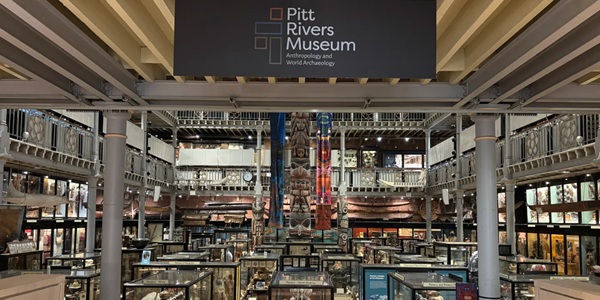
Pitt Rivers Museum Victorian display cases and anthropological treasures
Pitt Rivers Museum
One of the world's finest anthropology museums, founded in 1884, with 500,000 objects arranged by function. Dim Victorian display cases, glass cabinets stacked from floor to ceiling, handwritten Victorian labels — a single museum is a panoramic archive of human creativity

Pitt Rivers Museum One-Day In-Depth Tour

From Haida totem poles to Japanese samurai armour, from African sceptres to Inuit snow goggles, step into a panoramic chamber of human civilisation arranged by function

Duration
1 day (extendable to 2-3 day Oxford trip)
Main Destinations
Upper Gallery Mask Section, Main Court Weapons & Totem Pole, Lower Gallery Currency & Material Culture, Oxford University Museum of Natural History
Suitable For
Anthropology enthusiasts, archaeology lovers, museum connoisseurs, cultural researchers, family educational trips
Budget Per Person
£0-£30 (permanent exhibition free, dining extra)
01
Journey Through Human Civilisation's Wonders
Upper Gallery: Masks & Ritual · Main Court: Weapons & Totem Pole · Lower Gallery: Currency & Material Culture · Natural History Museum
Highlights

Enter through the main entrance of the Oxford University Museum of Natural History in the morning — the Pitt Rivers Museum has no separate entrance; you must pass through the Natural History Museum's dinosaur skeleton hall, turn left at the statue of Darwin, and pass through an arched doorway, instantly entering another world. A towering Victorian central hall, three-storey glass display cases rising from floor to ceiling, densely packed with man-made objects from around the globe under dim lighting. First, ascend the stairs to the Upper Gallery, pausing at the Masks & Ritual section where Japanese Noh masks, African Dan masks, and Native American shaman masks gather together — observing Noh masks from front and side reveals fascinating shifts in expression. Return to the Main Court, gazing up at the 11-metre Haida Totem Pole — brought from Haida Gwaii, British Columbia, Canada in 1901, the museum's most spectacular "guardian pillar." Move to the weapons section, comparing African spears, Pacific war clubs, Japanese swords, and Inuit harpoons — the infinite variations of the same function across different cultures. In the afternoon, descend to the Lower Gallery, exploring the Currency & Measures section with Ashanti gold weights and Ghanaian brass weights, and the Material Culture section featuring Inuit snow goggles, Tibetan kapala bowls, and Polynesian fishhooks. Finally, enjoy afternoon tea at the Natural History Museum café, reflecting on this fantastical journey through human civilisation.

Attractions
Upper Gallery: Masks & Ritual
A paradise for mask enthusiasts, with display cases densely packed with ritual masks from Japan (Noh and Kabuki masks), Africa (Dan, Dogon, Chokwe masks), and North America (Kwakwaka'wakw, Haida shaman masks). Japanese Noh masks appear calm from the front but sad from the side — artisans deliberately curved the chin line upward to create an optical illusion. African Dan masks are used in initiation ceremonies and judicial proceedings, with wearers believed to embody spirits. Observe each mask from multiple angles.
Main Court: Weapons & Haida Totem Pole
The core space of the museum, with three-storey glass display cases lining both sides of the soaring central hall. The 11-metre Haida Totem Pole stands in the centre, brought from Star House in Haida Gwaii, British Columbia, Canada in 1901, carved with thunderbirds, whales and the clan crest of Haida chief Anetlas. Weapon cases display African Zande spears, Pacific war clubs, Japanese samurai armour and swords, and Inuit harpoons and blowpipes — showing how humans solved the shared challenge of "hunting and fighting" in different ways.
Lower Gallery: Currency, Material Culture & Music
The Lower Gallery focuses on the creativity of everyday human life. The Currency & Measures section displays Ashanti gold weights from Ghana — intricately carved brass miniatures that serve both as weighing tools and allegorical carriers; West African glass beads, shell money, and Chinese copper coins form a global panorama of monetary systems. The Material Culture section includes Inuit bone snow goggles (for preventing snow blindness), Tibetan kapala bowls (ritual skull cups), Polynesian fishhooks, and Maori greenstone pendants (hei-tiki). The Music section gathers instruments from around the world — African thumb pianos, Papua New Guinean bamboo trumpets, Japanese sho and shakuhachi.
Oxford University Museum of Natural History
The "vestibule" and entrance passage to the Pitt Rivers Museum, itself a masterpiece of Victorian Gothic Revival architecture. The central court features statues of scientists including Darwin, Newton and Galileo, with natural light streaming through the glass dome. The museum houses 7 million specimens, including the first scientifically described dinosaur — the Megalosaurus bucklandii fossil, the Oxford Dodo (soft tissue specimen), and a Japanese spider crab. Allow 30-45 minutes to explore before entering the Pitt Rivers.
Practical Information
Transportation
  • Train from London Paddington to Oxford approx. 1 hour
  • Approx. 15-min walk from Oxford train station to Parks Road
  • Bus 14/500 to Keble Road stop, 5-min walk
  • Approx. 15-min walk from Carfax Tower in city centre
Ticketing
  • Permanent exhibition: Free (donation £5 encouraged)
  • Special exhibitions: £5-£10 (advance booking recommended)
  • Free guided tours: Daily 11:30 & 14:30
  • Audio guide: Free download of Pitt Rivers official app
  • Group visits (10+): Advance booking required
Travel Tips
  • No separate entrance; enter through Natural History Museum first
  • Dim lighting inside; bring phone torch to read labels
  • Display cases are tight; large backpacks and pushchairs not allowed
  • Opens at noon on Mondays — don't arrive too early
  • Allow 2-4 hours; exhibits are extremely dense

Must-Try Eats Around Pitt Rivers Museum

Museum Café (Natural History Museum Café)

A shared café on the upper level of the Natural History Museum, serving soup, sandwiches and scones under arched glass skylights. Budget £8-£15 per person, the perfect refuelling stop mid-visit.

The Eagle and Child Pub

A literary pub frequented by Tolkien and C.S. Lewis, a 5-minute walk from Pitt Rivers. Signature beef pie with dark beer gravy, full of collegiate charm. Budget £15-£25 per person.

Quod Restaurant & Bar

A refined restaurant converted from an old bank, featuring a glass atrium and academic art collection. Recommended mains include Oxford roast lamb cutlets and local trout. Budget £25-£40 per person.

George & Davis Ice Cream

Oxford's legendary handmade ice cream shop. Thyme honey and Earl Grey flavours are full of British creativity. Perfect for a summer afternoon stroll along the High Street. Single scoop from £4.

Pitt Rivers Museum Travel Tips
Best Time to Visit
  • Closed Monday mornings; opens at 12:00
  • Tuesday-Friday mornings have fewest visitors
  • Weekends and school holidays are busier with families
  • Avoid the crowded exam season (May-June)
Must-Try Foods
  • Museum Café light meals
  • Eagle and Child beef pie
  • George & Davis handmade ice cream
  • Oxford Blue cheese
  • The Grand Café English afternoon tea
Budget Reference
  • Permanent exhibition: Free
  • Special exhibition: £5-£10
  • Accommodation: £80-200/night (Oxford city centre)
  • Dining: £15-30/day
  • Total: £15-50 (one-day trip)
Frequently Asked Questions
  • Is admission free? → Permanent exhibition is completely free; only special exhibitions charge
  • Is there a Chinese audio guide? → Currently English only; official app has audio guide
  • Can I take photos? → Yes (no flash, to protect organic materials)
  • Why typological arrangement? → Founder Pitt Rivers believed it shows the evolutionary trajectory of human culture
  • Can I enter on Monday morning? → No, opens at 12:00 on Mondays

Explore More Areas of Oxford