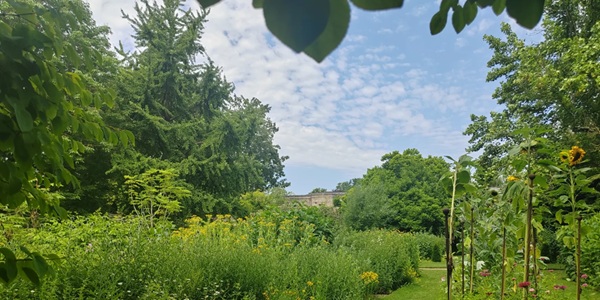
Walled Garden & Medicinal Plants
The core area surrounded by original 17th-century stone walls, with the archway and walls designed by architect Nicholas Stone in the 1630s. Plants are arranged by family classification, serving as a living textbook of botany. The Medicinal Plants Collection showcases key species that changed medical history: rosy periwinkle (leukaemia treatment), foxglove (source of heart medication digoxin), cinchona tree (quinine source), and more. The European yew planted in the 1640s by first curator Jacob Bobart still stands in the garden and is one of the UK's oldest cultivated specimen trees.
Glasshouse Collection
Seven greenhouses with different climate themes create a global plant journey: the Tropical Rainforest House features Victoria cruziana water lilies with leaves up to 2 metres in diameter, where the hybrid Nymphaea × daubenyana was first successfully bred in 1874; the Desert House houses century-old cacti and succulents; the Alpine House displays rare alpine flowers such as rhododendrons and gentians; the Bog House showcases carnivorous plants like pitcher plants and Venus flytraps waiting silently for prey. Temperature and humidity are precisely controlled, making every step feel like crossing to another continent.
Lower Garden & Rock Garden
Adjacent to Christ Church Meadow and the River Cherwell, this is the most visually striking area of the garden. The Rock Garden centres on a waterfall and water lily pond, with the Nymphaea 'Amabilis' water lily variety blooming brilliantly in summer. The Herbaceous Border, established in 1946, is a classic example of English herbaceous borders, with colours changing through spring, summer and autumn. Gunnera manicata leaves exceed 1.2 metres in diameter, earning it the nickname "giant rhubarb," and often attracting local moorhens to nest beneath its leaves. The Merton Borders employ sustainable gardening principles requiring no artificial irrigation or fertiliser.
Plants that Changed the World & River Cherwell
A themed exhibition area along the River Cherwell showcasing plants that profoundly changed human civilisation and trade patterns: coffee, cocoa, bananas, sugar cane, cotton, tea, and more. Each plant has an interpretive panel telling the story of its journey from origin to global distribution. The riverside path offers distant views of Magdalen College Tower and Christ Church Tom Tower, providing excellent photo opportunities of the garden alongside the Oxford skyline. The dawn redwood (Metasequoia glyptostroboides) introduced in 1949 is also in this area — one of the earliest specimens brought to Europe after China's rediscovery of this "living fossil" in the 1940s.