Oxford Natural History Museum Travel

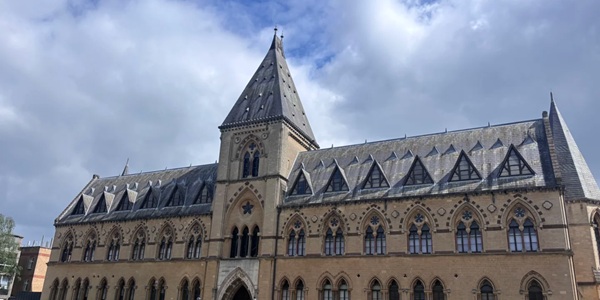
The Oxford University Museum of Natural History — a temple that perfectly blends Victorian scientific passion with Gothic architectural beauty. On 28 June 1860, one of the most famous debates in the history of science erupted in its lecture theatre: Thomas Huxley and Oxford Bishop Samuel Wilberforce clashed fiercely over Darwin's On the Origin of Species. This "Oxford Debate" forever changed humanity's understanding of the evolution of life. The museum itself is an architectural masterpiece — an iron-and-glass domed atrium inspired by the Crystal Palace, yet given warmth by Gothic decorative details. Suspended in the centre of the hall is the 26-metre-long Diplodocus skeleton, alongside a Microraptor fossil, a Tyrannosaurus rex skull, a dodo specimen, a 7-tonne meteorite and gleaming gold crystal clusters. This is the only place in Oxford where children and adults alike hold their breath in wonder.

1860
Darwin Debate Year
26m
Diplodocus Skeleton Length
Free
Admission
7M+
Specimens in Collection
Oxford Natural History Museum Gothic glass dome with dinosaur skeleton
Oxford Natural History Museum
Beneath the Victorian Gothic glass dome, the 26-metre Diplodocus skeleton stands proudly, while the echoes of the 1860 Darwin debate still resonate through the hall

Oxford Natural History Museum One-Day In-Depth Tour

From the Diplodocus skeleton to the dodo specimen, journey through 4.6 billion years of Earth's epic story beneath a Victorian Gothic dome

Duration
Half day to 1 day (extendable to 2-3 day Oxford trip)
Main Destinations
Main Court Dinosaur Gallery, Mineral & Gemstone Hall, Darwin Debate Steps, Pitt Rivers Museum
Suitable For
Families, natural science enthusiasts, geology lovers, history buffs, photography enthusiasts
Budget Per Person
£0-£30 (free admission + optional guided tour)
01
Natural Science Discovery Tour
Main Court Dinosaur Gallery · Mineral & Gemstone Hall · Darwin Debate Steps · Pitt Rivers Museum · Museum Courtyard
Highlights

Enter through the main entrance in the morning, greeted by the breathtaking Victorian Gothic Central Hall — an iron framework supporting a glass dome, with natural light cascading down like a waterfall. At the centre stands the 26-metre-long Diplodocus skeleton, the museum's most iconic star. To the left, the Dinosaur Gallery displays a Tyrannosaurus rex skull, Triceratops shield and Pterosaur fossils; children love the touch zone where they can feel the rough texture of dinosaur eggs. Climb the stone steps on the west side of the hall — this is where Huxley and Bishop Wilberforce held their Darwin debate in 1860. The lecture theatre remains intact, with a commemorative plaque marking this milestone in scientific history. In the afternoon, head downstairs to the Mineral and Gemstone Hall, where a 7-tonne Cape York meteorite, amethyst geode and gold veins shimmer with the light of the Earth's deep interior. Finally, cross the courtyard into the Pitt Rivers Museum, where anthropological treasures are displayed layer upon layer in Victorian cabinets, creating a fascinating dialogue with the natural science specimens.

Attractions
Main Court & Dinosaur Gallery
The heart of the museum — a Victorian Gothic central hall where cast-iron columns and a glass dome create a cathedral-like sense of awe. The central Diplodocus skeleton measures 26 metres, excavated in Wyoming, USA in the 1860s. The Dinosaur Gallery features a 1.5-metre-long T.rex skull, Triceratops shield, Pterosaur fossils and dinosaur eggs; the touch zone lets you feel real fossil textures. Statues of Darwin and a bust of Huxley occupy the four corners of the hall, commemorating the 1860 debate that changed scientific history.
Darwin Debate Steps & Mineral Gallery
The stone steps on the west side of the hall mark the site of the "Oxford Debate" on 28 June 1860 — where Huxley defended Darwin's theory of evolution, famously declaring: "I would rather be descended from an ape than from a man who uses his eloquence to conceal truth." The lecture theatre retains its original form, with a commemorative plaque on the wall. The basement Mineral Hall houses a 7-tonne Cape York iron meteorite, amethyst geodes, gold veins and rare gems, glittering with the light of 4.6 billion years of Earth's deep interior.
Pitt Rivers Museum
An anthropological treasure trove hidden behind the Natural History Museum, founded in 1884 from General Augustus Pitt Rivers' donation of 20,000+ objects. Victorian wooden display cases stacked layer upon layer showcase weapons, masks, totem poles and ceremonial items from around the world — arranged by type rather than geography, reflecting the concept of "the unity of the human mind." An 11-metre Haida totem pole rises from floor to skylight, one of the most famous museum exhibits globally. Admission free.
Museum Courtyard & Beehive
The Victorian courtyard behind the Natural History Museum features stone pathways encircling an active beehive — an experimental hive from Oxford University's apiculture research group, where bees can be seen dancing among lavender in summer. The century-old ginkgo tree at the centre of the courtyard was planted in 1864 — a "living fossil" that carpets the stone benches with golden leaves in autumn. This is the quietest resting spot between museum visits and the best angle for photographing the Gothic rear facade of the museum.
Practical Information
Transportation
  • Train from London Paddington to Oxford approx. 1 hour
  • Approx. 12-min walk from Oxford train station to Parks Rd
  • Bus 2/2A/7 to "Museum of Natural History" stop
  • Approx. 15-min walk from Bodleian Library
Ticketing
  • Museum admission: Completely free
  • Guided tours: Free (weekends 11:00/14:00 departure)
  • Special exhibitions: Some charge £5-£10
  • Audio guide: Free (scan QR code to listen)
  • Pitt Rivers Museum: Free
Travel Tips
  • Completely free, no booking required, enter anytime
  • Weekends busy; weekdays or arrive at opening time recommended
  • Photography allowed (no flash); dinosaur skeleton is a must-photo
  • Courtyard has free WiFi, good for rest and organising

Must-Try Eats Around the Natural History Museum

Museum Café

A bright café located in the museum basement, serving homemade sandwiches, scones and freshly brewed coffee beneath arched ceilings. Specialities include Oxford local honey cake and lemon loaf cake. Budget £8-£15 per person, the perfect refuelling stop between exhibits.

The Eagle and Child Pub

A literary pub frequented by Tolkien and C.S. Lewis, an 8-minute walk from the museum. Signature roast beef with Yorkshire pudding and beef pie with dark beer gravy, full of collegiate charm. Budget £15-£25 per person.

Quod Restaurant & Bar

A refined restaurant converted from an old bank, featuring a glass atrium and academic art collection. Recommended mains include Oxford roast lamb cutlets and local trout. Budget £25-£40 per person.

George & Davis Ice Cream

Oxford's legendary handmade ice cream shop, a 5-minute walk from the museum. Thyme honey and Earl Grey flavours are full of British creativity. Grab a cone and stroll on a summer afternoon. Single scoop from £4.

Oxford Natural History Museum Travel Tips
Best Time to Visit
  • Open year-round, ideal rainy day indoor activity
  • Recommend weekday visits; weekend family crowds larger
  • Special events on 24 June "Darwin Day"
  • Autumn courtyard ginkgo trees golden and stunning
Must-Try Foods
  • Museum Café honey cake
  • Eagle and Child roast beef
  • George & Davis handmade ice cream
  • Museum courtyard picnic
  • The Grand Café English afternoon tea
Budget Reference
  • Museum admission: Free
  • Dining: £15-30/day
  • Accommodation: £80-200/night (Oxford city centre)
  • Transport: £15-25 (London return train)
  • Total: £15-£55 (half-day trip)
Frequently Asked Questions
  • Do I need a ticket? → Completely free, no booking required
  • Can I take photos? → Yes, but no flash
  • Suitable for children? → Very suitable, with touch zones and children's guides
  • Relationship to Oxford University? → It is Oxford University's natural science museum
  • Is there a Chinese audio guide? → Not currently, but free English guided tours available

Explore More Areas of Oxford