Birmingham Pen Museum (The Pen Museum) Travel Guide

Birmingham Pen Museum (The Pen Museum) — housed in an 1880s iron foundry building in the Jewellery Quarter, it is the only museum in the UK dedicated exclusively to the craft of pens and nibs. In the 19th century, Birmingham was the global centre of pen manufacturing — at its peak, the city boasted over 100 nib factories producing hundreds of millions of steel nibs annually, supplying the British Empire and markets worldwide. The museum's collection spans over a millennium of writing instruments, from 7th-century quills to the Montblanc Meisterstück 149, with the most precious being the complete production archive of Dixon & Sons — including 1870s gold nib stamping dies and Queen Victoria's personal dip pen. Visitors can operate an 1890s hand-operated nib press, make their own steel nib under guidance, and experience writing with pens from different centuries in the calligraphy workshop. A half-day in-depth tour includes the permanent exhibition, live demonstrations and a stroll through the Jewellery Quarter.

1880s
Building Era
5000+
Pen & Nib Artefacts
100+
Nib Factories Once Here
£5
Adult Admission
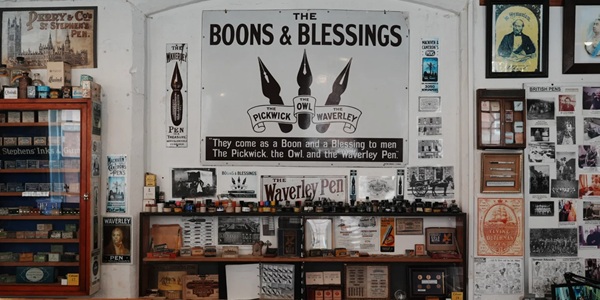
Birmingham Pen Museum nib craftsmanship exhibition and Victorian interior
Birmingham Pen Museum (The Pen Museum)
The world's largest collection of pens and nibs is breathtaking — Victorian nib presses still in operation, Dixon & Sons' gold dies alongside quills, dip pens and fountain pens spanning a thousand years of writing history, gleaming beneath the Jewellery Quarter's cast-iron dome

Birmingham Pen Museum (The Pen Museum) Half-Day In-Depth Tour

From quills to Montblanc, step inside a Victorian iron foundry, stamp your own steel nib, and feel the industrial soul of Birmingham as the 19th-century world pen capital

Duration
Half day (extendable to a full Jewellery Quarter day trip)
Main Destinations
Nib Craftsmanship Exhibition, Global Pen Collection, Calligraphy Experience Zone, Museum Shop
Suitable For
Stationery lovers, history buffs, calligraphy enthusiasts, families, industrial heritage travellers
Per Person Budget
£5-£25 (ticket £5, workshop £10-15)
01
Nib Craftsmanship & Writing History Journey
Nib Craftsmanship Exhibition · Global Pen Collection · Calligraphy Experience Zone · Museum Shop · Jewellery Quarter Stroll
Highlights

In the morning, take the metro from Birmingham New Street station to Jewellery Quarter station (approx 5 minutes), then a 2-minute walk to the Pen Museum on Frederick Street. The building itself is a surviving 1880s iron foundry — cast-iron domes, red brick walls and timber beam floors preserve the rugged character of Victorian industrial architecture. First, enter the nib craftsmanship hall to watch volunteers operate an 1890s hand-operated press, transforming brass sheets into delicate nibs step by step — the entire process is like watching a miniature ballet. Then proceed to the global pen collection hall, where the evolution of writing instruments unfolds before you: from 7th-century quills, 18th-century silver-handled dip pens, 19th-century Dixon & Sons "Eagle" brand steel nibs, to 20th-century Parker 51 and Montblanc Meisterstück 149. In the afternoon, join the calligraphy workshop, write with pens from different centuries and feel the difference in ink flow. Finally, pick up a handmade steel nib as a souvenir from the museum shop, and stroll along the Jewellery Quarter streets admiring century-old silver workshops.

Attractions
Nib Craftsmanship Exhibition & Live Stamping Demonstration (Nib Making Demonstration)
The beating heart of the museum — an 1890s hand-operated nib press still demonstrated by volunteers. Visitors can witness the entire process of a steel nib from brass sheet blanking, stamping, slitting, polishing to final quenching, each step requiring precision to a thousandth of an inch. The exhibition displays the complete production archive of Dixon & Sons: 1870s gold nib dies, royal commission steel nib samples engraved with "Victoria," and the "test paper" workers once used to check nib flexibility. Most astonishing is a micro-display — the capillary channel structure inside a nib magnified a hundred times, revealing the engineering secrets of writing smoothness that have endured for over a century. All volunteers are retired nib craftsmen, and every detail they share comes from personal experience.
Global Pen Collection & Calligraphy Experience Zone (Global Pen Collection & Calligraphy Zone)
The permanent exhibition "Evolution of Writing" uses over 5,000 artefacts to trace the complete lineage of human writing tools from the 7th century to the 21st century. Treasures include: a 7th-century Anglo-Saxon quill (made from a swan wing feather, with visible nib wear marks), an 18th-century silver-handled dip pen (handle stamped with Birmingham silversmith's mark), Dixon & Sons 1885 "Eagle" brand gilt steel nib set, and a circa 1900 nib counting machine — workers once used it to tally daily output, ringing a bell every 1,000 nibs. The calligraphy zone provides three types of tools — medieval quills, 19th-century dip pens and modern fountain pens — paired with parchment and different ink formulas, allowing visitors to freely try writing and experience the evolution of writing feel across millennia. Display cases are equipped with magnifying glasses and microscope cameras for close observation of nib iridium tip microstructure.
Birmingham Pen Trade History Exhibition (Birmingham Pen Trade History)
In the 19th century, Birmingham was the undisputed global capital of pen manufacturing — at its peak, the city had over 100 nib factories producing hundreds of millions of steel nibs annually, accounting for 75% of global output. Through factory photographs, worker badges, trade catalogues and oral history recordings, the exhibition reconstructs this forgotten industrial empire. The centrepiece is an 1891 "Nib Factory Distribution Map," densely marking every factory name and worker count in the Jewellery Quarter and surrounding areas. Another precious artefact is Dixon & Sons' 1907 export order book, documenting steel nib shipments to India, Australia, South Africa and China — confirming how Birmingham nibs travelled the globe with the British Empire. The exhibition also features interactive screens for searching the factory name and product type corresponding to each building in the historic Jewellery Quarter.
Museum Shop & "Make Your Own Nib" Workshop (Museum Shop & Make-a-Nib Workshop)
The boutique shop on the museum's ground floor sells pen-related souvenirs: handmade brass nib bookmarks (£4.50), reproduction Dixon & Sons 1880s-packaged dip pen sets (£12), silver tie pins and earrings designed after museum nib prototypes (£15-£35). The most popular offering is the "Make Your Own Nib" experience workshop — under volunteer guidance, visitors use a 1920s small press to hand-make a functional brass nib, lasting approximately 20 minutes, costing £10 (including materials and instruction), with the finished product yours to take home. The museum also publishes a series of monographs and booklets on Birmingham pen trade history, valuable resources for industrial heritage research. All shop revenue supports museum operations and collection conservation.
Practical Information
Getting There
  • Train from London Euston to Birmingham New Street: approx 1hr 20min
  • Take metro from New Street to Jewellery Quarter station: approx 5 minutes
  • Museum located on Frederick Street, 2-min walk from metro station
Tickets
  • Adult ticket: £5
  • Children (under 16): free
  • Students/seniors: £3
  • "Make Your Own Nib" workshop: £10/person (incl. materials)
  • Audio guide: free (available in Chinese & English)
Travel Tips
  • Open Tuesday to Saturday; closed Sunday and Monday
  • Advance booking recommended via official website; busy on weekends
  • Photography allowed inside; please turn off flash
  • Stamping demonstrations at 14:00 and 15:00 daily

Must-Try Eateries Near the Pen Museum

1000 Trades (Jewellery Quarter Community Café)

A 3-minute walk from the museum, this community café occupies a converted factory, retaining brick walls and cast-iron columns. Signature locally roasted pour-over coffee and homemade carrot cake, with full English breakfast on weekends. £8-£12 per person — the ideal spot for a rest before or after your museum visit.

Pushkar (Jewellery Quarter Fine Indian Dining)

A 5-minute walk away, this refined Indian restaurant blends traditional Indian spices with modern cooking techniques. Signature slow-cooked Rogan Josh lamb and smoked aubergine Bharta are stunning. Three-course tasting menu approx £35, with an extensive wine list.

The Jeweller's Arms (Jewellery Quarter Historic Pub)

A Victorian pub opened in the 1850s, preserving original mosaic tiles and brass bar. Signature handmade pie with mashed potatoes and gravy (Pie & Mash), paired with locally brewed bitter ale. £12-£18 per person — experience Birmingham's most authentic pub culture.

Peach Garden (Chinatown)

Take the metro from Jewellery Quarter to Chinatown in about 8 minutes. This family-run Cantonese restaurant serves glossy roast duck rice and wok-fried beef chow fun bursting with flavour. £15-£22 per person — the perfect choice for satisfying your taste buds after visiting the museum.

Birmingham Pen Museum (The Pen Museum) Travel Tips
Best Time to Visit
  • Open year-round (Tuesday to Saturday); weekdays recommended for quieter visits
  • Stamping demonstrations at 14:00 and 15:00 — arrive early
  • Workshop requires advance booking via official website; weekend slots limited
Must-Try Foods
  • 1000 Trades handmade coffee and cake
  • The Jeweller's Arms pie and mash + bitter ale
  • Pushkar fine Indian cuisine
  • Chinatown Cantonese dim sum and roast meats
  • Jewellery Quarter independent bakery sourdough bread
Budget Reference
  • Adult ticket: £5
  • Workshop experience: £10/person
  • Accommodation: £50-180/night (Birmingham city centre)
  • Dining: £15-40/day
  • Total: £5-25 (museum only) / £40-80 (including city)
FAQs
  • Are children free? → Yes, under 16s are completely free
  • Do I need to book? → Recommended via official website; walk-ins may need to wait
  • Can I make my own nib? → Yes, workshop £10/person, approx 20 minutes
  • How does it connect to the Jewellery Quarter? → Museum is in the JQ core area; can be combined in one trip

Explore More of Birmingham