Roman Baths Travel

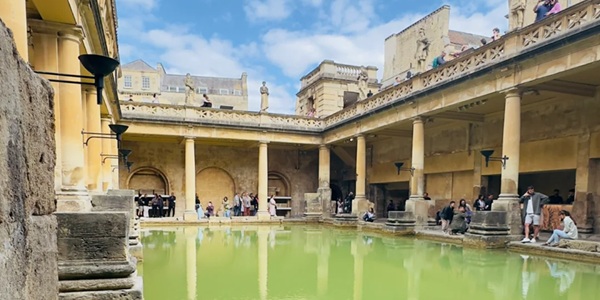
The Roman Baths in Bath — the most magnificent public bath complex built by the Roman legions in the province of Britannia during the 1st century AD, and the best-preserved ancient Roman site in Britain. The Great Bath measures 23 metres long and 10 metres wide, still filled with 46°C natural thermal water, steam swirling as if the laughter of Roman nobles from 2,000 years ago still echoes. Here you will find the famous "curse tablets," exquisite mosaic floors, and the remains of the Temple of Sulis Minerva — the core gem of this UNESCO World Heritage site. This half-day in-depth tour covers the Great Bath, museum, and temple precinct in full.

43
AD Bath Built
23m
Great Bath Length
46°C
Natural Spring Temp
2000
Years of History
Roman Baths Great Bath with millennium-old thermal water
Roman Baths, Bath
The emerald-green thermal water of the Great Bath still surges at 46°C, surrounded by Roman colonnades and statues reflected in the water, as if the bathing sounds of Roman legionaries from 2,000 years ago still echo — Britain's most awe-inspiring ancient Roman site.

Half-Day In-Depth Tour of the Roman Baths

From the millennium-old thermal waters of the Great Bath to the mysterious curse tablets of the Temple of Sulis Minerva, step into the imperial glory of Roman Britannia and feel the awe of 46°C natural thermal water still bubbling today.

Duration
Half-day (extendable to a 1-2 day Bath itinerary)
Main Destinations
Great Bath, Temple Precinct, Roman Museum, Sacred Spring, Pump Room
Suitable For
History buffs, archaeology enthusiasts, Roman culture fans, families, photography lovers
Budget per Person
£24.50-£45 (including entry + Pump Room afternoon tea)
01
Imperial Hot Springs & Echoes of a Millennium
Great Bath · Temple Precinct · Roman Museum · Sacred Spring · Pump Room
Itinerary Highlights

Start your morning by entering the Roman Baths through the entrance beside Bath Abbey. Descend the Roman-legion-laid stone steps, and the first sight to greet you is the emerald-green Great Bath — 23 metres long and 10 metres wide, still filled with 46°C natural thermal water, steam swirling as if you've travelled back to the 1st-century Roman Empire. Next, visit the remains of the Temple of Sulis Minerva, gaze up at the Gorgon's head of the goddess, and study the famous "curse tablets" inscribed with Latin wishes in the museum. Follow the underground passage to the Sacred Spring, where 9 litres of thermal water surge from deep beneath the earth every second. In the afternoon, climb to the terrace for a panoramic view of the Great Bath, and finally head to the adjacent Pump Room to taste a cup of mineral-rich thermal water (with its distinctive "eggy" flavour), completing a sensory journey across 2,000 years.

Attractions
Great Bath & Temple Precinct
Built between 43-75 AD, this was the most magnificent public bath complex in the Roman province of Britannia. The centrepiece Great Bath measures 23m long, 10m wide, and 1.6m deep, still filled with 46°C natural thermal water, its emerald surface wreathed in steam. The adjacent Temple of Sulis Minerva preserves exquisite Corinthian capitals and the Gorgon's head of the goddess — the spiritual heart of Romano-British religious life. The Great Bath appears even more mysterious and spectacular under evening lights.
Roman Museum & Curse Tablets
The museum houses over 40,000 ancient Roman artefacts. Its crown jewels are more than 130 "curse tablets" — thin sheets of lead inscribed with wishes, thrown into the sacred spring by Romans asking the goddess Sulis Minerva to punish thieves or grant desires. Also on display are exquisite Roman mosaic floors, carved sarcophagi, jewellery, and everyday utensils, vividly recreating life in Roman Britain.
Sacred Spring & Pump Room
The Sacred Spring is the soul of the Roman Baths — 9 litres of 46°C natural thermal water surge forth every second, containing over 40 minerals including iron, sulphur, and calcium, flowing without pause for 2,000 years. The Georgian-era Pump Room, built adjacent to the sacred spring in the 18th century, allows visitors to taste the mineral-rich thermal water (with its distinctive "eggy" flavour) accompanied by piano music, experiencing a ritual unchanged for two millennia. This was the social heart of Regency society as described by Jane Austen.
East Baths & Underfloor Heating
The East Baths area showcases the Romans' ingenious bath design — the complete sequence from the cold pool (Frigidarium) to the warm pool (Tepidarium) to the hot pool (Caldarium), with the underground hypocaust heating system still clearly visible. Arched brick pillars support hollow floors through which hot air passed, a brilliant example of Roman engineering. Archaeologists have also uncovered the complete Roman drainage system and lead water pipes here.
Practical Information
Transport
  • Train from London Paddington to Bath takes approx. 1.5 hours
  • Approx. 10-minute walk from Bath Spa station to the baths
  • The Roman Baths are in the city centre, within walking distance
Tickets & Admission
  • Adult ticket: £24.50 (includes audio guide)
  • Student/Senior: £22.00
  • Child (6-16): £16.00
  • Under 5: Free
  • Book in advance online for 10% discount
Travel Tips
  • Strongly recommend booking a time slot online in advance
  • Photography allowed inside (no flash)
  • Chinese-language audio guides available
  • Evening light shows require separate tickets

Must-Try Food Near the Roman Baths

The Pump Room

An elegant Regency-era restaurant adjacent to the Roman Baths, open since 1795. Enjoy a three-tier afternoon tea or full meal accompanied by live piano music, and sample the mineral-rich thermal water with its distinctive "eggy" flavour — believed by the Romans to be health-giving, and described by Jane Austen in *Northanger Abbey* as a social hub. Budget: £20-£40 per person.

Sally Lunn's Historic Eating House

A bakery housed in Bath's oldest building, dating from 1482, just a 1-minute walk from the Roman Baths. The signature Sally Lunn Bun is a large, hollow sweet bread served with sweet or savoury toppings — Bath's most iconic taste memory. The underground baking museum traces bread-making back to Roman times. Budget: £10-£20 per person.

The Raven — Classic Bath Chap Pie

One of Bath's most beloved traditional pubs, a 3-minute walk from the Roman Baths. Specialises in the local delicacy Bath Chaps (pork cheek pie), paired with Bath Ales craft beer, full of Georgian-era character. Timber-beamed ceilings and an open fireplace create a warm, authentic British pub atmosphere. Budget: £15-£30 per person.

The Regency Tea Room

Located above the Jane Austen Centre, a 5-minute walk from the Roman Baths. Faithfully recreates the tea-party atmosphere of the Regency era, with three-tier silver stands laden with finger sandwiches, scones, and rose petal jam, served by staff in empire-line dresses alongside proper Yorkshire tea. Budget: £18-£30 per person.

Roman Baths Travel Tips
Best Time to Visit
  • Spring/Summer (May-Aug): Open-air ruins at their best, evening light shows
  • Winter (Nov-Feb): Indoor museum warm and comfortable
  • Avoid midday peak crowds in July-August
Must-Try Foods
  • Pump Room thermal water afternoon tea
  • Sally Lunn's Bath bun
  • The Raven Bath chap pie
  • Local craft Bath Ales
  • Regency Tea Room three-tier afternoon tea
Budget Reference
  • Entry: £24.50 (adult with audio guide)
  • Accommodation: £80-200/night (central Bath)
  • Dining: £20-40/day
  • Transport: £30 (return train from London)
  • Total: £80-150 (half-day trip)
Frequently Asked Questions
  • Can I bathe in the springs? → No, the Roman Baths are a museum; visit Thermae Bath Spa for bathing
  • Is there a Chinese audio guide? → Yes, Chinese-language audio guides are available
  • Can I take photos? → Yes, but no flash photography
  • Do I need to book? → Strongly recommended to book a time slot online in advance

Explore More of Bath