A History of Fashion — From Blackwork to McQueen
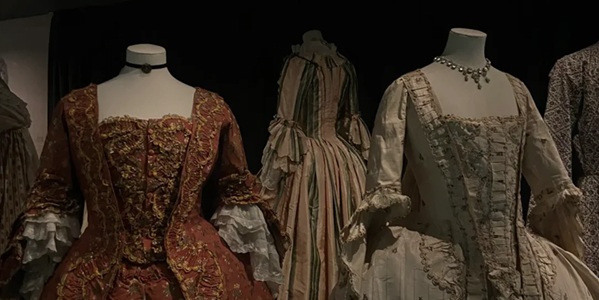
The museum's core permanent exhibition "A History of Fashion in 100 Objects" distils 400 years of fashion through 100 star pieces. The earliest exhibit is a late 16th-century Elizabethan men's shirt — embroidered with floral and insect motifs in black silk thread on linen (blackwork technique), reputedly owned by Alice L'Estrange of James I's court. The 1660s Silver Tissue Dress is an extremely rare survival from the Restoration — silver thread and silk woven into sumptuous fabric that would have glittered by candlelight, epitomising the lavish revival of Charles II's court. The 18th-century section showcases silk gowns from Bath's social golden age — a saffron yellow satin robe à la française trimmed with metallic thread brocade, with a skirt trailing over three metres; menswear is represented by a sculptural red velvet coat with turned-back cuffs. Jane Austen-era (1810s) white cotton round gowns are elegantly simple, the everyday attire of Elizabeth Bennet in Pride and Prejudice. In the Victorian section, a replica of Queen Victoria's 1840 wedding dress and various corsets demonstrate the extreme pursuit of shaping the female body. The 20th century is a visual feast: Dior's 1947 "New Look" black wool suit and skirt (donated by Dame Margot Fonteyn), 1950s Christian Dior archive pieces from his first UK exhibition, 1960s Mary Quant mini skirts and space-age dresses, 1970s Missoni knits, 1980s Katharine Hamnett slogan T-shirts, 1990s Alexander McQueen ivory silk tulle evening gown (2011 Dress of the Year), through to Bianca Saunders' 2023 printed menswear. Multilingual audio guides are available, with detailed commentary for each numbered exhibit.
Dress of the Year Gallery
The Dress of the Year is the most iconic project of the Fashion Museum since its founding in 1963 — each year a fashion authority (usually a top fashion journalist or stylist) is invited to select one garment (or ensemble) that best represents the spirit of that year's fashion, acquired together with a custom Adel Rootstein mannequin. The inaugural 1963 selection by the Fashion Writers' Association chose Mary Quant's grey wool sleeveless dress; subsequent years feature a roll call of fashion greats: 1969 Prudence Glynn chose Ossie Clark's silk chiffon trouser suit (Celia Birtwell print), 1972 Moira Keenan picked Biba's red polka dot cotton dress with knee-high boots, 1976 Kenzo Takada's Jungle Jap printed suit, 1984 Brenda Polan chose Bodymap's striped knit suit, 1985 Suzy Menkes selected Scott Crolla's velvet jacquard menswear, 2010 milliner Stephen Jones unusually chose Dior's T-shirt jacket dress, 2014 the first fashion blogger Susanna Lau (Style Bubble) made her pick, 2017 Dior's ivory silk tulle dress, 2023 Bianca Saunders' printed men's suit. The gallery is arranged chronologically, forming a miniature contemporary fashion chronicle, with mannequins, accessories and shoes perfectly recreating each year's "total look." Also features "10 Shoe Moments" — from Georgian silk shoes to Air Jordans — and a "10 Children's Fashion Looks" family tour route.
Dressing Up Area & Royal Crescent Photo
The museum's most popular interactive feature — the Dressing Up Area offers multiple replica historical costumes for visitors to try on: Victorian corseted gowns (replicas of 19th-century silk dresses and corsets), Edwardian suits, Regency-style long dresses, Georgian hats and gloves, and vintage coats from various 20th-century decades. Adults and children alike can participate with no age limit — numerous visitor reviews say "the whole family went crazy for it, even grown men loved it." After dressing up, pose for photos in front of a specially constructed Royal Crescent backdrop, creating your "time-travel portrait" against Bath's most magnificent Georgian architecture. This area is free with admission, no advance booking required — a must-do for families and couples. The museum gift shop is also worth browsing — curated fashion books, vintage-style jewellery, scarves and postcards make perfect "Bath fashion memories" souvenirs.
Assembly Rooms — Jane Austen's Ballroom
The Assembly Rooms housing the Fashion Museum are Bath's most magnificent Georgian public building — designed by architect John Wood the Younger and built between 1769-1771, originally called the "New Rooms" to distinguish them from the old Assembly Rooms in the lower town. Four principal rooms each have their own character: the 30-metre Ballroom is Bath's largest Georgian interior space, capable of hosting thousand-person dances, with five giant crystal chandeliers (bought for £80 each in 1771) illuminating the dance floor where Catherine Morland in Jane Austen's Northanger Abbey first entered society; the Tea Room with three chandeliers is the warm scene prototype where Anne Elliot reunites with her lost love in Persuasion; the Card Room for gaming and conversation; and the central Octagon with four symmetrically placed fireplaces, hung with a Gainsborough portrait of the first Master of Ceremonies, Captain William Wade. The building was severely damaged by Nazi bombing in 1942, restored and reopened in 1963, the same year the Fashion Museum moved into its basement. The Assembly Rooms also served as filming inspiration for Bridgerton and other period dramas. The Assembly Rooms are free to visit (unless closed for private weddings or events), and you can enjoy coffee and handmade cakes at the Assembly Rooms Café.