The Circus Bath Travel Guide

The Circus, Bath — John Wood the Elder's most magnificent Georgian architectural masterpiece, Britain's best-preserved Palladian circular square. With a diameter of 318 feet (97 metres), exactly matching the outer circle of Stonehenge, three curved residential blocks embrace a central lawn, with Doric, Ionic and Corinthian classical columns stacked in ascending order, and 525 mysterious reliefs of snakes, acorns, maritime and Freemason symbols adorning the frieze — none repeated. This is the Wood father-and-son's "sun-moon union" cosmic vision embodied as the Ring of the Sun, and a filming location for Bridgerton and other period dramas. Open to the public free of charge 24/7. A half-day in-depth tour includes architectural appreciation, a relief treasure hunt and a key-shaped axis walk.

1754
Construction Began
318ft
Square Diameter
525
Mysterious Reliefs
3
Stacked Orders
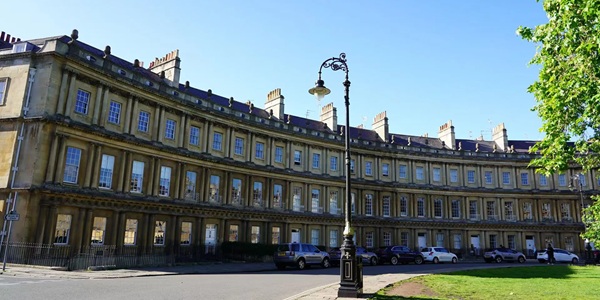
The Circus three-order curved buildings with central ancient trees
The Circus, Bath
Three curved honey-coloured limestone blocks embrace a central lawn, with Doric, Ionic and Corinthian columns stacked from bottom to top, the frieze reliefs whispering secrets of Druids and Freemasons spanning millennia — Britain's most stunning Georgian circular square

The Circus Bath Half-Day In-Depth Tour

From Doric capitals to Corinthian acorns, from 525 mysterious reliefs to the Stonehenge-matching diameter — step into John Wood's Ring of the Sun and experience the intersection of Georgian architectural mastery and Druidic legend

Duration
Half day (extendable to a 1-2 day Bath trip)
Main Destinations
Circular Façade, Frieze Reliefs, Central Lawn, Key-Shaped Axis, Gay Street
Suitable For
Architecture enthusiasts, history buffs, symbology lovers, photography enthusiasts, Bridgerton fans
Budget per Person
£0-£35 (free admission + afternoon tea nearby)
01
Ring of the Sun & Druid Code
Circular Façade · 525 Reliefs · Central Ancient Trees · Key-Shaped Axis
Highlights

Start from Bath Abbey direction in the morning and walk slowly uphill along Gay Street — this straight Georgian thoroughfare is itself a visual corridor, with the vast curved façade of The Circus gradually revealing itself in full the higher you climb. First you are struck by the perfect circle formed by three equal-length curved blocks: the robust Doric columns on the ground floor, the elegant Ionic scrolls on the middle level, and the Corinthian capitals entwined with garlands and female masks on the top floor. Approach the frieze and 525 reliefs emerge one by one — snakes, acorns, ship anchors, compasses, astrological instruments, Freemason symbols, each unique, representing John Wood the Elder's secret encoding of Druidic, Celtic and Classical civilisations. After circling the square, step into the central lawn where five giant plane trees cast dappled shadows — sit down and gaze up at the majestic curves of the three stacked orders. In the afternoon, walk along Brock Street towards the Royal Crescent, viewing from above the axis connecting "Sun" and "Moon," appreciating the Wood father-and-son's "sun-moon union" cosmology. Finally, enjoy a locally sourced lunch at a fine restaurant on Gay Street or Brock Street, completing this sensory journey of architecture and symbolism.

Attractions
The Circus Main Structure & Three-Order Façade
Construction began in 1754, designed by John Wood the Elder and completed by John Wood the Younger in 1768. Grade I listed building. Three equal-length curved honey-coloured limestone terraces form a perfect circle 318 feet (97 metres) in diameter, exactly matching the outer circle of Stonehenge — Wood deliberately replicated this dimension after personally surveying Stonehenge. The ground floor uses Doric order (robust and powerful), the middle level Ionic order (elegant volutes), and the top floor Corinthian order (florid foliage), with decoration becoming increasingly elaborate as it rises, symbolising civilisation progressing from simplicity to splendour. The three entrances are staggered so that no matter which street you enter from, you are greeted by a complete classical façade.
525 Mysterious Reliefs & Acorn Finials
The most fascinating detail of The Circus is hidden in the frieze — 525 stone reliefs, none repeated, covering subjects including snakes (wisdom and Druidism), acorns (the legend of Prince Bladud and the healing pigs), navigational instruments (Bath's memory as a Roman port), compasses and set squares (Freemason symbols), and astronomical and scientific tools. Wood was deeply influenced by Druidic culture and Freemasonry, carving these symbols into the stone to create a "code book written in stone." The pineapple-shaped finials on the roofs symbolise hospitality, while the acorn finials pay homage to Prince Bladud's pigs — legend says these pigs rolling in the warm mud cured leprosy, making Bath a city of healing.
Central Lawn & Ancient Trees
At the centre of the ring lies a circular green space approximately 40 metres in diameter, planted with five giant plane trees (London planes) — Bath's most magnificent avenue tree grouping, their canopies blocking out the sky. Each season offers different scenery: tender green in spring, deep shade in summer, golden in autumn, and bare branches tracing architectural contours like ink lines in winter. Before the 19th century this area was paved with a central reservoir, later converted to greenery. Flower beds and the surrounding carriageway serve both traffic and leisure functions, making it an excellent spot for photography, picnics and quiet contemplation. Early morning and dusk offer the best light for capturing the clearest shadow layers of the column reliefs.
Key-Shaped Layout & Royal Crescent Axis
Viewed from above, Queen Square, Gay Street and The Circus together form a giant "key" shape — a Freemason symbol deliberately embedded by Wood. The Circus represents the "Sun," while the nearby Royal Crescent represents the "Moon," connected by Brock Street to form a "sun-moon union" cosmic axis. Wood was inspired by both the Roman Colosseum and Stonehenge, but reversed the viewing direction: the Colosseum looks inward from outside, while The Circus looks outward from within, radiating the energy of public space across the entire city. A 5-minute walk along Brock Street leads to the Royal Crescent, with opportunities to admire the refined doorways of Georgian terraced houses along the way.
Practical Information
Getting There
  • Train from London Paddington to Bath: approx 1.5 hours
  • Approx 15-minute walk from Bath Spa station
  • Walk uphill along Gay Street to reach the northern entrance
  • Alternatively, 5-minute walk from Royal Crescent along Brock Street
Tickets & Prices
  • Square visit: completely free
  • Open 24 hours (public space)
  • Recommended: Bath Walking Tours guided tour from £15
  • No.1 Royal Crescent museum: £13.50 (separate ticket)
  • No reservation required, visit anytime
Travel Tips
  • Early morning or dusk offers the best light for photography
  • One full circuit takes approximately 10-15 minutes
  • Bring binoculars or a telephoto lens to examine the reliefs closely
  • Note that vehicles still use the circular carriageway
  • Look for the commemorative plaque at No.17 — Lord Gowersborough's residence

Must-Try Foods Near The Circus

The Circus Restaurant

Located at 34 Brock Street, in a Georgian townhouse midway between The Circus and the Royal Crescent, named by The Times as the 4th best "secret restaurant foodies must visit in Britain." Family-run, warm and refined, with a seasonal menu highlighting local ingredients and creative British cuisine — signature crispy pork belly burnt ends, turbot with herb sauce, roasted peach Basque cheesecake. Lunch set menu with a glass of wine is just £38, exceptional value. Average spend: £20-£35.

Pulteney Bridge Coffee Shop

Located on Pulteney Bridge, about a 5-minute walk from The Circus. Order a hot latte with a scone and sit by the window overlooking the River Avon and the three-tiered weir — the filming location for Javert's suicide leap in Les Misérables. The second-floor terrace offers views towards The Circus's Georgian skyline. Average spend: £8-£15.

The Salamander

A classic English pub just a 3-minute walk from The Circus, with timber-beamed ceilings and an open fireplace creating a cosy atmosphere. Famous for its Sunday Roast and local Bath Ales craft beer, plus live folk music nights. Pork belly burger and shepherd's pie are regular favourites. Average spend: £15-£25.

Comptoir + Cuisine

An elegant French bistro and wine bar about a 5-minute walk away. Truffle baked Camembert, French duck breast and crème brûlée are the signature trio. The wine list focuses on natural wines and small-producer champagne, with good options by the glass. The lunch menu is concise and the dinner atmosphere romantic — the perfect finish to a stroll around The Circus. Average spend: £25-£40.

The Circus Bath Travel Tips
Best Time to Visit
  • Spring-Summer (May-Aug): Ancient trees in full leaf, lawn at its greenest
  • Autumn (Sep-Oct): Plane trees turn golden, superb light and shadow
  • Early morning 8-9am: Soft light, few vehicles, ideal for photos
  • Avoid midday tourist group peak
Must-Try Foods
  • The Circus Restaurant pork belly burnt ends
  • Pulteney Bridge Coffee Shop river-view coffee
  • The Salamander Sunday Roast
  • Comptoir + Cuisine truffle Camembert
  • Local craft beer Bath Ales
Budget Reference
  • Square visit: free
  • Guided tour: £15-£20/person
  • Dining: £20-40/day
  • Transport: £30 (London return train)
  • Total: £15-£70 (half-day trip)
Frequently Asked Questions
  • Do I need a ticket? → Completely free, open 24 hours
  • Can I go inside the buildings? → Interiors are private residences, exterior viewing only
  • Is there a Chinese-language guided tour? → Recommend joining an English guided tour or bringing your own materials
  • Best photo spot? → Looking up at the façade from Gay Street, or from the centre looking up at the three stacked orders
  • Is it a Bridgerton filming location? → Yes, street scenes were filmed here

Explore More of Bath