Pulteney Bridge Travel

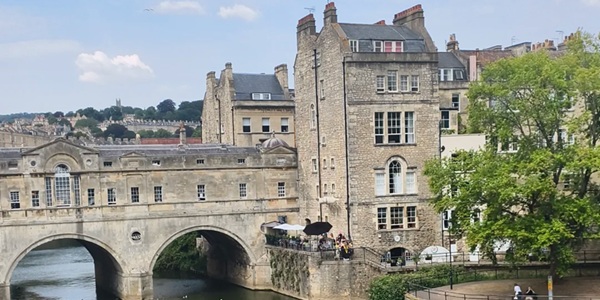
Pulteney Bridge in Bath — designed in 1774 by neoclassical master Robert Adam in the Palladian style, this stone bridge spans the River Avon and is one of only four bridges in the world lined with shops on both sides (alongside Florence's Ponte Vecchio, Venice's Rialto Bridge, and Erfurt's Krämerbrücke). At 45 meters long and 18 meters wide, its three limestone arches and lead-covered domed pavilions at each end form Bath's most iconic postcard image. The horseshoe-shaped weir below creates a three-tiered waterfall where water rushes through, famously featured as the location for Javert's suicide leap in *Les Misérables*. This half-day in-depth tour covers the bridge itself, the weir, Parade Gardens, and Great Pulteney Street.

1774
Year Built
45m
Bridge Length
4
Similar Bridges Worldwide
3
Number of Arches
Pulteney Bridge and River Avon Weir Waterfall
Pulteney Bridge, Bath
A three-arched Palladian stone bridge spanning the River Avon, lined with continuous Georgian shops. Below, the horseshoe-shaped weir cascades into a three-tiered waterfall, creating Bath's most iconic photographic scene and postcard cover.

Half-Day In-Depth Tour of Pulteney Bridge

From the Georgian shops on the Palladian stone bridge to the three-tiered waterfall of the horseshoe weir, step into Robert Adam's Georgian architectural masterpiece and feel the mist from the rushing River Avon against 200 years of timeless elegance.

Duration
Half-day (extendable to a 1-2 day Bath itinerary)
Main Destinations
Pulteney Bridge, Weir Waterfall, Parade Gardens, Great Pulteney Street, Laura Place
Suitable For
Architecture enthusiasts, photographers, Georgian culture fans, families, couples
Budget per Person
£0-£35 (bridge free, including riverside afternoon tea)
01
Georgian Stone Bridge & the Rush of the River Avon
Pulteney Bridge · Weir Waterfall · Parade Gardens · Great Pulteney Street · Laura Place
Itinerary Highlights

Start your morning from Bath Abbey, walking along Grand Parade for 5 minutes to reach the eastern end of Pulteney Bridge. You'll be immediately struck by the honey-coloured limestone Palladian facade — above the three arches are broken pediments supported by Doric pilasters, with lead-covered domed pavilions at each end resembling miniature temples. Stroll across the bridge past independent boutiques, florists, jewellery shops, and cafés. Choose a window seat overlooking the river and watch the water cascade over the weir in a three-tiered white waterfall. Then descend the stone steps to the riverside walkway for the classic low-angle shot of the bridge and shops reflected in the water. In the afternoon, cross the bridge onto Great Pulteney Street — a grand Georgian avenue 30 metres wide and 300 metres long leading directly to the Holburne Museum, flanked by uniform honey-coloured terraced houses representing Bath's most impressive urban axis. Return to Parade Gardens before sunset, enjoy an afternoon tea on the colonnaded terrace, and wait for the golden light to bathe the entire bridge.

Attractions
Pulteney Bridge Main Structure & Shops
Designed by Robert Adam and completed in 1774, this Grade I listed building is 45 metres long and 18 metres wide, constructed from local Bath honey-coloured limestone. Its Palladian facade features Doric pilasters and broken pediments, topped with lead-covered domed pavilions at each end. Both sides of the bridge are lined with independent shops — florists, antique map stores, jewellers, and cafés — making it one of only four fully-spanning, double-sided shopping bridges in the world. The bridge is restricted to buses, taxis, and pedestrians; private cars are prohibited. Many shops have cantilevered structures extending over the river, offering a superb example of 18th-century commercial and transport integration.
Pulteney Weir & River Avon
The horseshoe-shaped (V-shaped) weir downstream from the bridge is Bath's most photographed feature — three curved tiers divide the River Avon into layers of white waterfalls, thundering down with mist rising. Originally medieval in origin, the weir was rebuilt between 1968 and 1972 as a flood defence project designed by Neville Conder, incorporating radial gates to control water levels. This is the filming location for Javert's suicide leap in the 2012 film *Les Misérables*. Whether viewed from the bridge or captured from the riverside path looking up, the combination of arches, flowing water, and white spray creates a spectacular scene.
Parade Gardens & Riverside Walk
Established in 1709 as a Victorian municipal garden covering approximately 1 hectare, this is the best vantage point for panoramic views of Pulteney Bridge and the weir. The garden features a colonnaded terrace, flower beds, lawns, and a bandstand, hosting summer concerts and children's activities. Adjacent to Grand Parade, the on-site café serves sandwiches, cakes, and cream teas. From the eastern stone steps of the garden, you can descend to the riverside path, walking north along the west bank of the Avon for a low-angle view looking up at the underside of the bridge's shops and arches — widely recognised by photographers as the "classic postcard angle".
Great Pulteney Street & Laura Place
Designed by architect Thomas Baldwin and completed in 1789, Great Pulteney Street is 30 metres wide and 300 metres long, making it Bath's broadest and most magnificent Georgian avenue. The honey-coloured limestone terraces present a uniform facade, yet each building interior differs — some are private homes, others hotels — reflecting the unique 18th-century urban planning principle of "uniform facade, individual construction". The street terminates at Laura Place, marked by a central stone fountain that is a popular photo spot. Walking south along the street and crossing the bridge brings you back to Bath's old city centre, completing an axis that embodies the Pulteney family's grand vision for developing the new town.
Practical Information
Transport
  • Train from London Paddington to Bath takes approx. 1.5 hours
  • Approx. 15-minute walk from Bath Spa station to the bridge
  • Private cars prohibited on the bridge; buses/taxis allowed
  • 5-minute walk from the Roman Baths
Tickets & Admission
  • Pulteney Bridge: Free (open 24 hours)
  • Parade Gardens: Adults £2.50, Children £1.50
  • Bridge shops: Independently operated, 9:00-17:30
  • River Avon boat trips: approx. £10-15 per person
  • Holburne Museum: Free (10-min walk east of the bridge)
Travel Tips
  • Best photo time: Golden hour 1 hour before sunset
  • Afternoon sun can create backlighting; morning light illuminates the facade from the east
  • Wear comfortable shoes — cobblestone surfaces are uneven
  • Descend the stairs beside the Empire Hotel for the classic riverside angle
  • Bridge shop souvenirs tend to be premium-priced; browse but buy selectively

Must-Try Food Near Pulteney Bridge

Antica Pulteney Bridge Restaurant

A cosy Italian restaurant right next to Pulteney Bridge, specialising in fresh ingredients and traditional Italian recipes. Window seats offer views over the River Avon and the rushing weir. Signature homemade pasta and tiramisu are highly praised, making it one of the most popular dinner choices in the bridge area. Budget: £20-£35 per person.

The Pulteney Arms

A traditional British pub a 3-minute walk from Pulteney Bridge, famous for its Mushroom & Ale Pie paired with local craft beers, full of the lively atmosphere of the Georgian quarter. Featuring timber ceilings and a fireplace, it offers a warm, authentic pub experience perfect for a lunch break. Budget: £15-£25 per person.

Côte Brasserie Bath

A French brasserie located at the western end of Pulteney Bridge, inspired by the traditional brasseries of Paris, serving French classics all day — French onion soup, crêpes, and crème brûlée. Riverside seating offers views of the bridge and gardens, especially pleasant during breakfast and brunch. Budget: £18-£30 per person.

Parade Gardens Café

An open-air café inside Parade Gardens with the best viewing position of Pulteney Bridge and the weir. Serving sandwiches, cakes, and authentic clotted cream teas, you can enjoy afternoon tea on the lawn deckchairs in summer while pigeons and swans wander nearby. Budget: £10-£20 per person.

Pulteney Bridge Travel Tips
Best Time to Visit
  • Spring/Summer (May-Aug): Gardens in bloom, riverside paths at their finest
  • Sunset: Golden light illuminates the bridge facade
  • Avoid midday backlighting for photos
  • Early morning before 9am for fewer crowds and quiet photography
Must-Try Foods
  • Antica: Homemade pasta with river views
  • The Pulteney Arms: Mushroom & Ale Pie
  • Côte Brasserie: French brunch
  • Parade Gardens Café: Clotted cream tea
  • A riverside latte from a bridge café
Budget Reference
  • Bridge access: Free
  • Parade Gardens: £2.50/person
  • Meals: £15-35 per meal
  • River Avon boat trip: £10-15/person
  • Total: £0-50 (very economical for a half-day trip)
Frequently Asked Questions
  • Do I need a ticket? → No, the bridge is completely free and open 24/7
  • Can I drive across the bridge? → No, only buses/taxis/pedestrians
  • Best photo spot? → Parade Gardens or the riverside path looking up
  • Are the bridge shops worth visiting? → Interesting independent boutiques, but souvenirs can be pricey
  • Wheelchair accessible? → The bridge road level is fully accessible

Explore More of Bath