St Anne's Cathedral Travel Guide

St Anne's Cathedral, also known as Belfast Cathedral, is the most magnificent religious building and artistic treasure in the capital of Northern Ireland. The foundation stone was laid in 1899, designed by Belfast architects Sir Thomas Drew and W.H. Lynn in the Romanesque Revival style, taking nearly a century to complete — the nave was consecrated and opened in 1904, the west façade finished in 1927, the Chapel of the Holy Spirit completed in 1932, the north and south transepts built in 1974 and 1981 respectively, and the iconic Spire of Hope added in 2007. The entire building stands on soft clay, supported by piles driven 50 feet deep beneath every wall and column, unable to bear the weight of a stone tower — hence the 40-metre stainless steel spire piercing through the roof, shining like a city lighthouse at night. Inside, semicircular arches, rugged stone columns and clerestory windows create a solemn, grand Romanesque space; 150,000 Italian glass tesserae form the Genesis mosaic dome, the Good Samaritan stained-glass window, the handcrafted St Patrick's Voyage mosaic by the Martin sisters, Lord Carson's solitary tomb, and the Titanic Pall embroidered for the 1,517 victims of the Titanic — every detail a profound dialogue of faith, history and art. This is the soul of Belfast's Cathedral Quarter and the spiritual epitome of the city's journey from industrial glory to peaceful coexistence.

1899
Foundation Laid
£5
Adult Ticket (incl. Guidebook)
40m
Spire of Hope Height
150,000
Mosaic Glass Pieces
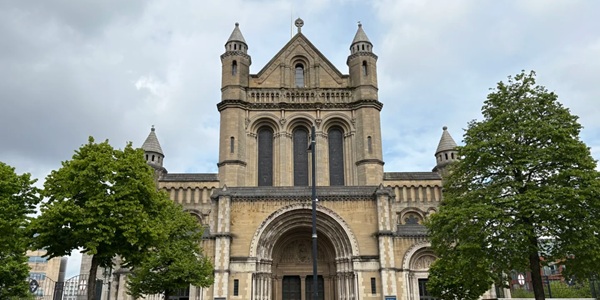
St Anne's Cathedral Romanesque façade and Spire of Hope
St Anne's Cathedral
Romanesque Revival stone façade stands at the heart of Donegall Street, the 40-metre stainless steel Spire of Hope piercing through the roof into the sky, shining like a city lighthouse at night; inside, semicircular arches and rugged stone columns create a solemn, grand Romanesque space — the spiritual landmark of Belfast's Cathedral Quarter

St Anne's Cathedral One-Day In-Depth Tour

From the serene light and shadow among Romanesque columns to the brilliant night lights of the Spire of Hope, from the Genesis narrative of 150,000 mosaics to the poignant memory of the Titanic Pall — step into the spiritual heart where a century of faith and art intertwine in Belfast

Duration
1 day (extendable to a 2-3 day Belfast trip)
Main Destinations
St Anne's Cathedral, Writers' Square, Commercial Court Street Art, MAC Metropolitan Arts Centre, Duke of York Bar
Suitable For
Architecture lovers, history buffs, art pilgrims, literary travellers, families
Per Person Budget
£15-£50 (incl. guided tour + lunch + coffee)
01
Symphony of Faith, Art & Street Culture
St Anne's Cathedral Main Building · Mosaics & Titanic Pall · Writers' Square & Commercial Court · MAC Arts Centre & Duke of York Bar
Highlights

Start your morning from Donegall Street, stepping into St Anne's Cathedral. First gaze up at the west façade — completed in 1927 as a war memorial, five angel mosaics in a golden background play instruments and pray above the archway, commemorating the sons of Ulster who fell in WWI. Enter the nave, walk along the labyrinth of white and black tiles toward the altar, symbolising life's choices between righteousness and temptation. Look up at the baptistry dome — 150,000 Italian glass tesserae form the Genesis mosaic, with earth, fire, water and air spinning in golden light, God's hand reaching out from the radiance to bless. Join the guided tour at midday (£6), where an expert guide deciphers the symbolic reliefs on every column: science, linen industry, shipbuilding, agriculture, music, feminine power — a stone encyclopedia of Northern Irish society. In the afternoon, stroll to Writers' Square, where stone plaques and paving stones bear the words of 27 deceased Northern Irish writers — C.S. Lewis's Narnian dreams, Louis MacNeice's Belfast ode, John Hewitt's poetic fragments — every step a literary pilgrimage. At the square's centre stands Anto Brennan's bronze bust "No Pasarán," commemorating the 78 Northern Irish volunteers who fought in the Spanish Civil War. Then wander through Commercial Court, Belfast's most concentrated street art corridor — Dalí-esque surreal murals blend city landmarks, bronze plaques on the walls record the bustling past of blacksmiths, pottery merchants and whiskey traders. Finish the evening at the Duke of York bar with a pint of Guinness and live traditional Irish music, the perfect end to a day in the Cathedral Quarter.

Attractions
St Anne's Cathedral Main Building & Spire of Hope
The namesake of Belfast's Cathedral Quarter, a Romanesque Revival masterpiece. Foundation laid in 1899, construction took nearly a century — nave consecrated 1904, west façade completed 1927, Chapel of the Holy Spirit 1932, Spire of Hope erected 2007. The cathedral is 300 feet long with a 120-foot-high nave, six-bay basilica structure with semicircular arches and rugged stone columns creating a solemn space. Each column capital is carved with symbols of Northern Irish society: science (Archimedes, Newton, Lord Kelvin), linen industry, shipbuilding, agriculture, healing, feminine power, music. The four corner angels are Gabriel, Michael, Raphael and Uriel. The only tomb is Lord Carson's granite monolith, requiring a special Act of Parliament for burial. The Spire of Hope is a 40-metre stainless steel needle piercing through a glass platform above the choir stalls, illuminated at night. Adult ticket £5 (includes multilingual guidebook), audio/guided tour £8, children free. Allow 1-2 hours.
Mosaic Art & Titanic Pall
The most breathtaking artistic treasures inside the cathedral. The baptistry dome was handcrafted by the Martin sisters (Margaret & Gertrude Martin) over seven years using 150,000 Italian glass tesserae, depicting the Genesis narrative — earth, fire, water and air spinning in golden light, God's hand reaching out from the radiance. The Chapel of the Holy Spirit dome features four angels holding a lamp, chalice, cross and scroll, with wall mosaics depicting St Patrick sailing past the Mountains of Mourne in AD 432. Five angel mosaics above the west door commemorate choristers killed in WWI. Most moving is the Titanic Pall — commissioned for the centenary of the sinking in 2012, hand-embroidered in deep blue merino felt by textile artists Helen O'Hare and Wilma Kirkpatrick of Ulster University. The central cross comprises 1,517 smaller crosses, Stars of David and crescents, each representing a victim's soul. Free entry (included in cathedral ticket), allow 30-45 minutes to appreciate.
Writers' Square & Commercial Court Street Art
Writers' Square, facing the cathedral's west façade, is an open-air museum of Belfast's literary heritage. The words of 27 deceased Northern Irish writers are engraved on stone plaques and paving stones — C.S. Lewis's Narnian dreams, Louis MacNeice's Belfast ode, John Hewitt's poetic fragments — every step a literary pilgrimage. At the centre stands Anto Brennan's bronze bust "No Pasarán," commemorating the 78 Northern Irish volunteers who joined the International Brigades in the Spanish Civil War (1936-1939). Commercial Court is Belfast's most concentrated street art corridor — the entrance features Dalí-esque surreal murals blending city landmarks, bronze plaques on the walls record the bustling past of blacksmiths, pottery merchants and whiskey traders. Hill Street's "Still Waters" giant mural and various political and cultural graffiti turn every alley into an outdoor gallery. Free entry, allow 30-60 minutes.
MAC Metropolitan Arts Centre & Duke of York Bar
MAC (Metropolitan Arts Centre) is Belfast's flagship contemporary arts venue, opened in 2012, hosting over 3,000 performances and exhibitions annually. Three galleries rotate local and international contemporary art, the theatre space stages experimental drama, dance and music, and the ground-floor MAC Café serves speciality coffee and handmade burgers. Next door, the Duke of York bar is one of Belfast's most legendary century-old taverns — walls densely hung with number plates, road signs, bottles and vintage photographs, housing an astonishing whiskey collection, with live traditional Irish music every evening. The surrounding Waring Street area also features The Dirty Onion (built 1680), The Dark Horse courtyard art square and other historic pubs. MAC free entry (special exhibitions excluded), Duke of York per person £8-15.
Practical Information
Getting There
  • Approx 10 min walk from Belfast City Hall to Cathedral Quarter
  • Multiple bus routes stop at North Street / Donegall Street
  • G1/G2 Glider to Custom House Square, 5 min walk
  • Lanyon Place / York Street train stations approx 15 min walk
  • Self-drive: park at St Anne's Square multi-storey car park
Tickets
  • Adult self-guided: £5 (includes multilingual guidebook)
  • Audio/guided tour: £8 (approx 40 min)
  • Student/Senior (60+): £4
  • Child (5-12): £3; Under 16 free
  • Family ticket (2 adults + 2 children): £12
  • Chapel of the Holy Spirit prayer: free (any time)
Travel Tips
  • Best time to visit: Tuesday or Wednesday morning at 10:30 opening — quietest
  • Short midday prayer at 13:00 — experience daily devotional life
  • Sunday 15:30 Choral Evensong is a must-hear — stunning acoustics
  • Guidebook available in Chinese/Spanish/Italian/French/German
  • Cathedral may close temporarily for weddings or funerals — check website in advance

Must-Try Eateries in the Cathedral Quarter

Coppi Italian Bistro

A boutique Italian restaurant on St Anne's Square, famous for handmade pasta, fried sheep's cheese with truffle honey (£7) and daily fresh fish tapas. Menu changes with the seasons; burrata with roasted tomatoes and spicy garlic prawns are popular choices. Dark-toned, understated interiors make it ideal for dates or catching up with friends. Per person £15-25, advance booking recommended.

Established Coffee

The Cathedral Quarter's most renowned speciality coffee shop, meticulous about coffee bean origins and roasting techniques — pour-over single-origin coffees with layered aromatic profiles. Brunch menu features avocado toast, overnight oats and homemade scones — simple, unfussy, refined. Opens daily at 8:00, the perfect breakfast stop before visiting the cathedral. Per person £5-12.

Duke of York

One of Belfast's most legendary century-old taverns, walls densely hung with number plates, road signs, bottles and vintage photographs, housing an astonishing whiskey collection. Live traditional Irish music every evening, Guinness stout is the standard. Upstairs, the Yardbird restaurant serves charcoal-grilled chicken with crispy skin and tender meat, and smoked-to-perfection ribs. Per person £10-20.

MAC Café

The bright café on the ground floor of the MAC Metropolitan Arts Centre, flooded with natural light through floor-to-ceiling windows. Handmade burgers, daily soups and a good selection of desserts; coffee supplied by local roasters. The ideal rest stop during an exhibition visit. Per person £8-15, open Sundays too.

St Anne's Cathedral Travel Tips
Best Time to Visit
  • Open year-round, may close only for Christmas and special service days
  • May: Cathedral Quarter Arts Festival — best atmosphere
  • December: "Black Santa" charity fundraiser — a unique Belfast tradition
  • Tuesday/Wednesday mornings quietest, best for photos and meditation
Must-Try Foods
  • Coppi fried sheep's cheese with truffle honey
  • Established Coffee pour-over single-origin coffee
  • Duke of York Guinness stout + Yardbird charcoal chicken
  • MAC Café handmade burgers
  • Christmas season: free mulled wine & mince pies at the cathedral
Budget Reference
  • Tickets: £5-12 (depending on tour type)
  • Accommodation: £50-180/night (Cathedral Quarter boutique hotels or city centre)
  • Dining: £10-25/day
  • Transport: £0-5 (walkable from city centre)
  • Total: £15-50 (day trip)
FAQs
  • Can I explore freely? → Yes, self-guided after purchasing ticket; guided tours depart at 11:00 and 14:00 daily
  • Is there a Chinese tour? → Guidebook available in Chinese; audio guide primarily in English
  • Can I take photos? → Personal photography permitted (no flash); please keep quiet in prayer areas
  • Why does the cathedral have a spire but no bell tower? → Soft clay foundations cannot support a stone tower, replaced by lightweight stainless steel spire
  • What is the Titanic Pall? → A deep blue felt cloth made for the 2012 centenary, with 1,517 crosses representing each victim

Explore More of Belfast