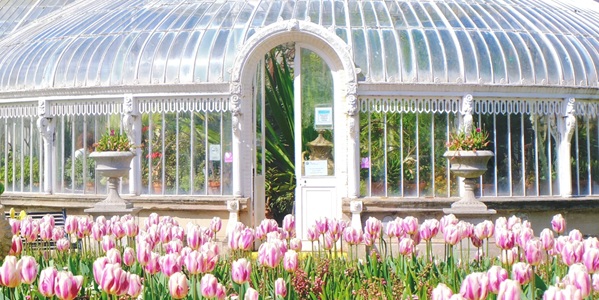
Palm House & Tropical Ravine Greenhouse
The Palm House was begun in 1839, designed by architect Charles Lanyon with its cast-iron frame built by ironmaster Richard Turner; the central 46-foot elliptical dome was completed in 1852 by Young of Edinburgh, making it one of the world's oldest surviving curved cast-iron glass structures. It comprises a central dome (planted with tall palms), a right-wing Stove Wing (bird of paradise, frangipani, bromeliads, orchids) and a left-wing Cool Wing (seasonal rotations of geraniums, fuchsias, bulbs). Adjacent is the Tropical Ravine greenhouse, built in 1889 by first superintendent Charles McKimm within a natural gorge, fully restored 2014-2018 at a cost of £3.5 million, retaining the original roof structure and Scrabo sandstone. Inside grow a 200-year-old cycad, Victoria Amazonica giant water lilies (first flowering in Ireland in 1852), a centenary banana plantation, and a central pond with tropical fish. Free entry; allow 1-1.5 hours.
Outdoor Gardens & Rose Garden
The Botanic Gardens cover 28 acres and feature Ireland's longest herbaceous border — 2,000 square metres of spring and summer borders stretching continuously, the garden's most spectacular photo backdrop. The circular Rose Garden, built in 1932, has each bed planted with a single variety, with the Sam McCready rose being the most famous; summer colours and fragrances are intoxicating. The Alpine Garden showcases succulents and alpine flowers; giant bird feeders attract kingfishers, robins and tits; mature Southern Hemisphere rare trees (such as hornbeam-leaved oaks planted in the 1880s) dot the lawns. The gardens also contain sculptures, a bandstand and a children's playground. Free entry; allow 45 minutes to 1 hour.
Queen's University & Naughton Gallery
Queen's University Belfast was founded in 1845, Northern Ireland's largest higher education institution, counting Nobel laureate Seamus Heaney among its alumni. The campus centrepiece, Lanyon Building, designed by Charles Lanyon in Gothic Revival style with red brick spires and arcades, is one of Belfast's most photogenic buildings. The ground-floor hall displays over 40 historical portrait oils; the Great Hall is open to visitors. The Naughton Gallery, located on the first floor of the Lanyon Building, opened in 2001 and hosts 6 contemporary art exhibitions annually — painting, sculpture, photography and digital media — alongside the university's silverware collection (Sir Robert Hart Collection) and ceremonial maces. Winner of the Times Higher Education Award for Arts Excellence and Innovation in 2008. Free entry; allow 30-60 minutes.
Ulster Museum & Queen's Quarter Cafés
The Ulster Museum is Northern Ireland's largest museum, separated from the Botanic Gardens by only a wall. Three floors of galleries cover natural history, art and history: the ground floor brings you face to face with dinosaur fossils, giant antlers, meteorites and Ancient Egyptian mummies; the first floor showcases Irish artistic masterpieces from the Renaissance to contemporary; the third floor's "The Troubles and Beyond" gallery presents Northern Ireland's conflict history from multiple perspectives. The museum's Wynne & Pym Café overlooks the greenery of the Botanic Gardens. After exiting, stroll along Botanic Avenue, stringing together the Queen's Quarter's artsy cafés — Kaffe O's Nordic-style lattes, Clements' traditional scones, No Alibis independent bookshop (25 years, specialising in Irish literature and crime fiction, hosting regular poetry readings and concerts). Museum free entry; coffee per person £5-15.