Peace Walls & Political Murals Travel Guide

The Peace Walls of Belfast — the steel scar of the Northern Ireland Troubles, and the heaviest testament to humanity's will for reconciliation. In 1969, the British Army hastily erected corrugated iron sheets and barbed wire to quell street riots, expecting them to be dismantled within weeks. But as cycles of violence escalated, they were repeatedly raised and reinforced, still standing today between Falls Road and Shankill Road. At their highest they reach 8 metres, stretching over 34 kilometres in total length — more than 60 walls and iron gates physically separating Catholic nationalists from Protestant unionists. Yet on both sides of the walls lie the densest collection of political murals in the world — the smiling face of Republican icon Bobby Sands, Palestinian flags and a replica of Picasso's Guernica on the International Solidarity Wall, UVF memorials and Crown Corps badges on the Loyalist side — each one either an unhealed wound or an extended olive branch. Today, the Peace Walls have become Belfast's most powerful open-air museum, with black taxis carrying visitors from around the world through their midst, while the walls themselves are densely covered with peace messages from Bill Clinton, the Dalai Lama and countless ordinary people — the gates are locked every evening at dusk, but during the day someone is always writing the future on the walls.

1969
First Peace Wall Erected
34km
Total Length of Peace Walls
8m
Highest Wall Height
1998
Year Bobby Sands Mural Painted
Belfast Peace Walls political murals and signing wall
Peace Walls & Political Murals
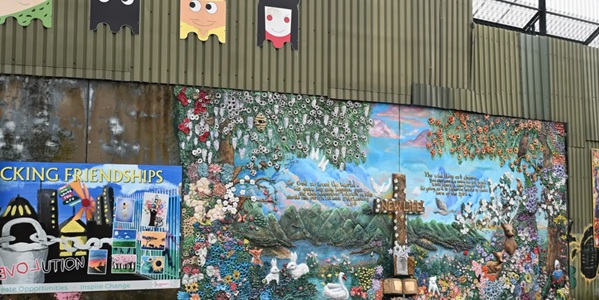
The Cupar Way Peace Wall rises 7 metres high, with corrugated iron panels stacked atop a concrete base and topped with barbed wire, the surface covered with peace messages from visitors worldwide and political murals — the heaviest monument to Northern Ireland's thirty years of conflict, and the most vibrant canvas of hope for reconciliation

Peace Walls & Political Murals One-Day In-Depth Tour

From the Republican murals of Falls Road to the Loyalist memorials of Shankill Road, from Bobby Sands' smile to Clinton's signature — walk the wounds and healing path of the Northern Ireland Troubles

Duration
Half to full day (extendable to a 2-3 day Belfast trip)
Main Destinations
Falls Road Murals, Peace Wall Signing Section, Shankill Road Murals, Cultúrlann Cultural Centre
Suitable For
History buffs, political enthusiasts, sociology students, street art lovers, documentary travellers
Per Person Budget
£15-£50 (incl. Black Taxi tour + lunch + coffee)
01
Divided City & Walls of Reconciliation
Falls Road Republican Murals · Bobby Sands Mural · Peace Wall Signing Section · Shankill Road Loyalist Murals · Black Taxi Political Tour
Highlights

Set out in the morning from the Europa Hotel near City Hall, boarding a classic black taxi driven by a local guide who lived through the Troubles for a 90-minute to 2-hour political tour. First drive into Falls Road — the heart of Catholic nationalism — where giant murals unfold one after another: on the International Solidarity Wall, a replica of Picasso's Guernica stands alongside Che Guevara, Palestinian flags intertwined with the Irish tricolour; at the Bobby Sands Mural (painted by Danny Devenney in 1998), the 27-year-old IRA volunteer who died on hunger strike smiles at every passer-by, beneath him the inscription "Our revenge shall be the laughter of our children." Then arrive at the Cupar Way Peace Wall — a 7-metre barrier of concrete and iron sheeting, densely covered with peace messages from around the world. Take the marker pen offered by your guide and leave your words beside signatures from Bill Clinton and Morgan Freeman. Pass through the peace gate into Shankill Road — the territory of Protestant unionism — where UVF (Ulster Volunteer Force) memorial murals, Crown Corps badges and crosses in the Memorial Garden silently tell another narrative. Two faiths, two histories, two sets of memory, confronting and conversing with each other across two sides of the same city. Return to the city centre in the afternoon to digest this heavy yet precious half-day in a warm Cathedral Quarter café.

Attractions
Falls Road Republican Murals & International Solidarity Wall
Falls Road is the heart of West Belfast's Catholic nationalist community, its gable walls covered with the densest concentration of Republican political murals in Northern Ireland. The International Solidarity Wall (also known as the Divis Street Wall) is the most globally-minded — a replica of Picasso's 1937 Guernica, Cuban socialist Che Guevara, American abolitionist Frederick Douglass and the Palestinian flag side by side, expressing the solidarity of Irish nationalism with oppressed peoples worldwide. The Bobby Sands Mural is located beside the Sinn Féin office (55 Falls Road), painted by renowned street artist Danny Devenney in 1998 based on Sands' smiling prison photo, inscribed with his famous words "Everyone has their own particular role to play" and "Our revenge shall be the laughter of our children." Free entry, allow 30-45 minutes.
Peace Wall Signing Section & Cupar Way Barrier
The Cupar Way section is Belfast's most famous, longest (approx 800m) and tallest (7m) peace wall, consisting of a concrete base, corrugated iron panels and barbed wire topping, separating Falls Road (south/nationalist) from Shankill Road (north/unionist). Initially a temporary corrugated iron barrier in 1969, it was repeatedly heightened and reinforced through decades of violence, and the iron gates are still locked every night. The wall surface has evolved into the world's largest open-air peace message board — Bill Clinton, the Dalai Lama and Lady Gaga are among the celebrities who have signed here; visitors can write their own peace messages freely with marker pens. This is the best place to understand both the physical and psychological division of the Northern Ireland Troubles. Free entry, allow 20-30 minutes for signing and photos. Important: ensure you are on your desired side before the gates close (approx 18:30-20:00).
Shankill Road Loyalist Murals & Memorial Garden
Shankill Road is the heart of West Belfast's Protestant unionist community, separated from Falls Road by a single wall yet belonging to a different world. The walls are covered with Loyalist murals: UVF (Ulster Volunteer Force) C Company memorial murals, Crown Corps badges, pillars commemorating Ulster volunteers killed in the 1916 Battle of the Somme, and a white cross garden for victims of the 1993 IRA bombing. Unlike the Republican "narrative of resistance," Loyalist murals focus more on themes of "loyalty," "sacrifice" and "remembrance," with the red poppy (symbol of Remembrance Day) appearing frequently. The Memorial Garden is a quiet, solemn space for reflection, listing the names of community members lost in the conflict. Free entry, allow 30 minutes.
Belfast Black Taxi Political Tour
Belfast's most iconic tourism experience — ride in a classic black taxi driven by a local guide who lived through the Troubles, traversing Falls Road, Shankill Road and the Peace Wall core zone. Each guide has first-hand memories: curfew nights, bomb scares, missing neighbours — stories that transform every mural from flat images into living, breathing history. Tours typically last 90 minutes to 2 hours, covering both Republican and Loyalist perspectives, stopping at the Peace Wall for visitors to sign, and dropping you back at your city centre hotel afterwards. Each taxi seats 4-6 people, priced at approximately £40-50 per vehicle (not per person), making it just £10-15 per person when shared — the best value in-depth guided experience. Highly recommended to book in advance — TripAdvisor rating 4.5+, 97% traveller recommendation. English-language tour only.
Practical Information
Getting There
  • 25-30 min walk from city centre to Falls Road
  • Translink Metro bus 10/11 from Chichester Street, approx 15 min journey
  • Black taxi provides hotel pickup (included in tour price)
  • Self-drive: street parking available on Shankill Road or Falls Road side
Tickets
  • Peace Walls & Murals: free entry (outdoor public space)
  • Black Taxi Tour: approx £40-50/vehicle (seats 4-6)
  • Walking tour: approx £15/person (2-2.5 hours)
  • Hop-on Hop-off bus: Peace Wall is Stop 15
  • Cultúrlann Cultural Centre: free entry
Travel Tips
  • Strongly recommend joining a guided tour — the stories behind the murals go far beyond what meets the eye
  • Best time: 10:00-12:00 for best light and fewer crowds
  • Bring a permanent marker pen to sign the Peace Wall
  • Gates close approx 18:30-20:00 — don't get locked on the wrong side
  • Photograph the walls, not the people — these murals are linked to real family trauma

Must-Try Eateries in West Belfast & Cathedral Quarter

Bia at Cultúrlann

A restaurant inside the Cultúrlann McAdam Ó Fiaich Irish Cultural Centre at 216 Falls Road, converted from a former Presbyterian church with vaulted ceilings and stained-glass windows creating a sacred and warm atmosphere. Signature wild mushroom risotto with garlic ciabatta bread (£14), slow-roasted beef with mashed potatoes and gravy (£18), and traditional Irish meat pie are all must-tries. Every Saturday 12:00-14:00 there's a free traditional Irish music jam session — eating while listening is the most authentic West Belfast experience. Per person £15-25, open until 21:00 Thursday to Saturday evenings.

Kangaroos Tie Their Own Laces Café

A family-run community café at 430 Falls Road, its name derived from an Irish saying meaning "everyone ties their own laces." Signature homemade scones with clotted cream, Full Irish breakfast (£9.50) and daily soup specials are all brimming with home-style warmth. The owner personally greets every guest, and the walls display works by local artists — the perfect rest stop during your mural walk. Per person £8-15, busiest at breakfast and brunch times.

Coppi Restaurant

A stylish Italian restaurant on St Anne's Square in the Cathedral Quarter, run by husband-and-wife team Tony and Andrea O'Neill, with thick wooden tables and white tiles creating an industrial-chic warm atmosphere. Signature feta cheese croquettes with truffle honey (£8.50), prawn linguine and the daily selection of tapas platters are stunning. The wine list is curated from Italy's finest regions — the perfect elegant dinner choice after visiting West Belfast. Per person £20-35, opens at 18:00 daily, advance booking recommended.

The Duke of York

The most historic traditional Irish pub in the Cathedral Quarter, which once employed Sinn Féin leader Gerry Adams as a barman, was bombed and rebuilt during the Troubles, its walls hung with Northern Ireland slogans, old photographs and mirrored whiskey cabinets. Live traditional music every evening, with three Irish stouts rotating — Guinness, Beamish and Murphy's. The perfect place to unwind and chat with locals after digesting a half-day of heavy history. Per person £10-18.

Peace Walls & Political Murals Travel Tips
Best Time to Visit
  • Open year-round, outdoor spaces never close
  • Summer (Jun-Aug): long daylight but crowded — start early
  • Spring/Autumn (Apr-May/Sep-Oct): soft light, fewer people — best experience
  • Avoid sensitive dates: 12 July Orange Order parades and surrounding days
Must-Try Foods
  • Bia restaurant wild mushroom risotto with garlic ciabatta
  • Kangaroos Café Full Irish breakfast
  • Coppi feta cheese croquettes with truffle honey
  • Duke of York Guinness stout with bar snacks
  • Cultúrlann Saturday traditional music lunchtime session
Budget Reference
  • Black Taxi Tour: £40-50/vehicle (shared £10-15/person)
  • Walking tour: £15/person
  • Accommodation: £60-200/night (city centre or Cathedral Quarter)
  • Dining: £15-35/day
  • Total: £15-65 (half-day to full-day trip)
FAQs
  • Is it safe? → Completely safe during the day; these communities welcome visitors genuinely interested in understanding their history
  • Do I need a guide? → Strongly recommended — the stories behind the murals go far beyond what meets the eye
  • Can I take photos? → Yes of murals, but please do not photograph residents' homes or private spaces
  • Can I sign the wall? → Yes, bring a permanent marker — it's tradition
  • Why are the walls still standing? → A 2012 poll found 69% of residents still believe the Peace Walls are necessary for safety

Explore More of Belfast