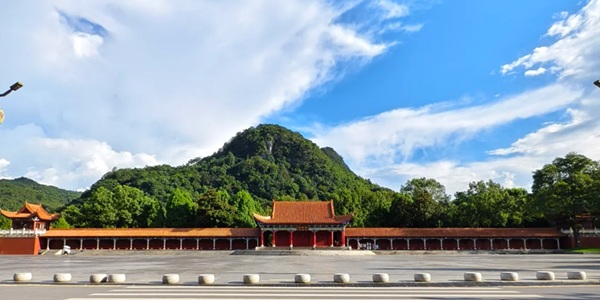
Jiuyi Mountain
A national forest park and the sacred place where Emperor Shun, the ancestor of the Chinese nation, rests. Named for its nine similar peaks, the main peak Shunyuan Peak has an altitude of 1959 meters. The mountain includes nine peaks such as Shunyuan Peak, Ehuang Peak, and Nüying Peak, with a forest coverage rate of over 95%. It is an important birthplace of Shun Emperor culture and a natural ecological tourist resort.
Shun Emperor Mausoleum
A key national cultural relic protection unit and the mausoleum of Emperor Shun, the ancestor of the Chinese nation, and one of the oldest mausoleums in China. The mausoleum is on a grand scale, with buildings such as a sacrificial square, mausoleum hall, and stele corridor. The sites where emperors of past dynasties sent officials to offer sacrifices are well preserved. It is an important place for Chinese people at home and abroad to seek roots and pay homage to their ancestors, known as the "First Mausoleum of China".
Ningyuan Confucian Temple
A key national cultural relic protection unit, first built in the Northern Song Dynasty, with existing buildings reconstructed during the Tongzhi period of the Qing Dynasty. The Confucian Temple is on a grand scale and well preserved, with buildings such as the Dacheng Hall, Lingxing Gate, and Pan Pool. Its stone carving and wood carving craftsmanship are exquisite, making it one of the largest and best-preserved Confucian temples in central South China.
Zixia Cave
A famous karst cave landscape in Jiuyi Mountain, named for the purple glow at the cave entrance when illuminated by the setting sun. The cave is fully developed with stalactites, stalagmites, stone curtains, etc., in various shapes, including landscapes such as Zixia Palace, Immortal Field, and Stone Qin. It is a typical representative of karst landforms.