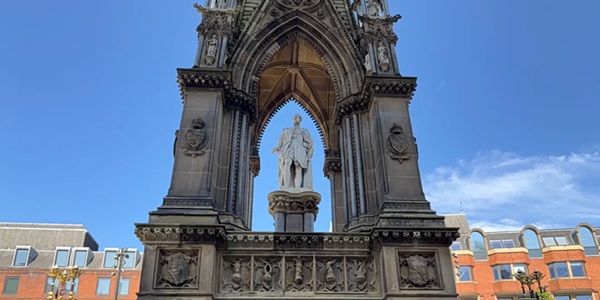
Manchester Town Hall — a Victorian Gothic Revival architectural masterpiece designed by Alfred Waterhouse, standing on the west side of Albert Square since its completion in 1877, commanding the city's skyline with its 85-metre clock tower and the chimes of "Great Abel." It is a Grade I Listed building, widely regarded as one of the finest Neo-Gothic buildings in Britain. The square is home to the Albert Memorial, statues of Gladstone, John Bright, Bishop Fraser and others — the most concentrated expression of Manchester's civic pride. Inside, the twelve Ford Madox Brown murals in the Great Hall tell the story of this cotton city's glory and struggle in Pre-Raphaelite brushstrokes. A half-day in-depth tour is enough to read all the ambition and tenderness of Victorian Manchester.
From the arched vaults of the Town Hall vestibule to the scientist statues in the Sculpture Hall, from the cotton epic of the Great Hall murals to the Gothic spire of the Albert Memorial on the square — step into the heart of Victorian Manchester
About a 10-minute walk from Manchester Piccadilly station, or take the Metrolink to St Peter's Square station and walk 2 minutes to Albert Square. We recommend arriving between 9-11am, when natural light illuminates the east-facing Town Hall facade — the best time for photographing the clock tower panorama. From the centre point of the fountain, look up at the 85-metre clock tower and the face of "Great Abel," then walk around the building's perimeter to admire Waterhouse's carefully designed asymmetrical facade and the texture of the Spinkwell sandstone beyond 14 million bricks. Enter the vestibule and follow the arcades and polished granite colonnade toward the Sculpture Hall, paying respects to the seated statues of Dalton and Joule. The twelve Ford Madox Brown murals in the Great Hall represent the pinnacle of Victorian narrative painting in Britain — from the Roman general Agricola establishing Mamucium, to the opening of the Bridgewater Canal, each panel tells Manchester's story in the intense colours of the Pre-Raphaelites. Finally, stroll across the square, reading the inscriptions on the Albert Memorial, Gladstone, Bright, Bishop Fraser and the Jubilee Fountain one by one. The entire tour takes about 2-3 hours — half a day is comfortably sufficient.
Located in the Grade II listed Memorial Hall on the south side of the square, part of the same family as Sam's Chop House — a traditional British restaurant. Low ceilings, warm lighting and wood panelling create a rich Victorian atmosphere. Recommended: Cornish crab cakes, Cheshire cheese soufflé, slow-roasted lamb and the signature corned-beef hash, paired with a Manchester bitter — as if travelling back to 1872. Average £15-£30 per person.
Right inside the Sculpture Hall beside the Town Hall vestibule, with vaulted arcades and walls lined with Gothic niches providing the "ceiling" for your afternoon tea. Serves freshly baked scones (£3.80), loose-leaf tea, sandwiches and hot soup, open Mon-Fri 09:00-16:00. Sipping Earl Grey under the gaze of Dalton and Joule is Manchester's most unique cultural pit-stop experience. Average £8-£15 per person.
A 3-minute walk from the square, this Grade II listed hotel was built in 1903 to serve railway travellers, with a magnificent Neo-Renaissance lobby. Its signature restaurant The French by Adam Reid holds AA Rosette certification. Recommended: slow-braised veal shank and Manchester's local Eccles cake with ice cream. The hotel bar is equally worth a visit, offering classic cocktails made with local gin. Average £25-£50 per person.
A lively restaurant and cocktail bar facing Albert Square, a 5-minute walk from the main shopping district. The menu focuses on Tapas sharing plates, sharing platters and juicy burgers, with signature 2-for-1 cocktails served daily. Perfect for a relaxed lunch or dinner after your visit, with large windows overlooking the greenery of the square. Average £12-£25 per person.