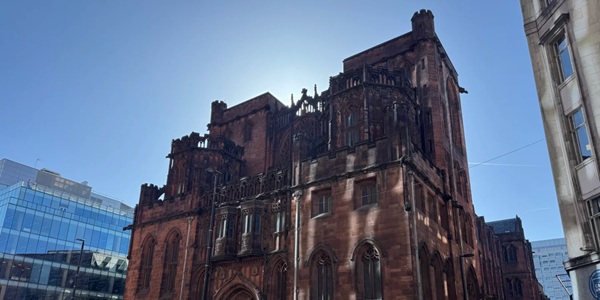
The John Rylands Library — located in the heart of Manchester's Deansgate, it is one of Europe's finest examples of Neo-Gothic architecture. Commissioned by Enriqueta Rylands, widow of textile magnate John Rylands, and designed by architect Basil Champneys over ten years (1890-1900) in memory of her deceased husband. The collection holds over 1.4 million rare books and manuscripts, including the Gutenberg Bible, the earliest surviving New Testament fragment (c. 125 AD), Shakespeare's First Folio and other priceless treasures. The soaring rib-vaulted ceiling of the Historic Reading Room, the stained glass windows and white marble statues create a cathedral-like atmosphere of solemnity, earning it the reputation as the "Cathedral of Knowledge". A half-day in-depth tour takes you through a Victorian-era scholarly sanctuary, feeling the eternal power of words and faith.
From the vaulted light and shadow of the Historic Reading Room to the parchment fragrance of the Gutenberg Bible, from the St John Gospel papyrus fragment to Shakespeare's First Folio — step into a Victorian scholarly sanctuary
A 15-minute walk from Manchester Piccadilly station to 150 Deansgate. We recommend arriving at 10am opening on a Wednesday or Thursday to avoid weekend crowds and enjoy the library's tranquility alone. Enter through the modern glass extension, cross the connecting corridor and step into the awe-inspiring Historic Reading Room — soaring rib-vaulted ceilings surge like stone waves, drawing the eye towards the enormous rose window at the far end, where stained glass portraits of 40 giants of human civilisation are depicted. Oak bookshelves line both sides filled with gilt-edged ancient texts, and under green-shaded lamps, long desks occasionally hold university students absorbed in study, as if time has frozen. Look up at the intricate stone carvings of the vaulted ceiling and feel the soul-stirring solemnity of this 'Cathedral of Knowledge'.
Day two's exploration focuses on the library's world-renowned special collections gallery. First, the Gutenberg Bible — a Latin Bible printed in 1454 using movable metal type, one of only 49 copies worldwide, of which 21 are complete. The Rylands copy is printed on vellum with hand-painted illuminated initials, truly the Holy Grail of printing history. Next comes the library's crown jewel: the 'St John Gospel Papyrus Fragment' (P52) — just 8.9 × 6 cm in size, yet recognised as the earliest surviving New Testament text, dating to around 125 AD. Then the 1623 Shakespeare First Folio, containing 36 plays, 18 of which (including Macbeth and The Tempest) survive only because of this volume. The first-floor gallery also hosts rotating themed exhibitions, from Newton's Principia Mathematica original edition to Herschel's handwritten letters announcing the discovery of Saturn's moon Enceladus — each a milestone of human civilisation.
Just a 1-minute walk from the library, this legendary Manchester establishment founded in 1867 retains its original wooden booths and brass fittings inside a Victorian red-brick building. Their signature Corned Beef Hash is featured in the official Manchester food guide, and the slow-braised lamb shank with Yorkshire pudding is equally unmissable. A living fossil of middle-class dining culture from the Industrial Revolution era. Average £12-£20 per person.
Located in the nearby Spinningfields district, the entrance features a glass pyramid reminiscent of the Louvre. The interior is minimalist in pale tones, blending Southeast Asian, Japanese and Australian cuisines — sushi, sashimi, Thai curries and Australian steaks share the stage. Afternoon tea seamlessly transitions into evening bar mode, offering one of the most design-forward dining experiences along Deansgate. Average £20-£40 per person.
Voted one of Manchester's best brunch spots by locals, just a 2-minute walk from the library. Their signature Australian-style pan-fried eggs (Shakshuka), smoked salmon bagels and handmade granola bowls are loved by tourists and students alike. The Deansgate branch is the most convenient of their three locations, with window seats overlooking the street — the perfect refuelling stop before or after your visit. Average £8-£15 per person.
A 5-minute walk to Spinningfields square, this authentic Spanish restaurant delivers bold flavours. Recommended: twice-slow-cooked lamb shoulder with pickled cherry tomatoes, Spanish paella (generous for two), and Iberico ham platter. The restaurant is elegantly appointed — even the washrooms show design flair — with an extensive Spanish wine list, making it the ideal reward for your palate after exploring the library. Average £15-£30 per person.