Glasgow Necropolis Travel

Glasgow Necropolis — Scotland's most awe-inspiring Victorian 'death garden,' built in 1833 modelled on Père Lachaise Cemetery in Paris, with 3,500 monuments cascading up the hillside overlooking the entire city. 50,000 souls rest here, including philanthropists, poets, industrial tycoons and Scottish Reformation leader John Knox. Crossing the wrought-iron 'Bridge of Sighs' enters a Gothic stone-carved forest where Alexander Thomson's classical mausoleums and Mackintosh's Celtic crosses converse in silence. The 1-day in-depth tour links Glasgow Cathedral, St Mungo Museum of Religious Life and Art, and the 1471-built Provand's Lordship — all free, making it Glasgow's most historically rich and photographically compelling day itinerary.

1833
Year Opened
3500+
Monuments
37
Acre Hillside Cemetery
£0
All Free
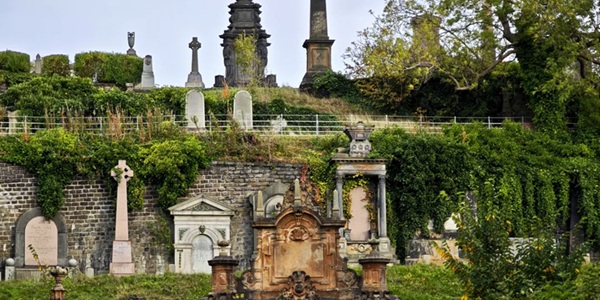
Glasgow Necropolis Victorian monuments and Bridge of Sighs panorama
Glasgow Necropolis
Built in 1833, a Victorian Gothic 'death garden' with 3,500 monuments cascading up the hillside to the foot of the John Knox statue, overlooking the Glasgow skyline — Scotland's most breathtaking open-air sculpture museum

Glasgow Necropolis 1-Day In-Depth Tour

From the cathedral's 32-metre wooden vaulted ceiling to the boundary between life and death on the Bridge of Sighs, walk through a stone-carved forest of 3,500 Victorian monuments and feel five centuries of Glasgow's faith and glory between Gothic spires and a Zen rock garden

Duration
1 day (extendable to 3-day Glasgow in-depth tour)
Main Destinations
Cathedral, St Mungo Museum, Necropolis, Provand's Lordship
Suitable For
History buffs, architecture lovers, photography enthusiasts, Gothic culture fans, film location hunters
Budget per person
£0-£30 (four major attractions all free, includes East End food)
01
Medieval Faith, Death Garden & East End Slow Living
Glasgow Cathedral · St Mungo Museum of Religious Life and Art · Glasgow Necropolis · Provand's Lordship
Highlights

In the morning, enter from the west main entrance of Glasgow Cathedral and look up at the 32-metre-high wooden fan-vaulted ceiling — one of the largest inverted wooden arches in Europe, with light streaming through pointed arch windows onto weathered stone pillars. Walk down the nave to St Mungo's crypt below, touching the 12th-century Romanesque capitals. Exit through the small door at the cathedral's east end to the cathedral square and visit St Mungo Museum of Religious Life and Art — the UK's first Zen rock garden is hidden in the museum's rear courtyard, where white sand ripples and moss-covered boulders create an Eastern tranquillity in stark contrast to the Gothic spires. Then cross the Bridge of Sighs into the Necropolis, climbing the winding path to the summit at the foot of the John Knox Monument, with a 360-degree panorama of the Glasgow skyline. In the afternoon, descend the slope to explore the 1471-built Provand's Lordship, touching Glasgow's oldest wooden beams and fireplace, finishing among the mysterious Tontine Head sculptures in St Nicholas Garden.

Attractions
Glasgow Cathedral
Founded in 1136, Scotland's only completely preserved medieval Gothic cathedral and one of the best-preserved medieval cathedrals in the UK. The highlight is the 32-metre-high wooden fan-vaulted ceiling — one of the largest inverted wooden arches in Europe, with oak rib vaults interwoven into geometric rosettes. The underground St Mungo's Crypt preserves the resting place of Glasgow's 6th-century patron saint, with Romanesque capitals and 12th-century fresco fragments that take your breath away. The cathedral also houses a finely carved Seven Deadly Sins stone pulpitum and medieval stained glass donated by the Scottish royal family. Open to tourists only from 1pm on Sundays; visit Monday to Saturday morning when morning light through the east window is most glorious. Free entry, guidebook £2.
St Mungo Museum of Religious Life and Art
Opened in 1993, one of the world's few public museums dedicated to religious life and art, built on the site of a medieval bishop's castle, with the building itself imitating the bishop's palace style. The collection spans Christianity, Islam, Hinduism, Sikhism, Buddhism and Judaism, including Hindu deities, Tibetan thangkas, African masks and Shinto ritual objects. The museum's most unique highlight is the UK's first Zen rock garden in the rear courtyard — white sand ripples surround moss-covered boulders, creating an ultimate Eastern-Western dialogue of stillness between the museum's Gothic spires. Permanent exhibitions explore the relationship between faith, life and death, gender and art, with interactive installations suitable for families. Free entry, gift shop selling Glasgow handmade crafts and religion-themed merchandise.
Glasgow Necropolis
Officially opened in 1833, a 37-acre Victorian 'death garden' modelled on Père Lachaise Cemetery in Paris, one of the earliest non-denominational landscape cemeteries in Britain. 50,000 souls rest here, with approximately 3,500 surviving monuments — from Gothic Revival spires, Egyptian obelisks to Classical Greek temple mausoleums, forming an open-air sculpture museum. The entrance 'Bridge of Sighs' was designed by David Hamilton in 1836, its cast-iron gates forged at the Glasgow Phoenix Foundry; the funeral procession crossing the bridge in tears gave it its name. At the summit stands the 1825 John Knox Monument — a 19-metre obelisk to Scotland's religious reformer, an iconic silhouette on the Glasgow skyline. The cemetery also hides a Mackintosh-designed Celtic cross (his first public commission), Alexander Thomson's classical mausoleum, and modern memorials to stillborn infants, the Korean War, and Glasgow's Victoria Cross recipients. Free entry, Friends of Glasgow Necropolis volunteers offer free guided tours (donation suggested). Batman Begins and Cloud Atlas filmed scenes here.
Provand's Lordship
Built in 1471, Glasgow's oldest domestic building and one of only four surviving medieval buildings in the city, reopened after a £1.6 million restoration. Over three centuries it served successively as a bishop's residence, inn and tavern, preserving walls 1.2 metres thick, oak beams and a 16th-century fireplace. Display rooms exhibit 17th-century Scottish furniture, silverware and royal portraits from the Burrell Collection, including portraits of James IV and Mary Queen of Scots. The rear St Nicholas Garden is lush and green, featuring the mysterious 'Tontine Heads' — four stone faces with different expressions, said to represent the joys and sorrows of medieval merchants. Free entry, the perfect finish to a Necropolis itinerary.
Practical Info
Getting There
  • From Glasgow Airport: bus 500 approx 20 min to city centre
  • Glasgow Queen Street station: 15 min walk
  • High Street station: 8 min walk
  • Bus 57 to Glebe Street stop
  • Approx 20 min walk from city centre via George Street
Tickets
  • Glasgow Cathedral: Free
  • St Mungo Museum: Free (donations welcome)
  • Glasgow Necropolis: Free
  • Provand's Lordship: Free
  • Necropolis guided tour: Free (donation £5 suggested)
Travel Tips
  • Cemetery paths are steep and slippery; wear non-slip shoes
  • Early morning light is best for photography
  • Few sheltered spots at the summit on windy days
  • Closes at 16:30 in winter; note sunset timing

Must-Eat Foods Near Glasgow Necropolis

Saint Luke's & The Winged Ox

Converted from the 1888-built St Luke's Church, retaining the original dome, stained glass and stone arches, yet transformed into Glasgow's East End trendiest gastropub and live music venue. Signature handmade burgers, charcoal-fired pizzas and local craft beers are the top choice for an afternoon break, with jazz and folk performances almost every night. Just a 5-minute walk from the Necropolis, the perfect place to unwind after your visit. Per person £12-£20.

Celentano's

Directly opposite Glasgow Cathedral and the Necropolis entrance, a family-run Italian restaurant by two brothers, using Scottish local ingredients to interpret Southern Italian home cooking. Handmade pasta, slow-braised beef lasagne and charcoal-grilled seasonal vegetables are signatures; the tiramisu dessert uses Glasgow local coffee and mascarpone. Cosy atmosphere, packed on weekends — reservations recommended. Per person £18-£28.

WEST Brewery

A German-style craft brewery inside Glasgow Green, following the 1516 German Beer Purity Law, producing IPA, wheat beer and pilsner. Food pairings focus on German sausages platter, schnitzel and currywurst, with a beer garden shaded by greenery in summer. About a 12-minute walk from the Necropolis, the perfect finish to an East End half-day tour. Per person £15-£25.

The Pot Still

Glasgow's most celebrated whisky bar, fourth-generation family-run, with shelves stocked with over 1,000 bottles of single malt, grain and blended whiskies from the Scottish Highlands, Islay, Japan, India and Taiwan. Order a 'flavour description' rather than a brand name at the bar, and the owner will perfectly match a dram for you. Pair with homemade steak pie and toasted sandwiches — the perfect contemplative finish after a Necropolis cultural tour. Per person £15-£30.

Glasgow Necropolis Travel Tips
Best Time to Visit
  • Spring/Summer (May-Aug): Lush greenery, softest morning light
  • Autumn (Sep-Oct): Golden leaves carpet the paths, maximum atmosphere
  • Winter (Nov-Mar): Frost-covered stone carvings have unique Gothic charm
  • Weekday mornings have fewest visitors, ideal for quiet photography
Must-Try Foods
  • Haggis — Scotland's national dish
  • Handmade pasta (Celentano's)
  • German sausages platter (WEST Brewery)
  • Single malt whisky tasting (The Pot Still)
  • Charcoal-fired pizza (Saint Luke's)
Budget Reference
  • Four major attraction tickets: £0 (all free)
  • Necropolis guided tour donation: £5
  • Dining: £15-30/day
  • Transport: £3-5 (subway day ticket or walking)
  • Total: £20-40 (day trip)
FAQ
  • Do I need to book? → All free, no booking required, walk in directly
  • Chinese guided tour available? → Necropolis only has English volunteer tours
  • Can I take photos? → Necropolis open for photography all day; drones prohibited
  • How to join a guided tour? → Friends of Necropolis free tours, book via website
  • Suitable for children? → Yes, but watch for steep steps and slippery surfaces

Explore More Glasgow Areas