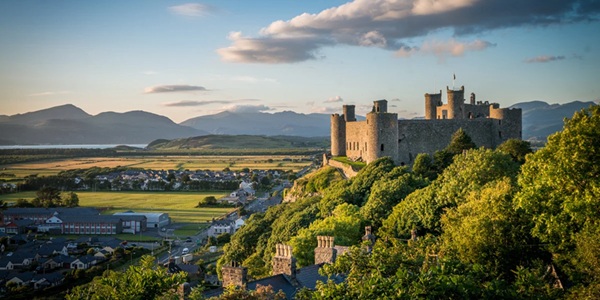
Harlech Castle (Castell Harlech) Travel

Harlech Castle (Castell Harlech) — in 1283, King Edward I of England, amidst the flames of conquering Wales, forged a "road to the sea" fortress of iron on a jutting rocky promontory for £8,190 (equivalent to tens of millions today). It stands proudly atop the Harlech Dome, with bottomless cliffs at its feet and the endless horizon of Cardigan Bay in the distance, where the waves of the Irish Sea once lapped at the end of the 127 steps leading to the castle's base. This concentric castle witnessed countless legends: the steadfast defence during Madog's rebellion of 1294, Owain Glyndŵr's capture in 1404 using it as a palace and military headquarters, and the Lancastrian army's seven-year siege from 1461 to 1468 — the longest siege in British history, giving birth to the battle song "Men of Harlech" that still echoes through the mountains and valleys of Wales. Standing atop the gatehouse, gazing at the Rhinog Mountains and the Lleyn Peninsula, you will understand why UNESCO ranks it alongside Caernarfon, Conwy and Beaumaris as "the most outstanding military architecture of the late 13th century in Europe."

1283
Year Built
7 yrs
Longest Siege
£10.90
Adult Admission
UNESCO
World Heritage
Harlech Castle Panorama
Harlech Castle (Castell Harlech)
The concentric fortress built by Edward I in 1283, perched on a cliff overlooking Cardigan Bay — the eternal stage of the Men of Harlech battle song

Harlech Castle In-Depth Tour

From the arrow loops of the D-shaped gatehouse overlooking the bottomless cliff, along the 127-step Water Gate staircase imagining medieval ship resupply, chasing the reflections of the Rhinog Mountains across four miles of golden sand — spend a day hearing Harlech's thousand-year echo from Edward I to Glyndŵr

Duration
Half Day - 1 Day
Main Destinations
Harlech Castle, Water Gate Steps, Harlech Beach, Royal St David's Golf Course
Suitable For
History lovers, military architecture enthusiasts, families, golfers, coastal walkers
Budget Per Person
£10-£50
01
A Thousand-Year Vigil on the Cliff
Harlech Castle · Water Gate & 127 Steps · Harlech Beach & Morfa Sand Dunes · Royal St David's Golf Course
Highlights

Arrive in the town of Harlech via the A496 road within Snowdonia National Park, park in the lot below the castle and walk uphill. First pass through the castle's iconic D-shaped twin-towered gatehouse — triple portcullises, heavy oak doors and arrow loops form a textbook lesson in medieval military engineering. Entering the inner ward, explore the four round towers one by one: Debtors' Tower (once containing dungeons), Mortimer Tower (named after the border lord), Bronwen Tower and Armourer's Tower, each serving different functions. Climb the wall walk for a 360° panorama: to the west, Cardigan Bay stretches to meet the sky; to the north, the Lleyn Peninsula's outline appears in ink-blue hues; to the east, the jagged Rhinog Mountains undulate. Then descend the 127 steps outside the Water Gate to the cliff base, imagining 13th-century ships docking here to deliver supplies and ammunition to the garrison. In the afternoon, walk 15 minutes to Harlech Beach — four miles of golden fine sand and the rolling dunes of Morfa Harlech Nature Reserve form a magnificent coastal tableau. In the evening, survey the 18-hole links course of the Royal St David's Golf Club from the town above, or tackle Ffordd Pen Llech — once recognised by Guinness World Records as the "steepest street in the world" — experiencing the ultimate walk on a 40% gradient.

Attractions
Harlech Castle Main Buildings (D-shaped Gatehouse · Four Round Towers · Inner Ward)
Ordered by Edward I in 1282-1289, designed by Master James of St George based on Savoyard military architecture, built from local grey-green sandstone into this concentric castle.
① D-shaped Gatehouse — The castle's most magnificent structure, two semi-circular defensive towers flanking the entrance passage, with triple iron portcullises and at least two heavy oak doors forming layered killing zones. The gatehouse interior is divided into two floors of multiple rooms, each with three large windows overlooking the inner ward, with chimney flues indicating high-status accommodation — possibly the constable's residence or VIP lodging.
② Four Round Towers — The inner ward is guarded by four large circular towers, named in 1343: Le Prisontour (Prison Tower, containing dungeons), Turris Ultra Gardinium (Tower Beyond the Garden), Le Wedercooktour (Weathercock Tower), and Le Chapeltour (Chapel Tower, later used as an artillery workshop in the 16th century). Renamed in 1564 as Debtors' Tower, Mortimer Tower, Bronwen Tower and Armourer's Tower.
③ Inner Ward Buildings — The rectangular area once contained a Great Hall, chapel, kitchens, granaries and servants' quarters, now only foundation outlines remain, but the huge stone fireplace remnants are still recognisable.
④ Architectural Details — Semi-circular door arches, window tracery, corbel turrets and putlog holes all reflect Master James of Savoy's signature style, echoing the contemporary triple-finial battlements of Conwy Castle. 2026 prices: Peak season (Jun-Aug) adult £10.90, 5-17 yrs/student £7.60, 65+ £9.80, family (2 adults + 3 children) £34.90; Off-peak (Sep-Mar) adult £10.40. Online booking receives 5% discount.
Water Gate & 127 Steps (Way to the Sea)
Harlech Castle's most unique and romantic feature — the Water Gate overlooks a 127-step stone staircase (approximately 61m elevation change) carved into the cliff, plummeting to the former coastline. In the 13th century, the Irish Sea reached the cliff base, allowing the garrison to receive food and weapons via this "sea lifeline" from supply ships, making the castle impregnable during sieges.
① Staircase Structure — Stone steps embedded in the natural rock face, with low protective walls on either side. Although the sea has receded about 800 metres making the original scene hard to imagine, descending the steps still lets you feel the hardship of medieval garrison climbing and the salty sea breeze.
② Historical Significance — These steps were key to Harlech's survival during Madog's siege of 1294-1295 and the seven-year siege of 1461-1468. Ships from the Irish Sea delivered supplies via these steps, earning the name "Way to the Sea."
③ Current Condition — The Water Gate at the top is well preserved and accessible; the steps themselves are partially weathered — descend carefully, wear non-slip shoes. Looking back at the castle from the bottom, the grey walls atop the massive rock appear as a sea fortress, offering one of the best angles for photographing the castle.
④ Coastline Changes — Since the 13th century, the Cardigan Bay coastline has retreated northwest by about 800 metres, forming today's vast beaches and dune landscapes, transforming the once-busy harbour into a tranquil coast.
Harlech Beach & Morfa Sand Dune Nature Reserve
Harlech Beach is one of the longest and most pristine golden sandy beaches on the Cardigan Bay coastline, stretching approximately four miles north and south from the town of Harlech, backed by the 540-hectare Morfa Harlech National Nature Reserve's magnificent dune system.
① Beach Experience — At low tide the beach becomes exceptionally wide, the wet sand mirroring the outlines of the Rhinog Mountains and the Lleyn Peninsula — a paradise for photographers. The beach is suitable for swimming (lifeguards in peak season), bodyboarding, kite surfing and beach cricket/frisbee. Named one of "Wales' Best Beaches" by The Times in 2025.
② Morfa Harlech National Nature Reserve — The dune system supports marram grass, sea holly, bird's-foot trefoil and moss-lichen communities. It is a nesting site for ringed plovers and oystercatchers, with skylarks, meadow pipits and stonechats singing in the meadows. During the April-July breeding season, please stick to marked paths to avoid disturbing ground-nesting birds.
③ Llandanwg Beach & St Tanwg's Church — A more secluded beach at the southern end of the bay, with an ancient church founded in the 5th century hidden in the dunes — St Tanwg's Church, considered one of Britain's oldest continuously used Christian worship sites, preserving 5th-6th century inscribed stones. Intertidal rock pools are great for children exploring nature.
④ Practical Info — Follow the western road from the town centre down to the beach car park (approx £5/day), which fills up quickly on summer weekends — arrive early. No shops on site — bring your own water and sun protection.
Royal St David's Golf Course & Ffordd Pen Llech
Harlech is not only a city of history but also a holy land of Welsh golf. Royal St David's Golf Club, founded in 1894, has remained one of the world's most challenging links courses.
① Royal St David's Golf Course — 18 holes, par 69, 6,403 yards, weaving through sand dunes with most holes offering magnificent views of Harlech Castle and the Snowdonia mountain range. The 16th hole is particularly famous, with the tee offering a panoramic view of the castle and mountains. Designed by Harold Finch-Hatton and William Henry More, the layout has remained largely unchanged for over a hundred years, ranked among the UK's Top 100 Courses by Golf Monthly. The club offers a putting green, custom club fitting and professional coaching from Stephen Doran. Visitors can pay to play (approx £50-90/round depending on season); advance tee time booking recommended.
② Ffordd Pen Llech — "World's Steepest Street" — This narrow road connecting Harlech town centre with the coastal railway station was certified by Guinness World Records as the "steepest street in the world" from 15 July 2019 to 8 April 2020, with the steepest 10-metre section reaching a gradient of 36.63% (signposted as 40%). Although the record has since been returned to Baldwin Street in New Zealand, Ffordd Pen Llech is still worth experiencing — walking uphill leaves you breathless, while descending requires careful pace control. Cyclists come from far and wide to challenge this 50-metre vertical drop.
③ Wales Coast Path — From Harlech, walk north along the coast to Barmouth (approx 27km, 8 hours), passing beaches, farmland and cliffs — one of the most magnificent sections of the Wales Coast Path.
Practical Information
Transportation
  • Train from London Euston to Harlech approx 4.5 hours
  • Change at Chester or Shrewsbury
  • Driving from Manchester approx 2.5 hours (A5→A494→A496)
  • Paid car park below the castle (approx £5/day)
  • TrawsCymru T3 bus stops in Harlech
Ticketing
  • Castle adult £10.90 (peak season Jun 1 - Aug 31)
  • Castle adult £10.40 (off-peak Sep - Mar)
  • 5-17 yrs/student £7.60, 65+ £9.80
  • Family ticket £34.90 (2 adults + 3 children)
  • Online booking 5% discount; beach/dunes/street free
Travel Tips
  • Castle on cliff top, very windy — bring windproof jacket
  • 127 steps are slippery — wear non-slip shoes
  • No shade on summer beach — bring sunscreen and water
  • Ffordd Pen Llech descent is steep — be careful
  • Welsh is the primary language; most signs are bilingual
  • No major dining inside the castle — eat in town first

Food Recommendations Around Harlech

The Plas Restaurant

A highly-rated restaurant on Harlech's High Street, with dining areas offering sweeping views of the castle, coastline and the distant Royal St David's Golf Course. Signature Seafood Platter brings together Cardigan Bay's daily catch of lobster, oysters, crab claws and smoked salmon, served with lemon and horseradish sauce; local lamb chops slow-cooked with rosemary and red wine melt in the mouth. Warm atmosphere and attentive service — the perfect reward after a castle visit or for celebrating a special occasion. Budget £18-30 per person.

Caffi Castell

A cosy café on Castle Square, directly facing the main entrance of Harlech Castle — the perfect rest stop before or after visiting the castle. The menu is full of surprises — freshly griddled Welsh Cakes, soft cinnamon rolls, and a daily-changing soup of the day served with oat bread. Sitting by the window on a rainy day, watching the castle's silhouette through the mist, adds an extra layer of medieval romance. Budget £5-12 per person.

Estuary Lodge Motel Café

A small restaurant inside the Estuary Lodge Motel in Harlech village, championing a "local or quality" ingredient philosophy. The breakfast menu is generous — Full English Breakfast (with local black pudding and bacon) and Welsh Breakfast (adding Laverbread seaweed and salted butter) are highly praised. Lunch offers homemade pies, sandwiches and fresh salads. Bedding and towel quality are surprisingly high — if planning an extra night, this is also a great value option. Budget £8-18 per person.

Harlech Tandoori

A highly rated Indian restaurant in Harlech town, with a varied menu, reasonable prices, fast and friendly service. Recommended Butter Chicken has rich sauce and tender chicken, Lamb Rogan Josh has layered spice profiles, and vegetarians can enjoy Chana Masala with plain naan. Special bonus: you can order a pint at the neighbouring Lion community pub and have Harlech Tandoori deliver your meal directly to your table — the perfect "pint with curry" combination. Budget £10-18 per person.

Harlech Castle Travel Tips
Best Time to Visit
  • May-June: Stable weather, pleasant beach and castle
  • July-August: Peak season, castle events, lifeguards on beach
  • September-October: Beautiful autumn colours, fewer visitors, good light for photography
  • Winter (Nov-Mar): Reduced castle hours, beach windy — bring windproofs
  • April-July: Sand dune breeding season — stay on marked paths
Must-Try Foods
  • Welsh Rarebit
  • Welsh Cakes
  • Laverbread
  • Cardigan Bay seafood (lobster/oysters/crab)
  • Bara Brith (fruit loaf)
Budget Reference
  • Castle ticket: £10.90
  • Beach/Dunes/Street: Free
  • Golf round: £50-90
  • Dining: £8-25
  • Transport: Train £15-40 or fuel costs
  • Total: £10-50 (excluding accommodation and golf)
Frequently Asked Questions
  • Do I need to book? → Recommended online booking for 5% discount
  • Is it wheelchair accessible? → Ground floor of gatehouse accessible; steps and towers difficult
  • Suitable for children? → Very suitable; dunes and beach are natural playgrounds
  • Can I climb the towers? → Yes, via spiral staircases
  • Is there a Chinese audio guide? → Not currently; download Cadw official app
  • Can I visit on rainy days? → Indoor exhibitions open; steps slippery when wet

Explore More Areas of Snowdonia