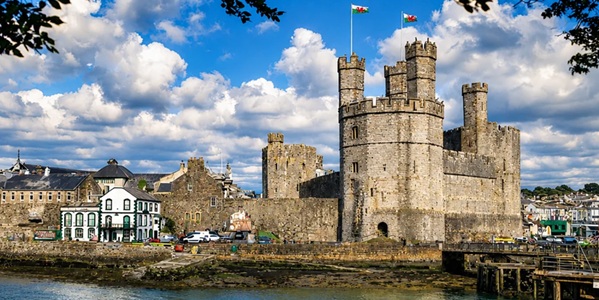
Caernarfon Castle (Castell Caernarfon) Travel

Caernarfon Castle (Castell Caernarfon) — in 1283, King Edward I of England, after conquering North Wales, raised an "imperial declaration in stone" on the banks of the River Seiont. This magnificent structure, combining both fortress and palace, took inspiration from the walls of Constantinople. With alternating bands of light and dark stone and seven polygonal towers, it proclaimed England's absolute rule over Wales. Yet history is full of irony — in 1284, Edward II was born here, forever binding the title "Prince of Wales" to this castle. The investiture of Prince Charles in 1969 made it a global focal point. Walking within walls up to 5.4 metres thick, touching the stone eagle atop Eagle Tower that has watched over the centuries for a millennium, you will feel the triple impact of medieval power, mythology and architectural beauty.

1283
Year Built
7
Polygonal Towers
£15.60
Adult Admission
UNESCO
World Heritage
Caernarfon Castle Panorama
Caernarfon Castle (Castell Caernarfon)
The magnificent fortress palace built by Edward I in 1283, a UNESCO World Heritage Site — a thousand-year legend of seven polygonal towers and banded coloured stone walls

Caernarfon Castle In-Depth Tour

From the summit of Eagle Tower overlooking the shimmering Menai Strait, from the medieval wall walk retracing Edward I's imperial ambition, from the broken walls of Segontium Roman fort tracing the footsteps of legions two thousand years ago — spend a day traversing Caernarfon's complete epic from Roman to medieval times

Duration
Half Day - 1 Day
Main Destinations
Caernarfon Castle, Medieval Town Walls, Segontium Roman Fort, Menai Strait
Suitable For
History lovers, architecture enthusiasts, families, photographers, Welsh culture explorers
Budget Per Person
£15-£50
01
A Thousand Years in One Day
Caernarfon Castle · Medieval Town Walls Walk · Segontium Roman Fort · Menai Strait & Anglesey Coast
Highlights

Take Arriva bus 5 from Bangor (approx. 30 minutes) in the early morning to reach Caernarfon, then a 5-minute walk to the castle. First climb Eagle Tower — the tallest decagonal tower in the castle. Ascend the spiral staircase to the top for a 360° view of the Seiont estuary, Menai Strait and the distant outline of Snowdon. Then walk through the labyrinthine defences of King's Gate — double drawbridges, triple portcullises, a 90-degree turning corridor — experiencing the pinnacle of medieval military engineering. In the afternoon, walk the 734-metre medieval town wall circuit, looking down from the walls onto colourful Welsh-language streets and the bustling Doc Fictoria harbour. Then walk 1.2 km to the Segontium Roman fort ruins, identifying the outlines of barracks, granaries and headquarters buildings in the open-air museum. In the evening, stroll along the Menai Strait coastal path, watching the sunset turn the strait gold, with the silhouette of Anglesey island against the horizon like an ink wash painting.

Attractions
Caernarfon Castle Main Buildings (Eagle Tower · King's Gate · Queen's Gate)
Commissioned by Edward I in 1283 and designed by Master James of St George, who took inspiration from the Theodosian Walls of Constantinople to create this architectural marvel combining fortress and palace. Seven polygonal towers connected by banded curtain walls form a figure-of-eight plan:
① Eagle Tower — The tallest building in the castle, a decagonal tower 10.5 metres in diameter with walls 5.4 metres thick. Three small turrets once topped with stone eagles (symbolising Roman imperial succession). Three floors plus basement, spiral staircase to the top, views encompassing the Menai Strait, Snowdon and Anglesey.
② King's Gate — Construction began in 1296, with triple-layer defences representing the peak of medieval military engineering: sunken drawbridge, double portcullises, 90-degree turning corridor, four guardrooms, triple arrow loops — enemies would die in the maze-like passages even if they breached the outer layer.
③ Queen's Gate — Southern secondary gate, its original approach ramp demolished, leaving the gate opening suspended in mid-air — an unsolved architectural mystery.
④ Royal Welch Fusiliers Museum — A free museum within the castle (entry with castle ticket), displaying over 300 years of history of Wales' oldest infantry regiment, from Waterloo to WWII medals, regimental colours and battlefield diaries.
⑤ Cistern Tower and Well Tower — Collecting rainwater and a 15-metre-deep stone-lined well respectively, ensuring water supply during sieges. The castle also preserves the remains of a huge stone fireplace kitchen and the foundations of a 30.5-metre-long great hall. 2026 summer prices: Adult £15.60, 5-17 years/student £10.90, 65+ £14.00, Family (2 adults + 3 children) £50.00. Online booking receives 5% discount.
Caernarfon Medieval Town Walls
Built concurrently with the castle between 1283-1292, stretching 734 metres with eight towers and two gates (East Gate and West/Water Gate) encircling the old town, forming an integral part of the UNESCO World Heritage Site "Castles and Town Walls of King Edward in Gwynedd." Most of the wall walk is accessible; a full circuit takes about 30-45 minutes on flat paved surfaces suitable for all ages. Highlights include:
① East Gate — The ancient entrance towards Bangor, with medieval iron gate hinges still visible above the arch.
② West/Water Gate — Facing the River Seiont, once a trading channel for unloading ships.
③ Porth Mawr Tower — One of the thickest wall towers; on certain days you can borrow the key from the neighbouring shop to climb it.
④ Views from the Walls — The north side overlooks the castle and docks; the south side looks over rooftops towards the distant Snowdon; the west side gazes straight at the Menai Strait and Anglesey. The walls offer the best angles for photographing the castle — especially at dusk when golden light strikes the banded stonework. Free entry. Comfortable walking shoes recommended.
Segontium Roman Fort & Museum
Established in AD 77-78 by the Roman general Agricola during his campaign to conquer the Ordovices tribe, this fort housed approximately 1,000 auxiliary troops, guarding North Wales for nearly 300 years until the end of Roman Britain in the 4th century. It is one of the best-preserved and most thoroughly excavated Roman auxiliary forts in Britain.
① Museum — Managed jointly by Cadw and the Gwynedd Archaeological Trust, displaying over 1,800 excavated artefacts: bronze helmet fragments of legionaries, iron gladius short swords, pottery sherds from Gaul and Spain, inscribed stones bearing garrison names, and religious offerings reflecting the multicultural camp life. Free admission.
② Open-Air Site — The rammed earth wall outlines, elongated barrack blocks (each housing 8 soldiers), commandant's house (praetorium), granary foundations and public bath drainage system are clearly identifiable. Walking among the grassy mounds, the grid pattern beneath your feet is the precise living layout of the Roman garrison.
③ Connection to the Castle — Stone from Segontium was later recycled by Edward I to build parts of Caernarfon Castle's walls — Rome and the Middle Ages achieved a material "dialogue" in Caernarfon. Allow 1-1.5 hours for visiting. Approximately 18 minutes walk from the castle.
Menai Strait & Anglesey Coastal Path
The Menai Strait east of Caernarfon is the narrow tidal channel separating mainland Wales from the Isle of Anglesey. Strong tidal currents create rapids and whirlpools known as the "Swellies" — both a navigational challenge and a natural wonder.
① Lôn Las Menai Coastal Path — A paved path extending east from Caernarfon harbour, winding approximately 5 km along the southern shore of the strait to the village of Y Felinheli. Flat and accessible for pushchairs and wheelchairs. Observation platforms and wooden bird hides along the way allow spotting of oystercatchers, curlews and occasional grey seals.
② Doc Fictoria Harbour — Caernarfon's vibrant hub, the starting point of the Welsh Highland Railway, where steam trains puff white smoke towards Beddgelert at the foot of Snowdon.
③ Opposite Shore — Across the strait you can clearly see the gardens and trees of Plas Newydd (the Anglesey aristocratic estate), with the distant limestone cliffs of the Great Orme appearing hazily on clear days.
④ Sunset — In the evening, the strait becomes mirror-like, reflecting the orange-purple gradient of the sky — Caernarfon's most romantic free attraction. Swellies Café and La Marina restaurant along the path offer places to rest.
Practical Information
Transportation
  • Train from London Euston to Bangor approx. 3h 20min
  • Arriva bus 5 from Bangor to Caernarfon approx. 30 min
  • Driving from Manchester approx. 2 hours (M56→A55→A487)
  • Pay car park behind the castle (approx. £5/day)
  • National Express direct coach from London to Caernarfon
Ticketing
  • Castle adult £15.60 (peak season Jun 1 - Aug 31)
  • Castle adult £14.90 (off-peak Sep - Mar)
  • 5-17 yrs/student £10.90, 65+ £14.00
  • Family ticket £50 (2 adults + 3 children)
  • Online booking 5% discount; town walls/Roman fort free
Travel Tips
  • Eagle Tower spiral staircase is steep — wear non-slip shoes
  • Wall walk has no shade — bring sunscreen and water on sunny days
  • Lift available at King's Gate (ask staff to operate)
  • Roman fort museum closed in winter — check website in advance
  • Welsh is the primary language; most signs are bilingual
  • No major dining inside the castle — eat in town first

Food Recommendations Around Caernarfon

Black Boy Inn

Caernarfon's oldest pub, founded in the Tudor period of the 16th century, with low beams, a warm fireplace and stone-walled dining room hiding centuries of stories. Signature Welsh Cawl (stew) uses local lamb and root vegetables slow-cooked, served with freshly baked oat bread; Welsh Rarebit is rich with cheese, elevated by Worcestershire sauce. The pub also serves Purple Moose local craft ales — the perfect warm refuge after walking the town walls. Budget £12-20 per person.

Palas Caffi

A creative café in a historic building in the castle district, with walls hung with works by local artists, creating a warm and artistic atmosphere. Specialising in handmade sandwiches, fresh salads and daily-changing homemade soup. The dessert counter features freshly baked Welsh Cakes — crisp on the outside, soft within, sprinkled with cinnamon sugar. Pair with a Welsh roast coffee or scone with clotted cream — the perfect recharge stop during a castle visit. Budget £5-12 per person.

Tŷ Castell

A family-run restaurant adjacent to Caernarfon Castle, with some seats offering direct views of the imposing Eagle Tower. The menu blends Welsh local ingredients with Mediterranean cooking styles — recommended Welsh lamb tagine (slow-cooked 3 hours with apricots and saffron rice) and Snowdonia salmon fillet (with lemon butter sauce and asparagus). Relaxed, friendly atmosphere with warm service — an ideal choice for families with children. Budget £15-25 per person.

The Gunroom Restaurant (Plas Dinas Country House)

An award-winning restaurant in the Plas Dinas country house on the outskirts of Caernarfon, set in an 18th-century country villa surrounded by gardens with candlelit ambience. The menu changes with the seasons, showcasing modern Welsh fine dining — spring lamb with wild garlic purée, summer sea bass with lemon curd, autumn truffle risotto. The daily afternoon tea menu (£22/person) offers three-tier finger sandwiches, scones and French pastries paired with Tregothnan Estate tea — the perfect choice for special occasions. Budget £25-45 per person.

Caernarfon Castle Travel Tips
Best Time to Visit
  • May-June: Stable weather, long daylight, best for wall walk
  • July-August: Peak season, abundant castle events, busy with visitors
  • September-October: Pleasant autumn colours, fewer visitors, good light for photography
  • Winter (Nov-Mar): Reduced castle hours, Roman fort museum closed
  • 2026 coronation anniversary events for Charles III may feature special exhibitions
Must-Try Foods
  • Welsh Rarebit
  • Cawl (Welsh stew)
  • Welsh Cakes
  • Laverbread (seaweed delicacy)
  • Bara Brith (fruit loaf)
Budget Reference
  • Castle ticket: £15.60
  • Town walls walk: Free
  • Roman fort: Free
  • Dining: £10-25
  • Transport: Bus £3-6 or fuel costs
  • Total: £15-50 (excluding accommodation)
Frequently Asked Questions
  • Do I need to book? → Recommended online booking for 5% discount
  • Is it wheelchair accessible? → Lift at King's Gate; partial accessibility
  • Suitable for children? → Very suitable; interactive exhibits available
  • Can I climb Eagle Tower? → Yes, via the spiral staircase
  • Is there a Chinese audio guide? → Not currently; download Cadw official app
  • Can I visit on rainy days? → Indoor exhibitions open; wall walk slippery when wet

Explore More Areas of Snowdonia