York Museum Gardens Travel

York Museum Gardens — a 10-acre (approximately 40,000 sq m) Victorian botanic garden in the heart of York, carefully cultivated on the site of St Mary's Abbey by the Yorkshire Philosophical Society from the 1830s onwards, and still managed by the charitable York Museums Trust. This is one of Britain's rare "millennium-strata" attractions — the land beneath your feet holds four layers of civilisation superimposed on the same patch of grass: from the AD 70 Roman Ninth Legion fortress (Eboracum), to the 1055 Benedictine St Mary's Abbey, to the completion of the Yorkshire Museum in 1835. The gardens are free to enter and receive over 1 million visitors annually, making them York's most popular public space. Core landmarks include: St Mary's Abbey Ruins — once the wealthiest monastery in northern medieval England, dissolved in 1539 under Henry VIII, leaving only Gothic arches and fragmentary walls standing proud on the lawn; the Multangular Tower — built in the 3rd century under Emperor Septimius Severus, a unique decagonal form in England, heightened in the Middle Ages with added arrow slits, still bearing visible cannonball scars from the 17th-century English Civil War; the York Observatory — completed in 1832, the oldest working observatory in Yorkshire, housing an 1850 Thomas Cooke 4-inch refracting telescope and an 1811 astronomical clock; and the Hospitium — a 14th-century monastic guesthouse, now one of York's most popular wedding venues. The gardens themselves contain over 4,500 plant species, featuring American prairie borders, an Oriental garden, butterfly borders, a fernery, rock garden and an Edible Wood, with different scenery in every season.

10
Acres
AD 70
Roman Fortress Founded
4500+
Plant Species
£0
Free Admission
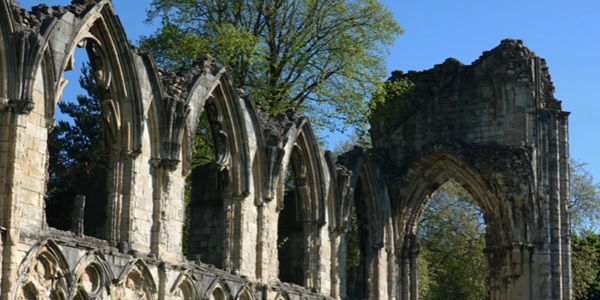
York Museum Gardens St Mary's Abbey Ruins Gothic Arch Green Lawn Ancient Roman Wall
York Museum Gardens
Gothic arches of St Mary's Abbey appear through centuries-old trees, while the decagonal stone walls of the Roman Multangular Tower silently watch over the River Ouse — one layer of earth stacking four civilisations, from the AD 70 Roman legion to the 1830s Victorian botanic garden, a millennium frozen in time.

Half-Day Stroll Through York Museum Gardens

From the stone fortifications of the Roman legion to the Gothic pointed arches of the Benedictine monks, from the exotic plants of Victorian botanical hunters to the modern telescope gazing at the stars — one meadow, two millennia of epic civilisation.

Duration
Half day (1.5-2 hour stroll + picnic, can be combined with York Minster and the Yorkshire Museum)
Main Destinations
St Mary's Abbey Ruins, Multangular Tower, Yorkshire Museum, York Observatory, Hospitium, Themed Flower Borders, Edible Wood
Suitable For
History enthusiasts, plant photographers, families, couples picnicking, joggers and dog walkers
Per Person Budget
£0-£15 (Gardens free, Museum £9.50, coffee/snacks £5-10)
01
A Millennia-Layered Time-Folded Stroll
St Mary's Abbey Ruins · Multangular Tower & Roman Walls · Yorkshire Museum · Observatory · Themed Borders & Edible Wood
Highlights

Enter the gardens from the main entrance on Museum Street (or via the side gate beside St Olave's Church on Marygate). Your first view is the imposing colonnaded facade of the Yorkshire Museum straight ahead. Turn right along the main path, and the Gothic arches of St Mary's Abbey ruins suddenly appear in the middle of the lawn — founded in 1055, this Benedictine abbey once held the most extensive landholdings in all Yorkshire. Under Henry VIII's Dissolution of the Monasteries in 1539, its stone was quarried for buildings across York, leaving only these fragmentary walls that remain profoundly moving 450 years later. Continue north to the Multangular Tower, standing at the northwest corner of the gardens — York's most complete surviving Roman structure, approximately 9 metres high, with the bottom 6 metres being 3rd-century Roman original masonry and the upper 3 metres a 13th-century medieval addition. Roman bricks are embedded in the tower, and the north face still clearly shows cannonball scars from the 17th-century English Civil War. Inside the tower are Roman sarcophagi excavated from various sites in York. Walk east along the city wall past the ruins of St Leonard's Hospital — one of the largest medieval hospitals in England, with its surviving chapel and undercroft. Returning to the garden centre, the Hospitium contrasts its timber-framed upper storey with stone lower level — the 14th-century stone base designed to resist damp from the River Ouse floods, and the 15th-century timber living quarters above, demonstrating ingenious medieval layered design. Today it is one of York's most sought-after wedding venues. On the south side, behind the York Art Gallery, you'll find the Artists' Garden — an outdoor rotating exhibition space — and the Edible Wood, planted with various edible species (please do not pick). Themed flower borders include the American Prairie (golden and blazing in autumn), the Oriental Garden (Japanese Zen blended with Chinese landscaping), the Butterfly Border (designed to attract Lepidoptera, buzzing with butterflies and bees in summer), the Fern Garden (a relic of the Victorian "Pteridomania" craze, exceptionally rich in variety), and the Rock Garden (a miniature world of succulents and alpine plants). Free guided garden tours depart at 12:00 noon every Saturday and Sunday (suggested donation £5). The observatory is open 11:30-14:30 (subject to volunteer availability). Picnics are permitted in the gardens (no alcohol, ball games or cycling), making this York's ideal afternoon retreat.

Attractions Arrangement
St Mary's Abbey Ruins & Multangular Tower
St Mary's Abbey was founded in 1055 by Earl Siward of Northumbria. At its height, it was the wealthiest Benedictine abbey in northern England, holding vast estates and manors across Yorkshire. During the Dissolution of the Monasteries under Henry VIII in 1539, the building stone was extensively reused — repairs to York Minster and expansions of townhouses across York all used stone from the abbey. The surviving Gothic arches, north transept and choir walls create an extraordinarily dramatic frame against the lawn, making this one of York's classic photo locations. The adjacent Multangular Tower was built in the 3rd century AD under Emperor Septimius Severus or Constantine the Great, with a decagonal form unique in England. The bottom 6 metres are original Roman masonry (including Roman brick courses), while the top 3 metres are a medieval addition with cruciform arrow loops. Several Roman stone coffins moved from various York sites are displayed inside the tower. The circular indentations on the north face are cannonball scars from the 1640s English Civil War, stark and tangible. Both structures are Grade I listed monuments.
Yorkshire Museum & York Observatory
The Yorkshire Museum was completed in 1835, designed by architect William Wilkins (whose other masterpieces include the National Gallery in London), with an imposing Doric colonnaded facade. Its collections span archaeology, geology and astronomy: the Viking-age York Helmet is a national treasure of Britain; the medieval jewellery and manuscripts are breathtaking; the natural history gallery features a moa skeleton and giant marine reptile fossils. Adult admission £9.50, free for York residents and Visit York Pass holders. On the lawn immediately in front of the museum stands the York Observatory — built in 1832 by renowned engineer John Smeaton, an octagonal single-storey building with a rotating conical roof, housing an 1850 4-inch refracting telescope made by local York craftsman Thomas Cooke, and an 1811 astronomical clock (once York's official time standard, running 4 minutes 20 seconds behind Greenwich Mean Time). This is also the oldest working observatory in Yorkshire. Garden tours depart at 12:00 noon every Saturday and Sunday from the museum front steps (suggested donation £5).
Hospitium & St Leonard's Hospital Ruins
The Hospitium was the guesthouse of St Mary's Abbey, accommodating pilgrims and distinguished visitors arriving from afar. The building has two distinct levels: the stone-built ground floor dates from the early 14th century (circa 1310), its stone walls effectively resisting the frequent flooding of the River Ouse; the timber-framed upper storey was built in the early 15th century as living quarters, displaying exquisite medieval craftsmanship. At the east end of the building survives a fine medieval arch — the "Watergate" — through which guests arriving by boat on the River Ouse could enter the abbey precinct directly. After the Dissolution, the building served successively as a farmhouse, warehouse and ruin. The Yorkshire Philosophical Society purchased it in 1828 and carried out the first restoration; a major renovation in 1930-31 raised the roof and replaced pointed arched windows with rectangular ones. Modern facilities were installed in 2008, and it is now leased by the York Museums Trust for weddings and corporate events, making it one of York's most popular wedding venues. Adjacent are the ruins of St Leonard's Hospital, one of medieval England's largest hospitals, with surviving chapel walls, undercroft and entrance passage, likewise destroyed by Henry VIII's Dissolution.
Themed Flower Borders & Edible Wood
Garden designer Sir John Murray Naysmith transformed this land into a Victorian temple of botany in the 1830s. Today the gardens contain over 4,500 plant species, many of them rare varieties introduced from overseas in the 19th century. The core highlights are six themed borders: the American Prairie — ablaze with gold, magenta and ochre in autumn like wildfire; the Oriental Garden — a small landscape blending Japanese Zen with Chinese water-and-stone aesthetics; the Butterfly Border — designed specifically to attract Lepidoptera, dense with butterflies and bees in summer; the Fern Garden — a relic of the Victorian "Pteridomania" fern craze, exceptionally rich in species; the Rock Garden — a miniature world of succulents and alpine plants; and the Daffodil Bank — a golden blanket covering the entire slope in spring, one of York's most healing sights. Added in the 2020s, the Edible Wood grows a variety of edible plants and fruit trees, educating visitors about food sources (please do not pick — leave the fruit for birds and the next visitor). The gardens are also home to around 40 bird species, grey squirrels and Yorkshire's emblematic insect — the Tansy beetle.
Practical Information
Transportation
  • Train from London King's Cross to York approx. 2 hours
  • Approx. 10-minute walk from York Railway Station
  • Adjacent to York Minster, approx. 5-minute walk
  • Four entrances (Museum Street main entrance most convenient)
  • Nearest public toilets at Bootham Bar (3-minute walk)
Ticket Information
  • Garden entry: Completely free
  • Yorkshire Museum: £9.50 (free for York residents)
  • Garden guided tour: Suggested donation £5/person
  • Observatory visit: Free (when volunteer present)
  • Visit York Pass holders: Free museum entry
  • Donations welcome to support garden maintenance
Travel Tips
  • Gardens are free but donations welcome (donation boxes at entrances)
  • Picnics allowed but no alcohol, ball games or cycling
  • No public toilets in gardens (accessible toilets in museum)
  • Fully wheelchair accessible (including Edible Wood and Artists' Garden)
  • Do not climb on abbey ruins or walls
  • Dogs on leads welcome
  • Ciao coffee kiosk (Museum Street entrance) open 9:00-16:00

Must-Try Foods Near York Museum Gardens

Mannetti's Artisan Deli & Cafe

Located at 5 Lendal, directly opposite the northwest corner of Museum Gardens, just a 1-minute walk away. TripAdvisor rating 4.6 (300+ reviews), one of York's most popular independent delis and cafes. All food made on site, signature dishes include bacon muffin stacks, Scotch eggs, homemade scones, cheese toasties with mushrooms, and exceptional coffee. Indoor and outdoor seating available, the ideal brunch/afternoon tea spot after exploring the gardens. Mon-Sat 10:00-15:00, Sun 10:00-16:00. Average cost £8-15.

Ciao York Coffee Kiosk

Right at the Museum Street entrance to the gardens — 0 minutes away (inside the gardens!). Open daily 9:00-16:00, serving handmade sandwiches, toasties, hot drinks and desserts. Signature items include gin & lavender and wild blackcurrant artisan gelato, award-winning hot chocolate, and goat's cheese toasties. Outdoor seating with a China Hat tent for shade and shelter. Grab a coffee and a scone to enjoy on the lawn watching the squirrels — one of York's most blissful moments. Average cost £5-10.

The Star Inn The City

Located beside the Museum Street garden entrance, close to York Minster and the River Ouse. Named after the adjacent Ye Olde Starre Inne — one of York's oldest pubs (circa 1700). The menu focuses on modern British and Yorkshire classics: Yorkshire pudding with roast beef, pan-seared sea bass, truffle fries, and raspberry cheesecake for dessert. Floor-to-ceiling windows overlook the garden greenery and the River Ouse, creating a warm and elegant atmosphere. Open 12:00-22:00, advance booking recommended. Average cost £15-28.

Baileys Cafe & Tearooms

At 7 Museum Street, directly opposite the gardens, just a 30-second walk. A family-run traditional York cafe, open Mon-Sat 8:30-18:00, Sun 9:00-18:00. Signature offerings include the Full English breakfast, homemade scones with clotted cream, assorted cakes and desserts, and steaming Yorkshire tea. Affordable prices, generous portions, a favourite haunt of York locals and children after school — full of community warmth. Average cost £6-12.

York Museum Gardens Travel Tips
Best Time to Visit
  • Spring (Mar-May): Daffodil Bank in full golden bloom, the most beautiful season
  • Summer (Jun-Aug): Prairie border at its peak, best for picnics
  • Autumn (Sep-Oct): Trees change colour, Gothic arches with red leaves stunning
  • Winter (Nov-Feb): Evergreens and bare branches create a stark beauty
  • Closed Christmas Day, Boxing Day and New Year's Day
Must-Try Foods
  • Mannetti's bacon muffin stack
  • Ciao gin & lavender gelato
  • Baileys homemade scone with clotted cream
  • The Star Inn Yorkshire pudding with roast beef
  • Garden picnic (bring your own sandwich + coffee)
Budget Reference
  • Garden entry: £0 (completely free)
  • Yorkshire Museum: £9.50 (free for York residents)
  • Lunch/Coffee: £5-15 per meal
  • Garden tour donation: £5/person
  • Total: £0-£30
Frequently Asked Questions
  • Is it really free? → Completely free, no reservation needed, just walk in
  • Can I picnic? → Yes, but no alcohol or ball games
  • Are there toilets? → No public toilets in gardens; nearest at Bootham Bar
  • Wheelchair accessible? → Full accessible pathway coverage
  • Can I bring my dog? → Yes, on a lead
  • Can I go inside the observatory? → Open 11:30-14:30 when volunteer present

Explore More of York