Museum of Free Derry Travel

The Museum of Free Derry — founded by the Bloody Sunday Trust in 2006 and rebuilt at a cost of £2.4 million in 2017, this community museum is located in Glenfada Park in the Bogside district. It is the most authentic and powerful witness to the Irish civil rights movement and the early years of the Northern Ireland conflict. Between 1969 and 1972, this working-class community declared autonomy, erected barricades, and kept police and the British Army at bay, becoming the famous "Free Derry" enclave. On 30 January 1972, the 1st Battalion Parachute Regiment shot dead 14 unarmed civil rights marchers on Rossville Street — a day forever remembered as "Bloody Sunday." The museum houses over 25,000 artefacts donated by local residents: the blood-stained clothes worn by victims on that day, Father Daly's white handkerchief, Queen's University Civil Rights Association banners, rubber bullets and CS gas canisters, and the complete archives of the Saville Inquiry — the longest and most expensive public inquiry in British history. On 15 June 2010, Prime Minister David Cameron told the House of Commons "unjustified and unjustifiable" — the families had waited 38 years. In 2024 the museum welcomed 49,063 visitors, and reached the same number in 2025, making it one of the most visited independent museums in the north of Ireland. This is not a cold display case, but a monument built by survivors and victims' families with their own hands.

2006
Year museum was founded
£10
Adult admission
25000+
Community-donated artefacts
14
Bloody Sunday victims
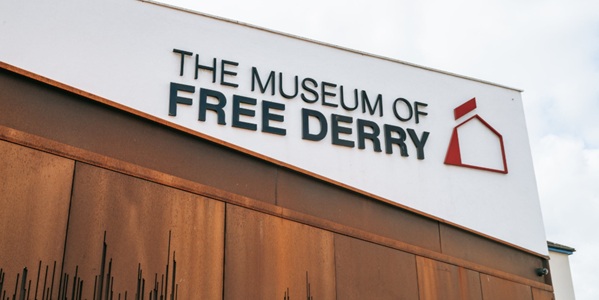
Museum of Free Derry Bogside civil rights movement and Bloody Sunday memorial
Museum of Free Derry
The "We Shall Overcome" steel sound-wave sculpture on the red exterior wall, created by artist Locky Morris, is a 30-metre stainless steel curved surface recording the soundwave of the civil rights anthem sung on Bloody Sunday — the museum itself is a monument, standing in the heart of the 1969-1972 Free Derry autonomous zone

Museum of Free Derry Half-Day In-Depth Tour

From the panoramic view of Bogside murals atop the city walls to the oral histories of victims' families inside the museum, from the "You Are Now Entering Free Derry" slogan wall to a reconciliatory walk across the Peace Bridge — step into the memory of a working-class community that was never tamed

Duration
Half day (extendable to 1-3 day Londonderry trip)
Main Destinations
City Walls Walk, Museum of Free Derry, Free Derry Corner, Bogside Murals, Peace Bridge
Suitable For
History buffs, politics enthusiasts, human rights advocates, film/TV fans, educational visits
Budget per person
£10-£55 (includes tickets + guided tour + lunch + afternoon tea)
01
Through Half a Century of Pain and Dignity
City Walls Walk & Bogside Overlook · Museum of Free Derry & Bloody Sunday · Free Derry Corner & Bogside Murals · Peace Bridge Sunset
Highlights

In the morning, ascend the city walls at Shipquay Gate and walk anticlockwise to the western section — the golden vantage point overlooking the entire Bogside district. The twelve giant murals of The People's Gallery unfold before you: The Petrol Bomber, The Death of Innocence, The Dove of Peace, spreading across the gable walls of terraced houses. Descend the walls and cross William Street into Glenfada Park, where the 30-metre steel sound-wave sculpture "We Shall Overcome" on the red exterior wall signals your destination. Inside the museum, journey from the 800-year timeline of Irish resistance through the civil rights movement and Battle of the Bogside exhibition to the core — the Bloody Sunday gallery: victims' clothing, Father Daly's white handkerchief, the bullet hole in James Wray's coat (proving he was shot from behind), and Cameron's 2010 parliamentary apology speech playing on continuous loop. Eyewitness Talks take place every Monday/Wednesday/Friday at midday, delivered by victims' families or survivors. In the afternoon, stand before the white gable wall of Free Derry Corner — "You Are Now Entering Free Derry" has remained unchanged since 1969. Walk the length of Rossville Street past all twelve murals, feeling the community's vitality at the Gasyard Féile. As evening falls, cross the Peace Bridge, looking back at the Bogside skyline from the curve where the steel towers clasp hands — a reconciliatory footnote to a heavy half-day journey.

Attractions
City Walls Walk & Bogside Overlook
Complete city walls built 1613-1618, a 1.5km diamond-shaped walkway encircling the old city. Walking anticlockwise from Shipquay Gate to the western section (Royal Bastion to Gunner's Bastion) provides the best elevated vantage point overlooking the Bogside neighbourhood and the twelve murals of The People's Gallery — the walls stand approximately 15 metres above the Bogside, making mural details clearly visible. This is the key to understanding Free Derry's geography: between 1969 and 1972, the community below erected barricades, expelled police, and established an autonomous enclave. Free 24/7 access, allow 30 minutes for the overlook and photos. Guided tours £10-15/person (90 minutes); local guides often explain the spatial logic of Bloody Sunday from this vantage point — which direction the bullets came from, how the march proceeded along Rossville Street.
Museum of Free Derry & Bloody Sunday Exhibition
Founded in 2006 by the Bloody Sunday Trust and rebuilt at a cost of £2.4m in 2017, this two-storey community museum holds a Northern Ireland Tourist Board four-star rating. Over 25,000 artefacts, the vast majority donated by local residents — the clothes worn by victims on the day (Michael Kelly's blood-stained shirt, the bullet hole in James Wray's coat), Father Edward Daly's white handkerchief waved through gunfire, Queen's University Civil Rights Association banner hung from the lead march truck, Radio Free Derry pirate radio record player, rubber bullets and CS gas canisters. The exhibition is divided into two sections: the first covers the civil rights movement, the Battle of the Bogside (August 1969), Internment and the Free Derry autonomous period; the second focuses on Bloody Sunday — the personal stories of the 14 victims (13 killed outright, one dying of wounds four months later), the 38-year struggle for the Saville Inquiry, and the full video of Cameron's 2010 parliamentary apology. Two original bullet holes are preserved on the exterior wall, and Locky Morris's 30-metre stainless steel sound-wave sculpture "We Shall Overcome" transforms the civil rights anthem's soundwave into a permanent installation. Adult £10, student £7, senior/disabled/low-income concession £8, local residents and Friends of the Bloody Sunday Trust £5, family ticket (2 adults + 2 children) £30.60 (10% discount). Self-guided visit approx 90 minutes, allow longer. Multilingual audio guides available Mon-Fri (English, French, Spanish), museum app supports 20 languages. Highly recommended: Eyewitness Talks every Wednesday and Friday at midday led by victims' families or survivors; additional sessions every Monday at 13:00 in June 2026.
Free Derry Corner & Bogside Murals
In 1969, local youths spray-painted "You Are Now Entering Free Derry" on the white gable wall at the junction of Rossville Street and Lecky Road, declaring this community a no-go zone for police and the British Army. More than 50 years later, the lettering remains clearly visible and has become a temporary canvas for social causes — marriage equality, LGBTQ+ rights, cancer care — with the wall repainted in different colours every few weeks to support various movements. Behind the gable wall lies the Bloody Sunday Memorial Garden with fourteen stars (one for each victim). Continuing along Rossville Street, the twelve murals of The People's Gallery created by the Bogside Artists form an open-air memorial — The Petrol Bomber (commemorating the Battle of the Bogside), The Death of Innocence (Bloody Sunday), The Dove Emerging from Oak Leaves, Annette McGavagin's Tribute (the 14-year-old schoolgirl, the first child killed in the conflict). Information panels beside each mural provide historical context. Free to visit, no ticket required. Highly recommended to combine with a Bogside History Walking Tour (£17/person, daily 11:00 and 13:00 departing from the Guildhall; some guides are relatives of the victims).
Peace Bridge & St Columb's Cathedral
Completed in 2011, this 312-metre S-shaped self-anchored suspension footbridge was designed by Wilkinson Eyre Architects, with two 38-metre inclined steel towers crossing mid-stream to form a "structural handshake" — symbolically linking the Catholic community on the west bank (where the Bogside lies) with the Protestant community on the east bank. An 8-minute walk from the museum via William Street leads to the west end of the bridge. Golden evening sunlight streams across the curved steel cables, and looking back at the Bogside gable walls and city walls silhouette creates the most healing moment of this half-day journey through heavy history. At the east end stands St Columb's Cathedral (built 1633, the first new cathedral in the British Isles after the Reformation), housing the 1689 siege bell and flags, with the tradition of ringing the bell at 21:00 every evening continuing for nearly 400 years. Peace Bridge free to cross; arrive half an hour before sunset for the best photos.
Practical Info
Getting There
  • Train from Belfast approx 2 hours (Translink)
  • Museum is in Glenfada Park, Bogside district
  • 8-10 minute walk from the Guildhall
  • 25-30 minute walk from train station via Peace Bridge
  • Nearest public car park: William Street Car Park
  • Lift and accessible toilet on site, fully wheelchair accessible
Tickets
  • Museum of Free Derry: £10 (adult)
  • Student: £7; Concession (senior/disabled): £8
  • Local residents/Trust Friends: £5
  • Family ticket 2+2: £30.60 (10% discount)
  • Under 12 with family: Free
  • Summer special (June-Aug every Monday): Residents free, students half price
  • City Walls/Free Derry Corner/Murals: Completely free
Travel Tips
  • Tuesday-Thursday mornings are least crowded, ideal for quiet reflection
  • Allow plenty of time — most visitors stay over 90 minutes
  • Don't rush; this is a museum that deserves to be experienced slowly
  • Staff are often relatives of those involved — feel free to ask questions
  • Recommended to pair with Bogside walking tour (£17)
  • No photography inside the museum (out of respect for victims)
  • Content may be too heavy for minors — discretion advised

Must-Eat Foods Near the Museum

The Gweedore Bar Traditional Irish Stew & Live Music

A century-old pub on Great James Street, just a 5-minute walk from the museum, the warmest gathering spot in the Bogside community. Signature slow-braised lamb with root vegetables (£12.50), fish and chips (£10.95), paired with a locally brewed stout. Traditional Irish music sessions (seisiún) start at 19:30 every evening, with standing room only on weekends. This is the best place to hear local elders talk about "back in the day" — many survivors habitually chat at the bar. Average £15-25, no reservation needed but arrive before 18:00 for a seat.

Serendipity Ulster Fry & Homemade Soda Bread

A cosy spot on Magazine Street, 8 minutes' walk from the museum. The most authentic Ulster fry — fried egg, bacon, sausage, black pudding (from Grace Hill, Antrim), white pudding, grilled tomato with homemade soda bread, a filling £9 meal. Rich coffee, relaxed atmosphere — the perfect refuel before or after visiting the museum. The owner often chats with customers about the changes in the Bogside over the years. Average £8-12, no reservation needed.

Walled City Brewery Craft Beer & Slow Cooking

UK's Best Taproom, located in the former Ebrington Barracks at the east end of the Peace Bridge, just across the bridge from the museum. 200+ craft beers paired with locally sourced slow-cooked food — Greencastle fresh fish, McAtamney's bone-in ribeye steak, beer-battered fish & chips (£13). You can also join a Beer Masterclass to brew and taste 10 different beers. Sitting on the terrace with floor-to-ceiling windows overlooking the Bogside skyline creates a unique atmosphere. Average £20-35, advance booking strongly recommended.

Java Cafe Riverside Coffee & Homemade Cake

A community café on Foyle Street, just a 6-minute walk from the museum. Signature hot chocolate with homemade scone (£4.50), smoked salmon bagel (£7.95), all cakes baked fresh daily. The walls are adorned with documentary photography of the Bogside by local photographers, and the owner is happy to recommend lesser-known corners of the community. The ideal spot for a light breakfast before the museum or an afternoon coffee break afterwards. Average £6-12, no reservation needed.

Museum of Free Derry Travel Tips
Best Time to Visit
  • Open year-round (closed 22 December - 2 January)
  • Summer (Jun-Aug): Long daylight, extra Eyewitness Talk sessions, Gasyard Féile arts festival
  • Spring/Autumn (May/Sep-Oct): Quiet with fewer visitors, best for reflective experience
  • Around 30 January: Bloody Sunday anniversary events, talks and screenings
Must-Try Foods
  • Gweedore Bar slow-braised lamb and Irish stew
  • Serendipity Ulster fry breakfast
  • Walled City Brewery craft beer
  • Java Cafe homemade scone and hot chocolate
  • Craft Village pub traditional Irish stew
Budget Reference
  • Tickets: £0-10 (walls/murals free, museum £10)
  • Guided tour: £17 (Bogside walking tour, highly recommended)
  • Accommodation: £50-120/night (boutique hotels near walls)
  • Meals: £15-35/day
  • Total: £10-55 (half-day trip very affordable)
FAQ
  • Do I need to book? → Online booking recommended, walk-ins also accepted
  • How long does the visit take? → Self-guided approx 60-90 minutes, allow longer
  • Are there Chinese-language tours? → App supports 20 languages including Chinese audio guide
  • Can I take photos? → Photography prohibited inside (respect for victims and families)
  • Wheelchair accessible? → Lift and accessible toilet throughout
  • Suitable for children? → Content involves violence and death, recommended for ages 14+
  • Relationship between museum and Bogside Murals? → Museum is the indoor core, murals are the outdoor extension, 3-minute walk apart

Explore More Londonderry Areas