Llanddwyn Island (Ynys Llanddwyn) Travel Guide

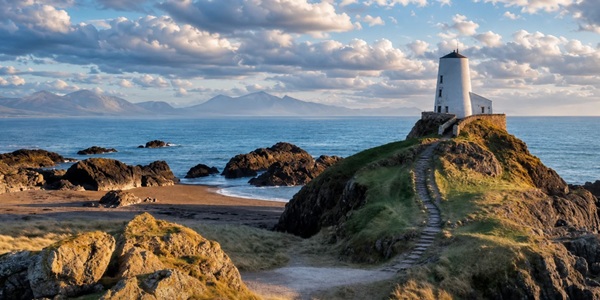
Llanddwyn Island — a tidal island off the southwest corner of Anglesey, whose Welsh name means "Island of St Dwynwen." It was the retreat and final resting place of St Dwynwen, the 5th-century Welsh patron saint of lovers. The island is crowned by the 1845 Twr Mawr Lighthouse, shaped like a fairy-tale windmill, overlooking the dramatic meeting of the Menai Strait and the Snowdonia mountain range. Here you will find 16th-century church ruins, 500-million-year-old pillow lava formations, Newborough National Nature Reserve (Wales' first coastal national nature reserve) with three miles of Blue Flag golden sand, and a precious reintroduced red squirrel population. Follow the Saint, Sand and Sea Trail through Corsican pine forest, climb to the lighthouse for a sunset view over Cardigan Bay, and feel the romance and mystery of the edge of the world as the tides rise and fall — in a single day, experience the most poetic and mysterious natural wonders and legends of the Welsh coast.

1845
Year Twr Mawr Lighthouse Built
3
Miles of Blue Flag Beach
500Myr
Pillow Lava Geological Feature
£5
All-Day Parking Fee
Panoramic view of Llanddwyn Island (Ynys Llanddwyn)
Llanddwyn Island (Ynys Llanddwyn)
Twr Mawr Lighthouse on the tidal island off southwest Anglesey — a romantic sentinel at the meeting of Snowdonia and Cardigan Bay

Llanddwyn Island In-Depth Tour

From the fairy-tale silhouette of Twr Mawr Lighthouse to the thousand-year-old legend of St Dwynwen's Church, from the nimble leaps of red squirrels in Newborough Forest to the majestic sunset over three miles of golden sand — experience the romance and wildness of southwest Anglesey in a single day.

Duration
Half day – 1 day
Main Destinations
Llanddwyn Island, Twr Mawr Lighthouse, Newborough Forest, Newborough Beach, Malltraeth Bay
Suitable For
Couples, nature lovers, hikers, photography enthusiasts, families
Budget per Person
£5 – £25
01
Lighthouse, Forest & Tidal Island
Llanddwyn Island · Twr Mawr Lighthouse · Newborough Forest · Newborough Beach · Malltraeth Bay
Highlights

Start your morning driving from Menai Bridge along the A4080 for about 30 minutes to the Newborough Forest car park (LL61 6SG). First, check the tide times at the visitor centre — this is essential for safely reaching Llanddwyn Island. Follow the Saint, Sand and Sea Trail through Corsican pine forest, stopping at the feeding station by Llyn Parc Mawr lake to quietly wait for a glimpse of rare red squirrels. Cross the boardwalk onto Newborough Beach, where three miles of golden sand stretch out before you and the snow-capped peaks of Snowdonia shimmer on the horizon. At low tide, walk about 1.5 miles southwest along the intertidal zone to reach Llanddwyn Island. First, pay your respects at the 16th-century St Dwynwen's Church ruins and the Celtic cross, then climb to the western tip of the island to Twr Mawr Lighthouse — this 10-metre white tower, built in 1845 and shaped like a windmill, is one of Wales' most photographed landmarks, offering commanding views over the entrance to the Menai Strait and the Llŷn Peninsula beyond. Explore the old pilot's cottages, the smaller Twr Bach lighthouse and the remains of St Dwynwen's Well (said to predict true love), then enjoy a picnic in one of the island's sheltered coves. In the afternoon, walk north along the beach towards Malltraeth Bay, watching oystercatchers, ringed plovers and various sandpipers feeding in the intertidal zone, and searching for the wreck of the Athena, a sailing ship that ran aground in 1852. As evening falls, return through the pine forest with the sunset silhouetting Snowdon behind you — a perfect end to the day.

Attractions
Llanddwyn Island & Twr Mawr Lighthouse (Ynys Llanddwyn & Twr Mawr)
Llanddwyn Island is a tidal island off the southwest corner of Anglesey, approximately 1.1 km long and 0.8 km wide. At low tide it can be reached on foot across the intertidal zone; at high tide it becomes a true island cut off by the sea. The island's most prominent landmark is the Twr Mawr ("Great Tower") Lighthouse, built in 1845. Standing about 10 metres tall with a white tower and conical slate roof, its shape resembles a traditional Welsh windmill. Originally used as a daymark, a light was added in 1846 using a lens manufactured in 1861. The light was deactivated in 1975, and the smaller Twr Bach tower now provides illumination. The western headland where the lighthouse stands offers the finest panoramic views of the Snowdonia mountain range (Eryri) and the Llŷn Peninsula — making it one of Wales' most photogenic locations. The island also preserves the stone wall ruins of the 16th-century St Dwynwen's Church, a Celtic cross slab, a holy well said to predict the course of true love, and a row of 19th-century pilot's cottages — these housed the pilots who guided vessels into the Menai Strait, who also doubled as the island's lifeboat crew from 1840 to 1903, saving 101 lives across 35 rescues during their 63 years of service.
Newborough Forest & Red Squirrel Reserve
Newborough Forest covers approximately 700 hectares and was planted largely with Corsican pine between 1947 and 1965, with the aim of stabilising the shifting sand dunes and protecting the village of Newborough from windblown sand. This pine forest is now Anglesey's most important habitat for red squirrels — the species came close to extinction in the 1990s due to competition from grey squirrels, with fewer than 40 individuals remaining. Following a grey squirrel eradication programme launched in 1998 and a reintroduction project from 2004 to 2007, the island's red squirrel population has recovered to around 700, and Anglesey was declared grey squirrel-free in 2016. A feeding station and information boards are located by Llyn Parc Mawr lake; sitting quietly in the early morning or late afternoon offers the chance to watch red squirrels leaping nimbly among the pine branches. The forest contains several marked trails, including the Postman's Trot (6.5 miles) and Woodland Trot (7.3 miles), passing through pinewoods, dunes and wetlands — excellent for walking and birdwatching.
Newborough Beach & Malltraeth Bay
Newborough Beach (also known as Traeth Llydan, meaning "broad beach") is a three-mile stretch of Blue Flag-awarded golden sand, backed by the dune system of Newborough Forest and facing Cardigan Bay. The gently sloping, fine-grained sand and crystal-clear water of the highest quality make it one of the most beautiful beaches in Britain. To the north (left side of the beach) there are sweeping views of the Snowdonia mountains; to the south (right side) lies the fairy-tale outline of Llanddwyn Island. The beach forms the core of the Newborough-Llanddwyn National Nature Reserve, established in 1955 as Wales' first coastal national nature reserve. The dune system contains at least four rows of parabolic dunes and damp dune slacks, which in spring and early summer are carpeted with rare orchids including early purple orchid, bee orchid and marsh helleboring. The intertidal zone and saltmarshes are important wintering grounds for migratory birds such as brent geese, wigeon, pintail, redshank and golden plover. On the Malltraeth Bay side, Penrhos Beach is more secluded and peaceful; at low tide the skeletal remains of the Athena, a sailing brig that foundered in 1852, can be seen half-buried in the sand — the ship was en route from Alexandria to Liverpool when it struck rocks in a blizzard, and all 14 crew members were rescued by the Llanddwyn Island lifeboat crew.
Penrhos Beach & Wreck of the Athena
Located on the north side of Llanddwyn Island at the edge of Malltraeth Bay, Penrhos Beach (Traeth Penrhos) is a more secluded and wild cove, backed by towering dunes and pillow lava cliffs. The sand here is equally golden, but because of its remote location requiring a walk to reach, it sees far fewer visitors than the main beach — making it ideal for those seeking absolute peace. The beach's most famous feature is the wreck of the brig Athena, which ran aground during a winter storm in 1852. The ship's skeletal frame now lies half-buried in the sand, a favourite subject for photographers, especially in the golden light of sunset when it takes on a haunting beauty. The nearby pillow lava formations were created around 500 million years ago by submarine volcanic eruptions; each bulging rock records the layered history of the ancient ocean floor, making this a must-visit spot for geology enthusiasts. From the car park at Malltraeth's embankment (the Cob), follow the flat path for about 1.5 miles to reach the beach, enjoying views of the Cefni estuary and the distant Snowdon peaks along the way.
Practical Information
Getting There
  • Train from London Euston to Bangor: approx 3.5 hours
  • Bus 42 from Bangor to Newborough village (infrequent service)
  • Drive from Menai Bridge along A4080: approx 30 minutes
  • Car strongly recommended on the island; bus services very limited
  • Nearest car park: Newborough Forest Main Beach Car Park (LL61 6SG)
Tickets & Prices
  • Llanddwyn Island: Free
  • Twr Mawr Lighthouse: Free (external viewing)
  • Newborough Forest parking: £2 for first 2 hours, then £0.40 per 20 mins, max £7/day
  • Blue Badge holders: free parking
  • Newborough Beach: Free
  • Malltraeth Embankment car park: Free
Travel Tips
  • Allow 3-4 hours (including forest walk + island exploration)
  • ⚠️ You MUST check tide times! Leave the island at least 2 hours before high tide
  • Car park fills by 10:30 on summer weekends — arrive early
  • Wear sturdy, non-slip footwear for the beach and intertidal zone
  • Strong sea breezes — bring a windproof jacket even in summer
  • Dogs prohibited on the island May-September (to protect breeding birds)

Food Recommendations Near Llanddwyn Island

The Marram Grass (Newborough Village)

Run by brothers Liam and Ellis, The Marram Grass at White Lodge in Newborough is one of Anglesey's most acclaimed restaurants. The menu is built entirely around Welsh seasonal ingredients — vegetables grown in their own garden, locally reared lamb, Menai Strait mussels and Snowdonia beef come together on the plate. Signature dishes include slow-cooked Welsh shoulder of lamb with fennel pollen and charcoal-grilled local sea bass with lemon cream. The warm, rustic interior with brick walls and wooden tables opens onto a garden terrace — the perfect reward after a day exploring Llanddwyn Island. Open Friday to Sunday; advance booking recommended. Average spend: £18-30.

The Codmother (Newborough Village)

A classic fish and chip shop in the centre of Newborough village, just a few minutes' walk from Newborough Beach. Fresh fish delivered daily — cod, haddock, sea trout — coated in a house batter and fried to golden crispiness, with thick-cut chips, mushy peas and tartare sauce. Enjoying a steaming portion of fish and chips on the beachside picnic tables in summer, with the sea breeze and dune views, captures the essence of the British seaside experience. Takeaway available for eating on the beach. Average spend: £8-15.

Caffi Wiwer Goch / Red Squirrel Café (Newborough Village)

A cosy café named after the star resident of Newborough Forest, located at Madryn House in Newborough village. Hand-ground artisan coffee, homemade scones with clotted cream, Welsh cakes and Bara Brith fruit loaf provide the perfect pre- or post-walk refuel. The café is decorated with paintings and crafts by local artists depicting red squirrels, giving it a strong community feel. The friendly owners are a great source of local walking advice. Conveniently located on the way back from Llanddwyn Island, it's a firm favourite with families. Average spend: £5-12.

The Oyster Catcher (Rhosneigr)

A glass-walled eco-restaurant set among the dunes on the shores of Rhosneigr's lake, about a 20-minute drive from Llanddwyn Island. Centred around the daily catch of Menai Strait oysters and mussels, signature dishes include the Menai oyster platter, local steaks, handmade pizzas and fish and chips. The Pat's Shack outdoor kiosk and Dune Bar offer more relaxed options, with the terrace overlooking Maelog Lake and the distant dunes. Named one of Anglesey's best restaurants by Ideal Magazine, the sunset casts golden light across the lake — a romantic finale to a day on the coast. Advance booking recommended for restaurant seating. Average spend: £15-28.

Llanddwyn Island Travel Tips
Best Time to Visit
  • Summer (Jun-Aug): most stable weather, best beach conditions, lighthouse fully accessible
  • Spring (Apr-May): wildflowers in bloom, red squirrels active, fewer crowds
  • Autumn (Sep-Oct): golden-toned dunes, spectacular sunsets, bird migration season
  • Winter (Nov-Mar): dramatic storms, empty beaches, but very windy and cold
Must-Try Foods
  • Menai oysters (The Oyster Catcher)
  • Welsh lamb chops (The Marram Grass)
  • Classic fish and chips (The Codmother)
  • Welsh cakes & Bara Brith
  • Artisan coffee & scones (Red Squirrel Café)
Budget Reference
  • Parking: £2-£7/day
  • Llanddwyn Island/Lighthouse: Free
  • Meals: £8-25
  • Transport: fuel/bus £3-10
  • Total: £5-£25
Frequently Asked Questions
  • Do I really need to check tide times? → Yes! Leave the island at least 2 hours before high tide
  • Where to find tide times? → Noticeboard at car park or search online for "Caernarfon Bar tide times"
  • Can I bring my dog? → Prohibited on the island May-September (protecting breeding birds); allowed other seasons but must be on a lead
  • Is it wheelchair accessible? → Boardwalk from car park to beach; the island itself has uneven terrain
  • What to do on rainy days? → Forest trails offer some shelter; visitor centre has information displays

Explore More of Anglesey